THE CLASSIC COLLECTION✦The Boys of ’61 or, Four Years of Fighting, Personal Observations with the Army and NavyCLASSIC FREE BOOKS
The Boys of ’61 or, Four Years of Fighting, Personal Observations with the Army and Navy
Charles Carleton Coffin
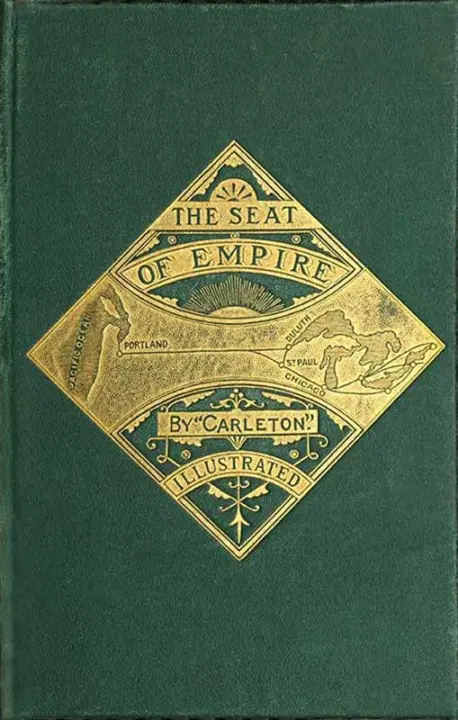
THE CLASSIC COLLECTION · 1870
"The Seat of Empire" by Charles Carleton Coffin is a historical account written in the late 19th century. In this work, Coffin explores the vast and evolving landscape of the American Northwest, providing insights and observations about the region's geography, resources, and the lives of its inhabitants during a time of significant westward expansion. The narrative unfolds through a series of expeditions and personal experiences that highlight the potential of the land for settlement and development. At the start of the text, the author recounts a summer journey he undertook with a group of gentlemen from Chicago to Minneapolis, filled with camaraderie and celebration on the Fourth of July. He provides vivid descriptions of the landscape, from the beauty along the Mississippi River to the bustling towns they encounter. Coffin shares anecdotes about the emigrants he meets, particularly the Norwegian immigrants setting out for new futures, emphasizing the hope and determination that drive many individuals toward this uncharted frontier. This introduction sets the stage for exploring the opportunities and challenges faced by those settling in the Northwest.
Introduction adapted from the source catalogue; source summaries may be automatically generated.
Free to read · English · 55,126 words · No account needed
MAKE TIME FOR A GOOD BOOK
On by default. Untick to stop anonymous reading totals. Each page counts after 10 seconds in view. How this works.
Anonymous counting is on unless you have switched it off.
The St. Paul Press, noticing the display of fruits at the Ramsay and Hennipen County Fair, says: "These two fairs have set at rest the long-mooted question, whether Minnesota is an apple-growing State. Over two hundred varieties of the apple, exclusive of the crab species, were exhibited at Minneapolis, and a large number at St. Paul, of the finest development and flavor, and this fact will give an immense impetus to fruit-growing in our State."
The following varieties were exhibited at the last meeting of the Fruit-Growers' Association, of Winona County: The Duchess of Oldenburg, Utter's Large, Early Red, Sweet June, Perry Russet, Fall Stripe, Keswick Codlin, Red Astracan, Plum Cider, Phoenix, Wagner, Ben Davis, German Bough, Carolina Red June, Bailey Sweet, St. Lawrence, Sops of Wine, Seek-no-further, Famuse, Price Sweet, Pomme Grise, Tompkins County King, Northern Spy, Golden Russet, Sweet Pear, Yellow Ingestrie, Yellow Bellflower, Lady Finger, Raule's Jannet, Kirkbridge White, Janiton, Dumelow, Winter Wine Sap, Chronicle, Fall Wine Sap, Rosseau, Colvert, Benoni, Red Romanite.
Many of the above are raised in New England, so that those people who may cut loose from the East need not be apprehensive that they are bidding good by forever to the favorite fruits that have been a comfort as well as a luxury in their former homes.
"I take it that grapes do not grow there; it must be too far north,"
said my visitor.
On the contrary, they are indigenous. You find wild grapes along the streams, and in the gardens around St. Paul and Minneapolis you will see many of the cultivated varieties bearing magnificent clusters on the luxuriant vines.
"How about corn, rye, oats, and other grains; can they be raised with
profit?"
The following figures, taken from the official report made to the last legislature of the products for 1869, will show the capabilities of the soil:--
Average per Acre.
Wheat, 18,500,000 bushels, 18-1/2
Corn, 6,125,000 " 35
Oats, 11,816,400 " 43
Potatoes, 2,745,000 " 90
Barley, 625,000 " 30.6
Rye, 58,000 " 18
Buckwheat, 28,000 " 16
Hay, 430,000 tons, 2.08
Wool, 390,000 pounds.
Butter, 5,600,000 "
Cheese, 145,000 "
Sorghum, 80,000 gallons syrup.
Maple Sugar, 300,000 pounds.
Flax, 170,000 "
From this it would seem that the State is destined to be one of the most productive in the Union.
"Have they good schools out there?"
Just as good as in New England. Two sections of land are set aside for the common-school fund. The entire amount of school lands in the State will be three million acres.
Your reading position is saved on this browser. Take it to another device with a library code. Reading pages adapt to text, rather than matching a printed edition.
Charles Carleton Coffin
Charles Carleton Coffin
Charles Carleton Coffin
Charles Carleton Coffin
BEHIND THE BOOK
This eBook is for the use of anyone anywhere in the United States and most other parts of the world at no cost and with almost no restrictions whatsoever. You may copy it, give it away or re-use it under the terms of the Project Gutenberg License included with this eBook or online at www.gutenberg.org. If you are not located in the United States, you will have to check the laws of the country where you are located before using this eBook. Read the source licence.
The original source file, including credits and licence, is retained by this library. Request an original-format copy at no charge. Please include the book title and Project Gutenberg identifier #44072.
KEEP YOUR CURIOSITY GOING
Wilfrid Scawen Blunt
Wilfrid Scawen Blunt

E. W. (Edgar Watson) Howe
Cécile Tormay

Moritz Busch
John L. Ransom