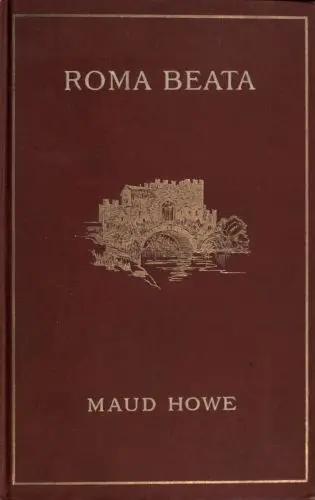
Roma beata; letters from the Eternal city
Maud Howe Elliott
THE CLASSIC COLLECTION · 1884
"The San Rosario Ranch" by Maud Howe Elliott is a novel written in the late 19th century. The story unfolds in California and centers around Millicent Almsford, a young woman who has recently traveled from Italy to visit her newly-found relatives at the San Rosario Ranch. The book explores themes of family, cultural clash, and the struggles of adjusting to a new environment. At the start of the novel, we are introduced to the idyllic San Rosario Ranch, where preparations are underway for the arrival of Millicent. The opening chapters reveal her arrival and initial impressions of the family: Barbara Deering, who warmly welcomes her, as well as Barbara's brother and mother. As Millicent grapples with her homesickness and the overwhelming differences between her previous life in Venice and her new surroundings, she begins to bond with the family and navigate her place among them. The narrative sets the stage for exploring Millicent's character and her evolving relationships, particularly with the enigmatic John Graham, a local artist, hinting at both friendship and potential romance.
Introduction adapted from the source catalogue; source summaries may be automatically generated.
Free to read · English · 85,886 words · No account needed
MAKE TIME FOR A GOOD BOOK
On by default. Untick to stop anonymous reading totals. Each page counts after 10 seconds in view. How this works.
Anonymous counting is on unless you have switched it off.
"Go!" was the one syllable which her frozen lips uttered; and with a gesture of command, majestic and beautiful, she had banished him from her presence. The secret was kept, even from the old woman, grown more sorrowful at the sight of the girl's dumb agony and of her son's grief, which she could not soothe. The secret was kept; and that very night Millicent's face, pale and clouded, shone out amidst a group of fair women who sat languidly chatting through the music of Faust at the opera. He kept her secret, poor wretch, and shielded her as best he might, forcing her to speak to him and see him before others, that no sudden breaking of their relations might be remarked. Save in the world, she never saw him again. That one word of command was the last syllable which he ever heard her speak to him directly. Not without a struggle did he give her up, but she was implacable. She yielded to him, and played her part in the little comedy which the world thought it understood. The beautiful Miss Almsford had found Holworthy a pleasant admirer, but her delicate American beauty and her solid American fortune would certainly win her a higher place in the world than that of the wife of Mr. Edward Holworthy, her countryman and old friend.
Youth and health are great physicians; and as the years passed, Millicent recovered something of her old spring and elasticity. She was infinitely more interesting, if something colder and harder, than she had been in the old days. Her unquenchable vigor of temperament came to her help, and gave her a keen pleasure in her studies and in the work and thought of the people about her. Always self-reliant, she grew to live entirely without support from man or woman. She was a friend to many people, but was herself friendless. The Palazzo Fortunio, under her reign, grew to be the centre of a charming social circle. Musicians and painters were made welcome by the young hostess. At once an artist and a patron of the arts, she stood in a peculiar relation to the men who frequented her salon. If she had been without fortune she would have made music her profession. As it was, she studied it as faithfully as if self-support had been her aim; and she claimed that sympathy from her artistic friends which a mere connoisseur, be he ever so enthusiastic, can never arouse. To her small world she was all-important. Her sympathy helped many a timid debutante, and her counsel cheered the black days of more than one disheartened artist. Always gracious and kind, she had drawn about her a group of people, to all of whom she was a sort of exalted fellow-worker, who knew but the poetry of art, and helped them to forget its prose. Her heart was quite empty, but her mind was keenly interested and fully occupied by the men and women among whom she lived. Happiness she had forgotten to look for, but in enjoyment her days were not wanting. It was a terrible blow to her when this pleasant, quiet life was suddenly broken up by her father's marriage. To her imperious nature the presence of the inferior woman whom Mr. Almsford had brought home to the Palazzo was intolerable. Where could she go? For the first time in her life she felt the power which her fortune gave her. She could establish herself wherever she liked. Her father's sister proposed a repetition of their joint establishment in London, but at the very mention of her returning to England Millicent's face blanched. She would never again set foot in that country. It was while she was in a state of doubt concerning her future movements that her half-brother wrote her a long and affectionate letter, urging her to come and dwell for a time among his people, to visit her mother's country before she decided the important question of where she should establish herself for life. The idea seemed a just one to her; and acting on a tender impulse roused by the loving words of her unknown brother, she had telegraphed her departure, and forthwith started on her long journey accompanied by her capable French maid. The Abigail discharged her trust faithfully, as far as San Francisco, from which city she turned her face on the very day of her arrival, unwilling to remain longer in what she called "le plus triste pays du monde." If the truth could have been known, Millicent would have signed away ten years of her life to have gone back with the woman to the Old World, the only home she had ever known.
Your reading position is saved on this browser. Take it to another device with a library code. Reading pages adapt to text, rather than matching a printed edition.
Maud Howe Elliott
Maud Howe Elliott
Maud Howe Elliott
Maud Howe Elliott
BEHIND THE BOOK
This eBook is for the use of anyone anywhere in the United States and most other parts of the world at no cost and with almost no restrictions whatsoever. You may copy it, give it away or re-use it under the terms of the Project Gutenberg License included with this eBook or online at www.gutenberg.org. If you are not located in the United States, you will have to check the laws of the country where you are located before using this eBook. Read the source licence.
The original source file, including credits and licence, is retained by this library. Request an original-format copy at no charge. Please include the book title and Project Gutenberg identifier #42283.
KEEP YOUR CURIOSITY GOING
Coulson Kernahan

Maurice Baring
Frances Wright
Cécile Tormay

Frederic Jesup Stimson

W. H. P. (William Henry Pope) Jarvis