
Roma beata; letters from the Eternal city
Maud Howe Elliott
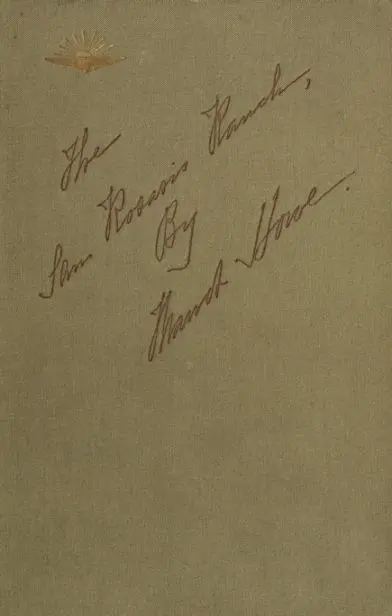
THE CLASSIC COLLECTION · 1884
"The San Rosario Ranch" by Maud Howe Elliott is a novel written in the late 19th century. The story unfolds in California and centers around Millicent Almsford, a young woman who has recently traveled from Italy to visit her newly-found relatives at the San Rosario Ranch. The book explores themes of family, cultural clash, and the struggles of adjusting to a new environment. At the start of the novel, we are introduced to the idyllic San Rosario Ranch, where preparations are underway for the arrival of Millicent. The opening chapters reveal her arrival and initial impressions of the family: Barbara Deering, who warmly welcomes her, as well as Barbara's brother and mother. As Millicent grapples with her homesickness and the overwhelming differences between her previous life in Venice and her new surroundings, she begins to bond with the family and navigate her place among them. The narrative sets the stage for exploring Millicent's character and her evolving relationships, particularly with the enigmatic John Graham, a local artist, hinting at both friendship and potential romance.
Introduction adapted from the source catalogue; source summaries may be automatically generated.
Free to read · English · 85,886 words · No account needed
MAKE TIME FOR A GOOD BOOK
On by default. Untick to stop anonymous reading totals. Each page counts after 10 seconds in view. How this works.
Anonymous counting is on unless you have switched it off.
"Dust and ashes, dead and done with, Venice spent what Venice
earned.
The soul, doubtless, is immortal--where a soul can be
discerned."
It was a pitiful story which the little journal had made known to John Graham,--the story of a woman grievously wronged, cruelly deceived.
Millicent Almsford's life had not been a happy one. Her childhood had been lonely, and she had none of those early recollections which are so comforting in after years to people more fortunately bred. Her father was an invalid and a bookworm, and looked upon his only daughter as a creature to be fed, clothed, educated, and kept quiet. Her feeding he intrusted to her faithful nurse, who had promised her dying mother never to leave the child till she should be grown to womanhood. Her wardrobe was ordered by a relative who lived in Paris, and who twice a year overlooked the making and packing of her clothes, from her first baby wrappings to the ball dress in which she was presented at the court of St. James. Her education he left very much to chance and her own taste, simply locking up the livres defendus of his library, and telling her English governess to order any necessary volumes from Mudie's. The young woman in whose charge Millicent was placed, was more eager to learn Italian than to teach English; to explore the literature of Dante than to familiarize her pupil with the British authors. When Millicent was sixteen years old, the feeble protection of this governess was taken from her; the woman returning to England to keep a long protracted marriage engagement with her own cousin. The same year old Nina died; and then it was that the lonely girl fell under the influence which was to darken her destiny and turn aside the natural current of her life. Millicent Almsford, at that age, was a very peculiar and interesting study. Her mind had eagerly grasped much more material than it could master. Her vivid imagination and great talent for music were, with a love of beauty, the most strongly developed traits in her nature, whose intellectual growth was destined to be slow and late; whose spiritual existence had not yet begun. An exquisite native refinement and a perfect taste were among her most interesting qualities. Singularly attractive and strangely incomplete, she had formed few relations; and her friendship with Edward Holworthy, the man whose influence so marred her life, was the first strong feeling which she had known. He was her opposite in character, and knew life only through people, while she had lived purely in ideas. Her complex nature, unfathomable to herself, was to him a novel and engrossing study, and it was through him that she learned to understand one side of it. The man found a great heart which had never loved; a strong power for working good or evil; a bold mind, that feared not to grapple with the deepest problems of life; and a possibility of absolute devotion to a resolution once formed, which is rarely found among young women. He became her mental guide, and directed her readings; with a certain clever intuition bringing her under the influence of minds as sophistical and frivolous as his own. Sympathetic to an extreme degree, her nature quickly took from his the color of an exaggerated cynicism, which was sometimes strongly shaken by the inner spirit which still slept under the untouched heart. Platonics, where the man is of the world wise, and the woman foolish with the innocence of childhood, are dangerous things, as he knew full well, and she did not. In pointing out the forces which mould the lives of men and women, what theme is so often upon the lips of two life students of opposite sexes as that of love? To the girl it seemed a strange, rather interesting force, whose power it would not be unpleasant to test; and when one day her mentor confessed to her that she had bound him irrevocably by those bonds which he had taught her were but ropes of sand, she smiled half sadly, but in her heart laughed with childish merriment. She now should see the actual workings of that strange hallucination; she should learn something of what love was. She was as unfeeling as a young lioness, and learned the lesson of making him turn pale and red by turns, as quickly as she had learned the knack of touching the chords of her mandolin. She looked upon her quondam friend in the light of an invalid, suffering from a dangerous but non-contagious malady. And so things went on; the man gaining every day a firmer hold over the girl, intoxicated by the new power in herself and a growing consciousness of her beauty and charms. During the long mornings at the Palazzo Fortunio, the two friends read and talked together, while the Italian governess, understanding no word of their intercourse, sat sewing patiently beside them. In the cool afternoons, when they were rowed by the strong-armed gondolier, Girolomo, out into the glory of the sunset, the same stolid companion always accompanied them. One day, Mr. Almsford, selfish old epicurean, perceived for the first time that his daughter had grown to a tall and fair womanhood. His attention had, perhaps, been first called to the fact by the increasing size of the half-yearly coffer which found its way from Fashion's capital to the Fortunio Palace, and by the proportionate lengthening of the account which accompanied it. Yes, Millicent was certainly grown to be a young lady. They were beginning to send her little, demure bonnets, and close-fitting, simple woollen dresses, made with more of an idea of displaying her graceful figure than heretofore. The girl was heiress to her mother's fortune; and it behooved him to see about finding a suitable husband for her. Whom should he consult in this matter, but their most intimate friend; the man who seemed at once his contemporary and hers; the handsome, clever fellow-countryman, who had been on the most intimate footing in his house for the last ten years? Edward Holworthy had started unaccountably when, in the midst of one of the solemn pauses of their game of chess, Mr. Almsford had propounded the unexpected question to him:--
Your reading position is saved on this browser. Take it to another device with a library code. Reading pages adapt to text, rather than matching a printed edition.
Maud Howe Elliott

Maud Howe Elliott
Maud Howe Elliott
Maud Howe Elliott
BEHIND THE BOOK
This eBook is for the use of anyone anywhere in the United States and most other parts of the world at no cost and with almost no restrictions whatsoever. You may copy it, give it away or re-use it under the terms of the Project Gutenberg License included with this eBook or online at www.gutenberg.org. If you are not located in the United States, you will have to check the laws of the country where you are located before using this eBook. Read the source licence.
The original source file, including credits and licence, is retained by this library. Request an original-format copy at no charge. Please include the book title and Project Gutenberg identifier #42283.
KEEP YOUR CURIOSITY GOING
Coulson Kernahan

Maurice Baring
Frances Wright
Cécile Tormay

Frederic Jesup Stimson

W. H. P. (William Henry Pope) Jarvis