
The Wasted Generation
Owen Johnson
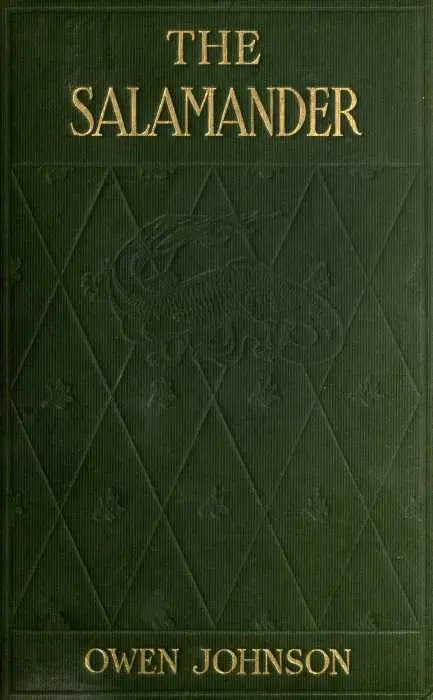
THE CLASSIC COLLECTION · 1914
"The Salamander" by Owen Johnson is a novel written in the early 20th century. The novel explores the lives of young women in New York City against the backdrop of social change and economic independence. The main character, Doré Baxter, embodies the archetype of the "Salamander," a spirited young woman navigating the complexities of a modern society that both attracts and repulses her. The opening of the book introduces us to the vibrant, chaotic world inhabited by Doré and her peers, who live in a boarding house and seek excitement amidst the trials of their ambition. The narrative reveals their playful conversations and their aspirations, interspersed with hints of the underlying seriousness of their lives as they balance the thrill of exploration with the harsh realities of their social circumstances. Doré is portrayed as a charismatic figure, eager for adventure and autonomy, embodying the spirit of the new generation of women challenging societal norms. The reader is drawn into her world of curiosity, where the thrill of living is painted vividly against the darker undertones of societal expectations.
Introduction adapted from the source catalogue; source summaries may be automatically generated.
Free to read · English · 127,148 words · No account needed
MAKE TIME FOR A GOOD BOOK
On by default. Untick to stop anonymous reading totals. Each page counts after 10 seconds in view. How this works.
Anonymous counting is on unless you have switched it off.
Did he believe her? He didn't care! Perhaps he preferred that it should
have been invented.
"It will mean a great deal to her," he said, his eyes on hers--his
eyes, that began to light up as lanterns showing through the fall of
night.
"It will mean a great deal!" she said, with an expression of such beatitude that his abiding doubt began to waver. "I just couldn't have kept them!"
"I want you to lunch with me--to-morrow," he said slowly.
"Where?"
"In my apartments. They overlook the park. It's quite delightful."
He watched her eagerly, for eagerness could occasionally show on his face, as a sudden joy may recall a past youth to the face of a mature woman. She considered thoughtfully:
"To-morrow? At what time?"
"At one," he said; and she noticed again the curious gesture of his feminine fingers sliding caressingly over the back of his hand.
"One's all right. I'll be delighted to meet Mrs. Sassoon."
He raised his head with an ironical smile; but the smile fled as he noticed that her face was blankly serious.
"I don't like that!" he said abruptly.
"What?"
"You know very well I am not inviting you to meet my wife."
"What do you want with me, then, Mr. Sassoon?" she said calmly, looking directly at him with her cloudy blue eyes of a child.
He rose, nonplused, walked to the window and slowly back. What was she--straightforward or deep? Did she wish to come directly to a business understanding, or--or was she truly independent and seeking this method to terminate the acquaintance? An instinct warned him of the danger in an answer. He returned, and said, leaning on the mantelpiece:
"Bring a friend, if you wish. I'll have in the Comte de Joncy.... You've aroused his curiosity--"
"At your private apartments?"
"Of course!"
"No!"
"At Tenafly's, then."
"At Tenafly's--down-stairs--yes!"
"A party of four?"
"No. Come to think of it, it'll be more interesting just with you."
This unexpected answer, said in the most natural manner imaginable, perplexed him more than ever. She noticed it, quite delighted at the helplessness of the experienced hunter.
"You won't lunch in a party of four at my apartments, but you will lunch with me alone at a public restaurant."
"Quite so!"
"And your reputation?"
"It isn't a question of reputation--my security! I wouldn't trust
you--that's all!"
He didn't choose to discuss this, but sought to give the conversation a
different turn.
"You are satisfied with this?" he said, with a sudden crook of his arm.
"You are delightfully direct, aren't you?" she said. "You usually don't have so much trouble coming to an understanding with women, do you?"
"No, I don't."
Your reading position is saved on this browser. Take it to another device with a library code. Reading pages adapt to text, rather than matching a printed edition.
BEHIND THE BOOK
This eBook is for the use of anyone anywhere in the United States and most other parts of the world at no cost and with almost no restrictions whatsoever. You may copy it, give it away or re-use it under the terms of the Project Gutenberg License included with this eBook or online at www.gutenberg.org. If you are not located in the United States, you will have to check the laws of the country where you are located before using this eBook. Read the source licence.
The original source file, including credits and licence, is retained by this library. Request an original-format copy at no charge. Please include the book title and Project Gutenberg identifier #36355.
KEEP YOUR CURIOSITY GOING
Coulson Kernahan

Maurice Baring
Frances Wright
Cécile Tormay

Frederic Jesup Stimson

W. H. P. (William Henry Pope) Jarvis

