
The Wasted Generation
Owen Johnson
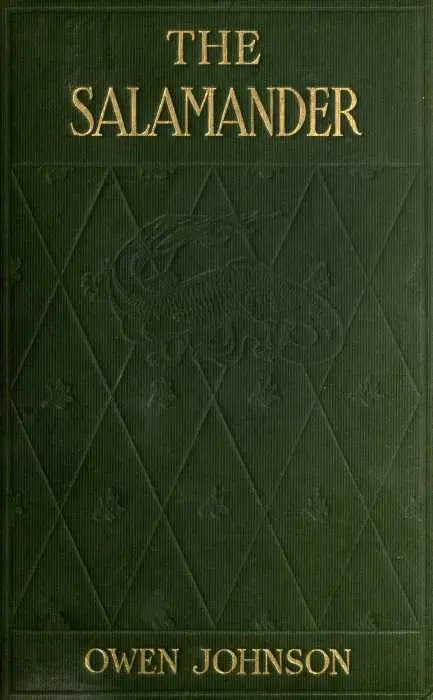
THE CLASSIC COLLECTION · 1914
"The Salamander" by Owen Johnson is a novel written in the early 20th century. The novel explores the lives of young women in New York City against the backdrop of social change and economic independence. The main character, Doré Baxter, embodies the archetype of the "Salamander," a spirited young woman navigating the complexities of a modern society that both attracts and repulses her. The opening of the book introduces us to the vibrant, chaotic world inhabited by Doré and her peers, who live in a boarding house and seek excitement amidst the trials of their ambition. The narrative reveals their playful conversations and their aspirations, interspersed with hints of the underlying seriousness of their lives as they balance the thrill of exploration with the harsh realities of their social circumstances. Doré is portrayed as a charismatic figure, eager for adventure and autonomy, embodying the spirit of the new generation of women challenging societal norms. The reader is drawn into her world of curiosity, where the thrill of living is painted vividly against the darker undertones of societal expectations.
Introduction adapted from the source catalogue; source summaries may be automatically generated.
Free to read · English · 127,148 words · No account needed
MAKE TIME FOR A GOOD BOOK
On by default. Untick to stop anonymous reading totals. Each page counts after 10 seconds in view. How this works.
Anonymous counting is on unless you have switched it off.
His reputation was of the worst, his name bandied about in big places and in small; nor, as is usually the case, did gossip bear unmerited reproaches. Neither a fool, as most believed, nor of originating imagination, as a few credited who witnessed from the inside the shrewd and infallible success of his colossal schemes, Sassoon at bottom was a prey to an obsession that stung him like a gadfly to restless seeking, eternally tormented by the fever of the hunter, eternally disillusioned. For thirty years, following the exigencies of a maladive heredity, he had raked the city with his craving eye, always alert, always disappointed, running into dark side streets, ringing obscure bells, pursuing a shadow that had awakened a spark of hope. And at the end it was always the same--emptiness! To-day he sat moodily, fiercely resentful at a fresh deception.
A certain disdainful defiance, a trick of Violetta Pax, fleeing, bacchante-like, in the sextette, had stirred in him a flash of expectancy, a hungering hope, which had died in hollowness now that she was at his side, unresisting, too ready. So he sat, brooding, heavy-lidded, already turning to other fugitive forms that he might follow in a vague impulse--of all the millions in the city the one most enslaved. When, in her turn, Dore came to take her place beside him, after the first listless acknowledgment he spoke no word to her. She responded by turning her back to him at once, with a complete ignoring. This attitude, so different from the challenging eyes of the others, struck him--he who craved opposition, resistance. All at once, as she was leaving him to take her place between Busby and Harrigan Blood, he said, his soft hand on her arm, in his low, rather melodious feminine voice:
"You haven't paid much attention to me, pretty thing!"
"Your own fault, Pasha!" she said impertinently. "Men run after me!"
And she was aware that his eye, dead as a cold lantern, followed her now, running over her neck and shoulders, aroused as from its lethargy. Satisfied that her instinct had not failed, she took her seat. Then, all at once, she felt a new annoyance: Massingale, the observer, was smiling to himself.
The hilarity began to freshen. Consuelo Vincent, who had magnificent
hair, was heard exclaiming:
"I say, girls! we're stiff as a bunch of undertakers. Let's slip our
roofs!"
Amid general acclaim, the top-lofty, overburdened hats were consigned to a butler. Every one began to chatter on a higher key, across the constant rise of laughter. Georgie Gwynne, installed by the Royal Observer, saucy and unabashed, was saying:
"Well, Kink, how do you like us?"
Your reading position is saved on this browser. Take it to another device with a library code. Reading pages adapt to text, rather than matching a printed edition.
BEHIND THE BOOK
This eBook is for the use of anyone anywhere in the United States and most other parts of the world at no cost and with almost no restrictions whatsoever. You may copy it, give it away or re-use it under the terms of the Project Gutenberg License included with this eBook or online at www.gutenberg.org. If you are not located in the United States, you will have to check the laws of the country where you are located before using this eBook. Read the source licence.
The original source file, including credits and licence, is retained by this library. Request an original-format copy at no charge. Please include the book title and Project Gutenberg identifier #36355.
KEEP YOUR CURIOSITY GOING
Coulson Kernahan

Maurice Baring
Frances Wright
Cécile Tormay

Frederic Jesup Stimson

W. H. P. (William Henry Pope) Jarvis

