
The Wasted Generation
Owen Johnson
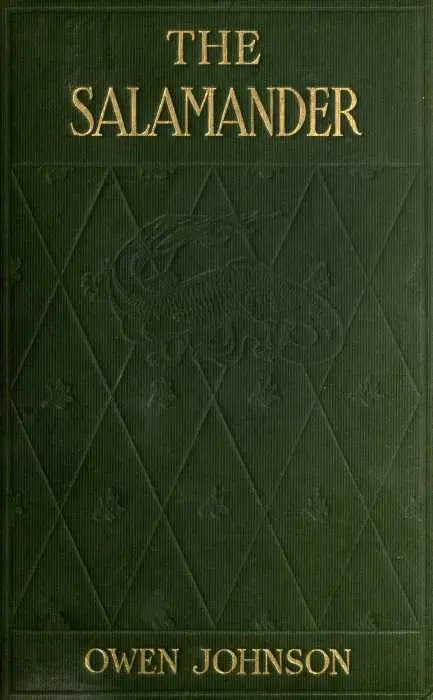
THE CLASSIC COLLECTION · 1914
"The Salamander" by Owen Johnson is a novel written in the early 20th century. The novel explores the lives of young women in New York City against the backdrop of social change and economic independence. The main character, Doré Baxter, embodies the archetype of the "Salamander," a spirited young woman navigating the complexities of a modern society that both attracts and repulses her. The opening of the book introduces us to the vibrant, chaotic world inhabited by Doré and her peers, who live in a boarding house and seek excitement amidst the trials of their ambition. The narrative reveals their playful conversations and their aspirations, interspersed with hints of the underlying seriousness of their lives as they balance the thrill of exploration with the harsh realities of their social circumstances. Doré is portrayed as a charismatic figure, eager for adventure and autonomy, embodying the spirit of the new generation of women challenging societal norms. The reader is drawn into her world of curiosity, where the thrill of living is painted vividly against the darker undertones of societal expectations.
Introduction adapted from the source catalogue; source summaries may be automatically generated.
Free to read · English · 127,148 words · No account needed
MAKE TIME FOR A GOOD BOOK
On by default. Untick to stop anonymous reading totals. Each page counts after 10 seconds in view. How this works.
Anonymous counting is on unless you have switched it off.
"Love! You will love ten--twenty times! What do you know of such things?" he said rapidly. "You have a vague illusion before your eyes, and in reality, what is guiding you is the same principle of nature that governs all life. A woman in the state you are in now is really in a state of hysteria--an unnatural state, that causes you to do any number of illogical things, crazy things--"
"As, for instance, falling in love?"
"Falling in love with impossible people," he corrected. "What do you know of love, anyhow? I may know."
"You!" she said scornfully.
"Yes--now. I've seen the rest, and if I love, it's the young, the beautiful, the past. I won't explain: you must experience to comprehend! Another thing about yourself that you don't understand: to love and to be loved are two different things. A woman like you will always be loved. You won't love, really love, not for a long while--not until you begin to grow old! What stops you from using me? Family? You have none! Friends? Bah!"
"And the man?" she said coldly, beginning fiercely to resent the brutality of his philosophy, though she had determined to remain impersonal and amused.
"The man!" He laughed, throwing himself back in his chair, scowling a little at this direct personal allusion. "There you have it! With one question you have betrayed your whole morality--woman's morality! The man! If I were a young cub with a romantic strut, talking big, it would be different; it would not be a case of selling yourself--it would be an infatuation!"
"Perhaps it is our morality," she said indignantly, thinking of Massingale, and led insensibly into a defensive attitude. "Say it is! It's at least natural!"
"You mean, in my case, the thing that makes you recoil is myself?" he said abruptly. "More than any other consideration? Say it!"
"Quite true!"
"If I were asking you to marry me, if you had that opportunity, would
that feeling stop you?"
She was silent, surprised.
"It's a money transaction in either case, isn't it?"
"What a terrible view of life you have!" she said, appalled. She had been prepared for danger of an overt character, not for the insidious subtle poisoning which he was distilling in her ears. She drew back, breathing quickly, fiercely resisting his ideas. "Money, money--that's all you see, because that's all you understand!"
"I only wish to make you see!" he said, shrugging his shoulders, "that there is no difference in being what I offer you and in being--"
"Mrs. Sassoon!" she said curtly.
He did not like the reference, man-like, though he frowned and admitted the allusion with a wave of his fingers.
Your reading position is saved on this browser. Take it to another device with a library code. Reading pages adapt to text, rather than matching a printed edition.
BEHIND THE BOOK
This eBook is for the use of anyone anywhere in the United States and most other parts of the world at no cost and with almost no restrictions whatsoever. You may copy it, give it away or re-use it under the terms of the Project Gutenberg License included with this eBook or online at www.gutenberg.org. If you are not located in the United States, you will have to check the laws of the country where you are located before using this eBook. Read the source licence.
The original source file, including credits and licence, is retained by this library. Request an original-format copy at no charge. Please include the book title and Project Gutenberg identifier #36355.
KEEP YOUR CURIOSITY GOING
Coulson Kernahan

Maurice Baring
Frances Wright
Cécile Tormay

Frederic Jesup Stimson

W. H. P. (William Henry Pope) Jarvis

