
The Wasted Generation
Owen Johnson
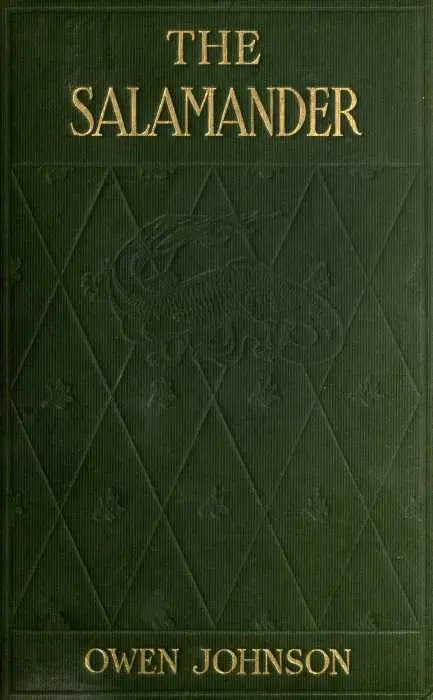
THE CLASSIC COLLECTION · 1914
"The Salamander" by Owen Johnson is a novel written in the early 20th century. The novel explores the lives of young women in New York City against the backdrop of social change and economic independence. The main character, Doré Baxter, embodies the archetype of the "Salamander," a spirited young woman navigating the complexities of a modern society that both attracts and repulses her. The opening of the book introduces us to the vibrant, chaotic world inhabited by Doré and her peers, who live in a boarding house and seek excitement amidst the trials of their ambition. The narrative reveals their playful conversations and their aspirations, interspersed with hints of the underlying seriousness of their lives as they balance the thrill of exploration with the harsh realities of their social circumstances. Doré is portrayed as a charismatic figure, eager for adventure and autonomy, embodying the spirit of the new generation of women challenging societal norms. The reader is drawn into her world of curiosity, where the thrill of living is painted vividly against the darker undertones of societal expectations.
Introduction adapted from the source catalogue; source summaries may be automatically generated.
Free to read · English · 127,148 words · No account needed
MAKE TIME FOR A GOOD BOOK
On by default. Untick to stop anonymous reading totals. Each page counts after 10 seconds in view. How this works.
Anonymous counting is on unless you have switched it off.
"So you knew!" he said, pursing his lips.
"You're disappointed because I'm not afraid!" she told him, laughing. "Well, I'm not! Besides, I have taken my precautions!"
"What do you mean?" he asked uneasily.
"There's a door from the dressing-room into the vestibule--you gave me plenty of time," she said quietly. "There happened to be a party I knew below when we came in, or we would not be here. They are to take me home--later."
"You went down--" he said slowly, at a loss whether to believe her or not. She nodded, and still incredulous, he went to the dressing-room, assuring himself that she had at least spoken the truth about the door.
"Well?" she said, folding her arms and laughing at him, but feeling every nerve and fiber alert with the sense of combat.
"Miss Baxter," he answered, standing by her and fastening his heavy oriental gaze on hers, "I have never, in all my life, wanted a woman as I want you!"
"I hope so!"
"Don't you know that?"
"It's the devil in me, then."
"The devil and the child," he said quietly.
She didn't like his look, so she motioned him away, saying:
"Something to eat first, please, and business later."
"With any other woman I would understand that," he said, without
shifting his gaze.
"Perhaps I am simpler than you think?"
"Let's go in to dinner!" he said abruptly.
He went to the curtain and drew it aside deferentially. She went past him quickly, watching him from under her eyelashes, choosing that seat at the table which would give her quick retreat in case of need. The waiter, bald and correctly vacant of expression, arrived after a discreet knock, and with the swinging of the door came a sudden burst of laughter from an arriving party. She waved away the proffered cocktail.
"Nothing?" he asked.
"At such an important interview? Of course not!"
He raised his glass to her honor, and she nodded.
"You don't look so terrible, after all," she said, examining him with a critical smile; and to herself she said disdainfully, as she had said another time: "If this is a dangerous man, what is it makes him dangerous?"
But this query was not simply of amusement. The seriousness of life had so obtruded itself upon her, in the last preparatory weeks, that she wanted to know everything, to have before her in detail that existence which could depend on his soft hands and wearied eyes.
"So I puzzle you very much?"
"You know you do!" he said, with a slow smile, still resolved to continue the role of bon enfant.
"Most women are simpler, then?"
"Much!"
Your reading position is saved on this browser. Take it to another device with a library code. Reading pages adapt to text, rather than matching a printed edition.
BEHIND THE BOOK
This eBook is for the use of anyone anywhere in the United States and most other parts of the world at no cost and with almost no restrictions whatsoever. You may copy it, give it away or re-use it under the terms of the Project Gutenberg License included with this eBook or online at www.gutenberg.org. If you are not located in the United States, you will have to check the laws of the country where you are located before using this eBook. Read the source licence.
The original source file, including credits and licence, is retained by this library. Request an original-format copy at no charge. Please include the book title and Project Gutenberg identifier #36355.
KEEP YOUR CURIOSITY GOING
Coulson Kernahan

Maurice Baring
Frances Wright
Cécile Tormay

Frederic Jesup Stimson

W. H. P. (William Henry Pope) Jarvis

