
The Wasted Generation
Owen Johnson
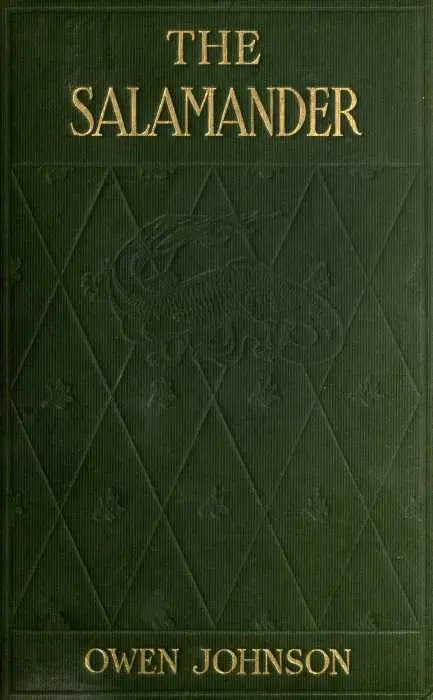
THE CLASSIC COLLECTION · 1914
"The Salamander" by Owen Johnson is a novel written in the early 20th century. The novel explores the lives of young women in New York City against the backdrop of social change and economic independence. The main character, Doré Baxter, embodies the archetype of the "Salamander," a spirited young woman navigating the complexities of a modern society that both attracts and repulses her. The opening of the book introduces us to the vibrant, chaotic world inhabited by Doré and her peers, who live in a boarding house and seek excitement amidst the trials of their ambition. The narrative reveals their playful conversations and their aspirations, interspersed with hints of the underlying seriousness of their lives as they balance the thrill of exploration with the harsh realities of their social circumstances. Doré is portrayed as a charismatic figure, eager for adventure and autonomy, embodying the spirit of the new generation of women challenging societal norms. The reader is drawn into her world of curiosity, where the thrill of living is painted vividly against the darker undertones of societal expectations.
Introduction adapted from the source catalogue; source summaries may be automatically generated.
Free to read · English · 127,148 words · No account needed
MAKE TIME FOR A GOOD BOOK
On by default. Untick to stop anonymous reading totals. Each page counts after 10 seconds in view. How this works.
Anonymous counting is on unless you have switched it off.
"What time is it?"
"Half past five only."
But she began to feel a menace in this other bank which they were nearing, in these long stretches of human wilderness leading to the sound. Sassoon was entirely too docile, she did not know why, but she scented danger in the air.
"We will go back," she said suddenly. "Brooklyn is too dreary; besides,
it's late for tea."
"I'm sorry," he said, stirring in his seat; "I'm afraid you don't trust
me?"
"No, I don't--not too far!"
"Supposing I decided to go on?" he said quickly.
"I should open the window and scream," she said, handing him the tube.
He complied reluctantly, seeking an excuse.
"It'll only take us twenty minutes. I wanted you to get the effect of New York coming back; in another half-hour it'll be magnificent!"
"I'll enjoy it very much now," she answered, laughing.
"You quite misjudge me," he said, without further trace of irritation. "However, as you wish. I saw you were blue, and I had planned something to distract you. But it's no use."
"What had you planned?" she said maliciously.
"To take you to a very nice party."
"What?"
"A supper with some interesting people--Emma Fornez, Sada Quichy--"
"Where?" she said suspiciously.
"At the Cafe Loo."
"Where's that?"
"In Harlem."
She reflected. She had expected him to give the name of some inn in the country where she would not venture; but Harlem reassured her. Perhaps the party existed, and, if so, she was crazy to meet Emma Fornez, of the Metropolitan Opera. Besides, she felt in a reckless mood, within certain safe limitations.
"If you asked me very nicely," she said softly, "you might be
surprised--"
An hour later they came to a stop before a restaurant flanked with plants and shining with the dazzle of reflecting mirrors. It was of new creation, on the order of the German Gardens, situated on one of the great thoroughfares, a publicity which quite reassured her. They went in by a private entrance, and up in an elevator to a suite on the third floor.
"We're ahead of time," said Sassoon. "Dressing-room to the left. Leave
your things there."
The room into which they had entered from an ante-chamber was a salon in false Empire furniture against plum-yellow carpets and hangings. Through a curtained door to the right was a glimpse of a dining-room in the corner of the house. She took in the surroundings with a quick glance as she went into the boudoir. What she had suspected was true. The party was an invention. She was alone with Sassoon.
Your reading position is saved on this browser. Take it to another device with a library code. Reading pages adapt to text, rather than matching a printed edition.
BEHIND THE BOOK
This eBook is for the use of anyone anywhere in the United States and most other parts of the world at no cost and with almost no restrictions whatsoever. You may copy it, give it away or re-use it under the terms of the Project Gutenberg License included with this eBook or online at www.gutenberg.org. If you are not located in the United States, you will have to check the laws of the country where you are located before using this eBook. Read the source licence.
The original source file, including credits and licence, is retained by this library. Request an original-format copy at no charge. Please include the book title and Project Gutenberg identifier #36355.
KEEP YOUR CURIOSITY GOING
Coulson Kernahan

Maurice Baring
Frances Wright
Cécile Tormay

Frederic Jesup Stimson

W. H. P. (William Henry Pope) Jarvis

