
The Wasted Generation
Owen Johnson
THE CLASSIC COLLECTION · 1914
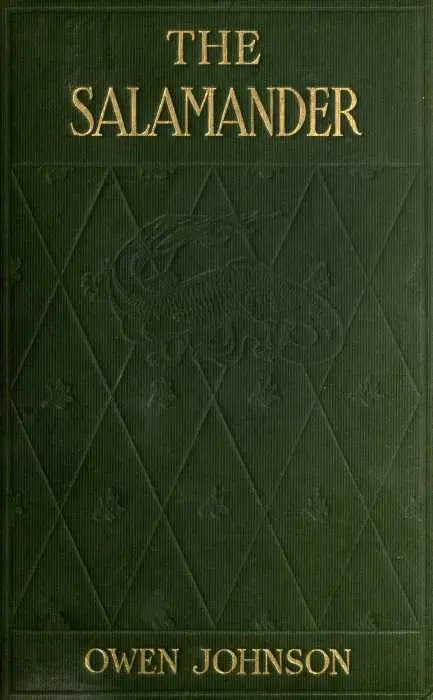
"The Salamander" by Owen Johnson is a novel written in the early 20th century. The novel explores the lives of young women in New York City against the backdrop of social change and economic independence. The main character, Doré Baxter, embodies the archetype of the "Salamander," a spirited young woman navigating the complexities of a modern society that both attracts and repulses her. The opening of the book introduces us to the vibrant, chaotic world inhabited by Doré and her peers, who live in a boarding house and seek excitement amidst the trials of their ambition. The narrative reveals their playful conversations and their aspirations, interspersed with hints of the underlying seriousness of their lives as they balance the thrill of exploration with the harsh realities of their social circumstances. Doré is portrayed as a charismatic figure, eager for adventure and autonomy, embodying the spirit of the new generation of women challenging societal norms. The reader is drawn into her world of curiosity, where the thrill of living is painted vividly against the darker undertones of societal expectations.
Introduction adapted from the source catalogue; source summaries may be automatically generated.
Free to read · English · 127,148 words · No account needed
MAKE TIME FOR A GOOD BOOK
On by default. Untick to stop anonymous reading totals. Each page counts after 10 seconds in view. How this works.
Anonymous counting is on unless you have switched it off.
"Don't suffocate me, sweethearts," said Busby, defending himself. "I didn't tell you for a damn good reason. No press-agent stunts before or after. Understand? Besides, the papers are bottled up--democratic respect for His Highness."
"I've a mind to have appendicitis," said one in a whisper to a
companion. "Gee! What a chance!"
"If you do, Consuelo, dear," said Busby urbanely, "we'll ship you down in a service elevator, and see you get the operation, too. Now, no nonsense, girls. You know what that means."
"What we've got to keep it out of the poipers? What, no publicity? Gee!"
"None, now or after," said Busby firmly.
All at once he looked up, astonished, perceiving Dore, who floated in at this moment like a golden bird.
"Gwendolyn had the sneezes," said Adele Vickers hastily. "This is her
sister."
"What's her name?" said Busby suspiciously, while the chorus girls, with their mountainous hats and sweeping feathers, their overloaded bodices and jeweled necks, studied with some concern the simple daring of this new arrival, uncertain and apprehensive.
"Miss Baxter," said Miss Vickers in a low voice.
"She's not a reporter?" said Busby, hesitating.
"Honest to God, Buzzy," said Adele Vickers vehemently. "She's on the stage, the legitimate--Dore Baxter, a friend of mine!"
"I know her!" said Busby, suddenly enlightened by the full name, and going to her, he said: "Met you at a party of Bruce Gunther's, I believe, Miss Baxter."
Dore, who thus found herself, to her vexation, sailing under her own colors, said, with a pleading look:
"Don't give me away, will you? It's just a lark, and," she added lower, "don't call me Miss Baxter!"
"A stage name, eh?"
"Splendid one--Trixie Tennyson. Doesn't that sound like a head-liner?" she added confidentially, in the low tone in which the conversation had been conducted.
Busby repeated the name, chuckling to himself, yielding to his sense of humor. "All right! Now, girls, come on!"
"But what shall we call him?"
"Call him anything you like ... after the soup!" said Busby, laughing. "Remember! he's here to be amused!... Have any of you girls changed your names since I saw you last?... No?... Then I know them!..." He told them off, counting with his fingers: "Adele Vickers, Georgie Gwynne--it used to be Bronson last year--"
"It never was!" exclaimed a petite Irish brunette, with a saucy smile and a roguish eye: "Baron--"
"I'll give you a better one: Georgie Washington!" continued Busby. "Why not? Fine!... A press-agent would charge for that!... I see an inch of nose, a gray eye and a brown cheek under an avalanche of hat--must be Viola Pax!"
"Violetta, please!" said a southern type with soft consonants.
Your reading position is saved on this browser. Take it to another device with a library code. Reading pages adapt to text, rather than matching a printed edition.
BEHIND THE BOOK
This eBook is for the use of anyone anywhere in the United States and most other parts of the world at no cost and with almost no restrictions whatsoever. You may copy it, give it away or re-use it under the terms of the Project Gutenberg License included with this eBook or online at www.gutenberg.org. If you are not located in the United States, you will have to check the laws of the country where you are located before using this eBook. Read the source licence.
The original source file, including credits and licence, is retained by this library. Request an original-format copy at no charge. Please include the book title and Project Gutenberg identifier #36355.
KEEP YOUR CURIOSITY GOING
Coulson Kernahan

Maurice Baring
Frances Wright
Cécile Tormay

Frederic Jesup Stimson

W. H. P. (William Henry Pope) Jarvis

