
The Wasted Generation
Owen Johnson
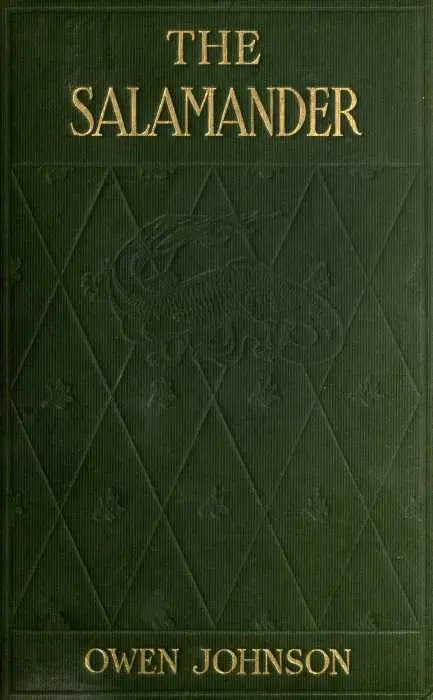
THE CLASSIC COLLECTION · 1914
"The Salamander" by Owen Johnson is a novel written in the early 20th century. The novel explores the lives of young women in New York City against the backdrop of social change and economic independence. The main character, Doré Baxter, embodies the archetype of the "Salamander," a spirited young woman navigating the complexities of a modern society that both attracts and repulses her. The opening of the book introduces us to the vibrant, chaotic world inhabited by Doré and her peers, who live in a boarding house and seek excitement amidst the trials of their ambition. The narrative reveals their playful conversations and their aspirations, interspersed with hints of the underlying seriousness of their lives as they balance the thrill of exploration with the harsh realities of their social circumstances. Doré is portrayed as a charismatic figure, eager for adventure and autonomy, embodying the spirit of the new generation of women challenging societal norms. The reader is drawn into her world of curiosity, where the thrill of living is painted vividly against the darker undertones of societal expectations.
Introduction adapted from the source catalogue; source summaries may be automatically generated.
Free to read · English · 127,148 words · No account needed
MAKE TIME FOR A GOOD BOOK
On by default. Untick to stop anonymous reading totals. Each page counts after 10 seconds in view. How this works.
Anonymous counting is on unless you have switched it off.
He did not continue the conversation, wondering to what extent Dodo had been listening to such an advanced apostle; but he said:
"Miss Monks, you're very honest, and I know you believe all you say; but--don't be offended if I tell you this!--opinions change with experience, and you have not yet had that experience with actual conditions that is necessary!"
Estelle Monks, piqued at this answer which precluded argument, rose
stiffly and went out.
"Why did you say that?" asked Dodo reproachfully, yet not displeased to be left alone in the tete-a-tete which he usually avoided.
He was in a serious mood, and because he wished to be honest in his own mind, he answered warily:
"She is too fine a type. I'd hate to see her make a mistake!"
He was thinking how much of what Estelle Monks had said applied to his own marriage. What a mockery it was, and what right had two human beings who were driven apart by every personal antipathy--physical, mental and spiritual--to go on, bound by a convention, preventing each other from seeking happiness elsewhere? And, remembering her attack on marriage as the slavery of woman, he thought bitterly that she had expressed only half the truth. He was, indeed, neither married nor a free man, checked in every impulse, denied at every turn.
"What are you frowning about?" said Dodo.
He answered hastily in that language which, as has been said, was given us to conceal our thoughts:
"I was wondering how much she had affected you!"
"Not the least!" said Dodo, adding impulsively: "And yet, that is just
what I feel!"
"You, Dodo?" he said anxiously.
She went to him with a sudden enthusiasm, taking his hands, perhaps subconsciously divining the bitter personal reflection that had been going on in his mind, feeling the moment to be propitious.
"Ah, let me tell you now what I want for us!" she began ardently.
"The great dream, Dodo?" he said, smiling.
"Yes, a dream, but a dream that will come true!" She hesitated, and standing before him, her eyes lighted up by the penetration of a woman, a glance that left him confused, she said directly: "You think you understand me? You don't; but I understand you! You are afraid of me! You love me, but you try not to, because you are afraid of me!"
"How?" he asked lamely.
"Because you think that I want to interfere in your life. Oh, yes, you do! I remember the look in your face when I was romancing about Sassoon, making him divorce--you remember, when you asked if that was what I intended to do with you?"
"I was joking!"
Your reading position is saved on this browser. Take it to another device with a library code. Reading pages adapt to text, rather than matching a printed edition.
BEHIND THE BOOK
This eBook is for the use of anyone anywhere in the United States and most other parts of the world at no cost and with almost no restrictions whatsoever. You may copy it, give it away or re-use it under the terms of the Project Gutenberg License included with this eBook or online at www.gutenberg.org. If you are not located in the United States, you will have to check the laws of the country where you are located before using this eBook. Read the source licence.
The original source file, including credits and licence, is retained by this library. Request an original-format copy at no charge. Please include the book title and Project Gutenberg identifier #36355.
KEEP YOUR CURIOSITY GOING
Coulson Kernahan

Maurice Baring
Frances Wright
Cécile Tormay

Frederic Jesup Stimson

W. H. P. (William Henry Pope) Jarvis

