
The Wasted Generation
Owen Johnson
THE CLASSIC COLLECTION · 1914
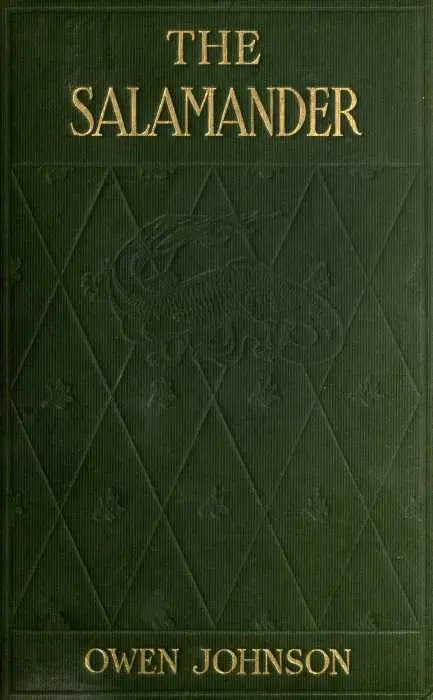
"The Salamander" by Owen Johnson is a novel written in the early 20th century. The novel explores the lives of young women in New York City against the backdrop of social change and economic independence. The main character, Doré Baxter, embodies the archetype of the "Salamander," a spirited young woman navigating the complexities of a modern society that both attracts and repulses her. The opening of the book introduces us to the vibrant, chaotic world inhabited by Doré and her peers, who live in a boarding house and seek excitement amidst the trials of their ambition. The narrative reveals their playful conversations and their aspirations, interspersed with hints of the underlying seriousness of their lives as they balance the thrill of exploration with the harsh realities of their social circumstances. Doré is portrayed as a charismatic figure, eager for adventure and autonomy, embodying the spirit of the new generation of women challenging societal norms. The reader is drawn into her world of curiosity, where the thrill of living is painted vividly against the darker undertones of societal expectations.
Introduction adapted from the source catalogue; source summaries may be automatically generated.
Free to read · English · 127,148 words · No account needed
MAKE TIME FOR A GOOD BOOK
On by default. Untick to stop anonymous reading totals. Each page counts after 10 seconds in view. How this works.
Anonymous counting is on unless you have switched it off.
In that brief terrifying instant, before she was able to raise her eyes, Dodo was shaken from head to foot. Never before had so much penetrating despair crowded upon her in such a fraction of time!
She was at a counter of fragrant hand-bags, staring up into the face of a bored, hostile, sharp-eyed woman, struggling for youth and attention--a brown little wanderer from nowhere confronting a great lady.
"What can I sell you?" said Mrs. Massingale with an instantaneous social
smile.
She found herself answering, breathlessly:
"No--nothing!"
The smile faded. The lady turned indifferently. It was close, she had been on her feet almost two hours, she was pardonably annoyed at this staring girl--and she showed it.
Suddenly, her face lit up, the surface smile on duty again. A group of men advanced effusively, taking her hand delicately, like a fragile ornament. She turned, and perceiving Dodo leaning vacantly, said:
"Excuse me!"
Without too much insistence she extended her fingers and moved her from the path of possible purchasers.
Dodo went, hurt, crushed and revolting. There had been nothing which the other had not had a right to do, yet in those seconds she had experienced the deepest humiliation a woman can receive from another, the disdain of caste.
She had come penitent and full of compassion. She went in a dangerous mood; this woman, perfectly correct, perfectly emotionless, perfectly cold and brilliant, might be Mrs. Massingale; she could never be his wife!
"No, that is not a marriage!" she said indignantly to herself.
The thing she dreaded, and hoped for, had come to pass. She forgave him,
and she understood!
Yet she hesitated day after day, until ten had passed in a whirl, alternately resolved, alternately recoiling. She had no defined morality. She was one of a thousand young girls of to-day, adrift, neither good nor bad, quite unmoral--the good and the bad equally responsive and the ultimate victory waiting on the first great influence from without, which would master her. She had no home; she was alone, a social mongrel. She could only hurt herself. What her parents had left her was only a heritage of lawlessness. Yet she hesitated, frightened by some fear conjured up from an unconscious self, like thin remembered notes of village bells, across the tumult of worldly clamors. At last, when she could see before her no other face, when the sound of his voice was mingled with every sound that came to her ear, when nothing else diverted her a moment from the insistent drumming ache of the present, she yielded. She went in the afternoon, just before four, to the court in Jefferson Market where she knew he was, pushing her way through the miserable, the venal, the vermin of all nations, clustered and ill smelling.
Your reading position is saved on this browser. Take it to another device with a library code. Reading pages adapt to text, rather than matching a printed edition.
BEHIND THE BOOK
This eBook is for the use of anyone anywhere in the United States and most other parts of the world at no cost and with almost no restrictions whatsoever. You may copy it, give it away or re-use it under the terms of the Project Gutenberg License included with this eBook or online at www.gutenberg.org. If you are not located in the United States, you will have to check the laws of the country where you are located before using this eBook. Read the source licence.
The original source file, including credits and licence, is retained by this library. Request an original-format copy at no charge. Please include the book title and Project Gutenberg identifier #36355.
KEEP YOUR CURIOSITY GOING
Coulson Kernahan

Maurice Baring
Frances Wright
Cécile Tormay

Frederic Jesup Stimson

W. H. P. (William Henry Pope) Jarvis

