
The Wasted Generation
Owen Johnson
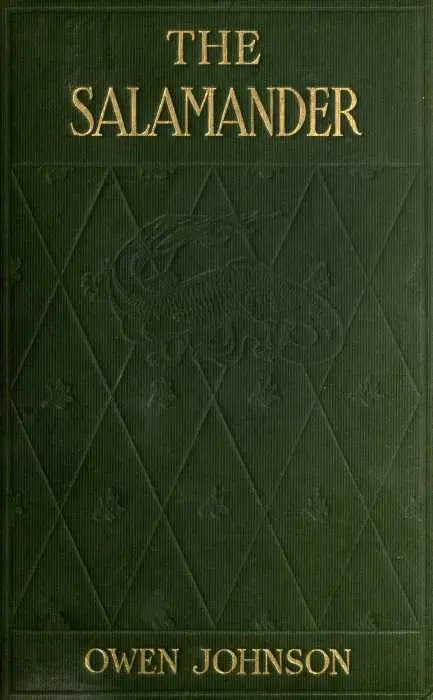
THE CLASSIC COLLECTION · 1914
"The Salamander" by Owen Johnson is a novel written in the early 20th century. The novel explores the lives of young women in New York City against the backdrop of social change and economic independence. The main character, Doré Baxter, embodies the archetype of the "Salamander," a spirited young woman navigating the complexities of a modern society that both attracts and repulses her. The opening of the book introduces us to the vibrant, chaotic world inhabited by Doré and her peers, who live in a boarding house and seek excitement amidst the trials of their ambition. The narrative reveals their playful conversations and their aspirations, interspersed with hints of the underlying seriousness of their lives as they balance the thrill of exploration with the harsh realities of their social circumstances. Doré is portrayed as a charismatic figure, eager for adventure and autonomy, embodying the spirit of the new generation of women challenging societal norms. The reader is drawn into her world of curiosity, where the thrill of living is painted vividly against the darker undertones of societal expectations.
Introduction adapted from the source catalogue; source summaries may be automatically generated.
Free to read · English · 127,148 words · No account needed
MAKE TIME FOR A GOOD BOOK
On by default. Untick to stop anonymous reading totals. Each page counts after 10 seconds in view. How this works.
Anonymous counting is on unless you have switched it off.
A quick descent, a sudden volcanic propulsion upward, and they were transferred a hundred feet above strife, into a noisy anteroom, gazing down at the gray-and-white tapestry of the spread city.
"Hello! What are you doing here?"
They turned. Estelle Monks, of the second floor front at Miss Pim's, owner of the white fox stole and the circulating garments, was standing beside them, jauntily alert.
"Goodness' sakes, it's Estelle!" exclaimed Ida. "Well, what are you
doing--?"
"Oh, I contribute," said Estelle evasively.
She was in a short tailored suit, Eton collar, Alpine hat and feather. With her hands in her side pockets, she was very direct, at ease, mannish, but not disagreeably so--rather attractive with her dark eyes, which, as Ida expressed it, had the "real come-hither" in their mocking depths.
A boy came shuffling out, saying nasally:
"Mr. Blood will see you naow."
They left Estelle Monks indulging in a long whistle of surprise, traversed a long chorus of clicking machines, and discovered a room of comparative quiet, spacious, with embattled desks. Harrigan Blood was waiting, a smile on his face as he fingered the two cards.
"Very nice of you to bring Miss Summers," he said jerkily, making his own introduction. "Added pleasure, I'm sure!"
Dore, who had expected some show of irritation, wondered in an amused way how he would manage to procure the tete-a-tete which she had just rendered impossible. In ten minutes Blood, without seeming to have considered the question, had resolved the knot by calling in Tony Rex, one of the younger cartoonists, a boyish person who eyed them with malicious curiosity, and having consigned Ida to him for a tour of inspection, had availed himself of the first interval to say:
"Come, you can see all this any time. You are not going to get out of a talk with me by any such tricks."
She consented, laughing, to be led back.
"Why did you do this?" he said, irritated.
"Do what?"
"Bring a governess?"
"Because I'm a very proper person."
"It annoys me. I hate women who annoy me!" he said abruptly.
She smiled in provoking silence, while, with a quick excusing gesture,
he lighted a cigar.
"You seem more natural here," she said, glancing at his ruffled hair and careless tie. "I'd like to see you at work."
He rose to get a copy of the editorial sheet for the day, and handed it
to her.
"You inspired that."
She took the editorial, which was entitled "Waste," and ran down its heavily leaded phrases, smiling to herself at these moralizations of the devil turned friar. He saw her amusement, and took the editorial abruptly.
"You won't understand--that's what I believe!"
Your reading position is saved on this browser. Take it to another device with a library code. Reading pages adapt to text, rather than matching a printed edition.
BEHIND THE BOOK
This eBook is for the use of anyone anywhere in the United States and most other parts of the world at no cost and with almost no restrictions whatsoever. You may copy it, give it away or re-use it under the terms of the Project Gutenberg License included with this eBook or online at www.gutenberg.org. If you are not located in the United States, you will have to check the laws of the country where you are located before using this eBook. Read the source licence.
The original source file, including credits and licence, is retained by this library. Request an original-format copy at no charge. Please include the book title and Project Gutenberg identifier #36355.
KEEP YOUR CURIOSITY GOING
Coulson Kernahan

Maurice Baring
Frances Wright
Cécile Tormay

Frederic Jesup Stimson

W. H. P. (William Henry Pope) Jarvis

