THE CLASSIC COLLECTION✦An outlaw’s diary: the CommuneCLASSIC FREE BOOKS
An outlaw’s diary: the Commune
Cécile Tormay
THE CLASSIC COLLECTION · 1922
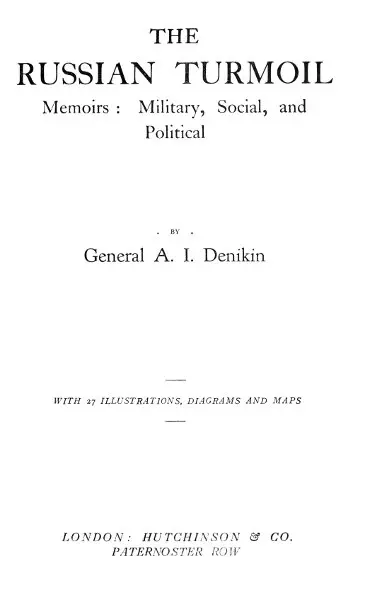
"The Russian Turmoil; Memoirs: Military, Social, and Political" by General A. I. Denikin is a historical account likely written in the early 20th century. The memoirs focus on the tumultuous events surrounding the collapse of the Russian Empire during the early stages of the Russian Revolution. Denikin, an officer closely connected to the military, discusses the disintegration of the army as well as the political and social factors that influenced these profound changes. The opening of the memoir sets the stage for the tumultuous events leading to the Russian Revolution by reflecting on the historical foundations that contributed to the collapse of the Russian state. Denikin outlines the conditions in the Russian army at the onset of the Revolution, emphasizing the soldiers' loyalty to the Czar and their traditional motivations of faith and patriotism. However, he also highlights a significant decline in moral and spiritual fortitude among the ranks, exacerbated by war weariness and the influences of revolutionary ideologies. As Denikin recounts his experiences and observations, he lays a strong foundation for understanding the complex interplay between military loyalty, political upheaval, and social change that characterized this pivotal moment in Russian history.
Introduction adapted from the source catalogue; source summaries may be automatically generated.
Free to read · English · 131,187 words · No account needed
MAKE TIME FOR A GOOD BOOK
On by default. Untick to stop anonymous reading totals. Each page counts after 10 seconds in view. How this works.
Anonymous counting is on unless you have switched it off.
We thus have many shortcomings, but numerical superiority is still on our side. If the enemy succeeds in breaking the French and the British, he will throw his entire weight upon us and we will then be lost. We need a strong government upon which we could rely, and we whole-heartedly greet the coalition government. The power of the State can only be strong when it leans upon the Army, which represents the armed forces of the nation.
General Dragomirov.--The prevailing spirit in the Army is the desire of peace. Anyone might be popular in the Army who would preach peace without annexations and would advocate self-determination. The illiterate masses have understood the idea of "no annexations" in a peculiar fashion. They do not understand the conditions of different peoples, and they repeatedly ask the question: "Why do not the Allied democracies join in our declarations?" The desire for peace is so strong that reinforcements refuse to accept equipment and arms and say: "They are no good to us as we do not intend to fight." Work has come to a standstill and it is even necessary to see to it that trenches are not dismantled and that roads are mended. In one of the best regiments we found, on the sector which it had occupied, a red banner inscribed: "Peace at all costs." The officer who tore that banner had to flee for his life. During the night men from that regiment were searching for the officer at Dvinsk, as he had been concealed by the Headquarters Staff. The dreadful expression "Adherents of the old régime" caused the best officers to be cast out of the Army. We all wanted a change, and yet many excellent officers, the pride of the Army, had to join the Reserve simply because they tried to prevent the disruption of the Army, but failed to adapt themselves to the new conditions. What is much more fatal is the growth of slackness and of a lingering spirit. Egoism is reaching terrible proportions, and each unit thinks only of its own welfare; endless deputations come to us daily, demanding to be relieved, to remove Commanding Officers, to be re-equipped, etc. All these deputations have to be addressed, and this hinders our work. Orders that used to be implicitly obeyed now demand lengthy arguments; if a battery is moved to a different sector, there is immediate discontent, and the men say: "You are weakening us--you are traitors." Owing to the weakness of the Baltic Fleet, we found it necessary to send an Army Corps to the rear to meet the eventual landing of an enemy force, but we were unable to do so, because the men said: "Our line is long enough as it is and if we lengthen it still more we will be unable to hold the enemy." Formerly we had no difficulty whatsoever in regrouping the troops. In September, 1915, eleven Army Corps were removed from the Western front, and this saved us from a defeat which might have decided the fate of the War. At present such a thing would be impossible, as every unit raises objections to the slightest move. It is very difficult to compel the men to do anything in the interests of the Mother Country. Regiments refuse to relieve their comrades in the firing line under various excuses--such as bad weather, or the fact that not all their men had had their baths. On one occasion a unit refused to go to the front on the plea that it had already been in the firing line at Easter time. We are compelled to ask the Committees of various regiments to argue the matter out. Only a small minority of officers is behaving in an undignified manner, trying to make themselves popular by bowing to the instincts of the men. The system of elections has not been introduced in its entirety, but many unpopular officers have been summarily dismissed as they were accused of being adherents to the old régime; other Commanding Officers, who had been considered incompetent and liable to dismissal, have been made to stay. It was quite impossible not to grant the demands for their retention. With regard to excesses there have been individual cases of shootings of officers.... Things cannot continue on these lines. We want strong power. We have fought for the country. You have taken the ground from under our feet. Will you kindly restore it? Our obligations are colossal, and we must have the power in order to be able to lead to victory the millions of soldiers who are entrusted to our care.
Your reading position is saved on this browser. Take it to another device with a library code. Reading pages adapt to text, rather than matching a printed edition.
BEHIND THE BOOK
This eBook is for the use of anyone anywhere in the United States and most other parts of the world at no cost and with almost no restrictions whatsoever. You may copy it, give it away or re-use it under the terms of the Project Gutenberg License included with this eBook or online at www.gutenberg.org. If you are not located in the United States, you will have to check the laws of the country where you are located before using this eBook. Read the source licence.
The original source file, including credits and licence, is retained by this library. Request an original-format copy at no charge. Please include the book title and Project Gutenberg identifier #43680.
KEEP YOUR CURIOSITY GOING
Cécile Tormay

Moritz Busch
John L. Ransom
Frances Wright
Cécile Tormay

Mabel Potter Daggett