THE CLASSIC COLLECTION✦An outlaw’s diary: the CommuneCLASSIC FREE BOOKS
An outlaw’s diary: the Commune
Cécile Tormay
THE CLASSIC COLLECTION · 1922
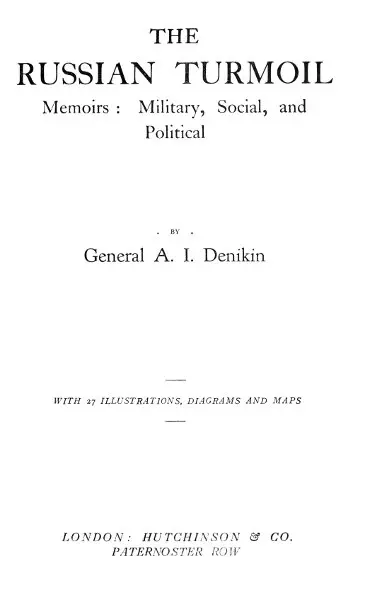
"The Russian Turmoil; Memoirs: Military, Social, and Political" by General A. I. Denikin is a historical account likely written in the early 20th century. The memoirs focus on the tumultuous events surrounding the collapse of the Russian Empire during the early stages of the Russian Revolution. Denikin, an officer closely connected to the military, discusses the disintegration of the army as well as the political and social factors that influenced these profound changes. The opening of the memoir sets the stage for the tumultuous events leading to the Russian Revolution by reflecting on the historical foundations that contributed to the collapse of the Russian state. Denikin outlines the conditions in the Russian army at the onset of the Revolution, emphasizing the soldiers' loyalty to the Czar and their traditional motivations of faith and patriotism. However, he also highlights a significant decline in moral and spiritual fortitude among the ranks, exacerbated by war weariness and the influences of revolutionary ideologies. As Denikin recounts his experiences and observations, he lays a strong foundation for understanding the complex interplay between military loyalty, political upheaval, and social change that characterized this pivotal moment in Russian history.
Introduction adapted from the source catalogue; source summaries may be automatically generated.
Free to read · English · 131,187 words · No account needed
MAKE TIME FOR A GOOD BOOK
On by default. Untick to stop anonymous reading totals. Each page counts after 10 seconds in view. How this works.
Anonymous counting is on unless you have switched it off.
General Brussilov.--I must first of all describe to you the present condition of the officers and men. Cavalry, artillery and engineering troops have retained about 50 per cent. of their cadres. But in the infantry, which is the mainstay of the Army, the position is entirely different. Owing to enormous casualties in killed, wounded and prisoners, as well as many deserters, some regiments have changed their cadres nine or ten times, so that only from three to ten men remain of the original formation. Reinforcements are badly trained and their discipline is still worse. Of the regular officers from two to four remain and in many cases they are wounded. Other officers are youngsters commissioned after a short training and enjoying no authority owing to their lack of experience. It is upon these new cadres that the task has fallen to remodel the Army on a new basis, and that task has so far proved beyond their capacity. Although we felt that a change was necessary and that it had already come too late, the ground was nevertheless unprepared. The uneducated soldier understood it as a deliverance from the officers' yoke. The officers greeted the change with enthusiasm. Had this not been so, the Revolution may not have probably passed so smoothly. The result, however, was that freedom was only given to the men, whereas the officers had to be content to play the part of pariahs of liberty. The unconscious masses were intoxicated with liberty. Everyone knows that extensive rights have been granted, but they do not know what these rights are, and nobody bothers about duties. The position of the officers is very difficult. From 15 to 20 per cent. have rapidly adapted themselves to the new conditions, because they believed that these conditions were all to the good. Those of the officers who were trusted by the men did not lose that trust. Some, however, became too familiar with the men, were too lenient and even encouraged internal dissensions amongst the men. But the majority of the officers, about 75 per cent., were unable to adapt themselves. They were offended, retired to the background and do not know what to do now. We are trying to bring them into contact with the soldiers once more, because we need the officers for continued fighting, and we have no other cadres. Many of the officers have no political training, do not know how to make speeches--and this, of course, handicaps the work of mutual understanding. It is necessary to explain and to instil into the masses the idea that freedom has been granted to everyone. I have known our soldiers for forty-five years, I love them and I will do my best to bring them into close touch with the officers, but the Provisional Government, the Duma and particularly the Soviet should also make every effort in order to assist in that work which must be done as soon as possible in the interests of the country. It is also necessary, owing to the peculiar fashion in which the illiterate masses have understood the watchword "without annexations and indemnities." One of the regiments has declared that not only would it refuse to advance, but desired to leave the front and to go home. The Committees opposed this tendency, but were told that they would be dismissed. I had a lengthy argument with the regiment, and when I asked the men whether they agreed with me, they begged leave to give me a written answer. A few minutes later they presented to me a poster: "Peace at any price and down with the War." In the course of a subsequent talk I had with one of the men, he said to me: "If there are to be no annexations, why do we want that hill top?" My reply was: "I also do not want the hill top, but we must beat the enemy who is occupying it." Finally, the men promised to hold on, but refused to advance, arguing that "the enemy is good to us and has informed us that he will not advance provided we do not move. It is important that we should go home to enjoy freedom and the land. Why should we allow ourselves to be maimed?" Is it to be an offensive or a defensive campaign? Success can be only obtained by an offensive. If we conduct a passive defence the front is bound to be broken. If discipline is strong a break-through may yet be remedied. But we must not forget that we have no well-disciplined troops, that they are badly trained and that the officers have no authority. In these circumstances an enemy success may easily become a catastrophe. The masses must, therefore, be persuaded that we must advance instead of remaining on the defensive.
Your reading position is saved on this browser. Take it to another device with a library code. Reading pages adapt to text, rather than matching a printed edition.
BEHIND THE BOOK
This eBook is for the use of anyone anywhere in the United States and most other parts of the world at no cost and with almost no restrictions whatsoever. You may copy it, give it away or re-use it under the terms of the Project Gutenberg License included with this eBook or online at www.gutenberg.org. If you are not located in the United States, you will have to check the laws of the country where you are located before using this eBook. Read the source licence.
The original source file, including credits and licence, is retained by this library. Request an original-format copy at no charge. Please include the book title and Project Gutenberg identifier #43680.
KEEP YOUR CURIOSITY GOING
Cécile Tormay

Moritz Busch
John L. Ransom
Frances Wright
Cécile Tormay

Mabel Potter Daggett