THE CLASSIC COLLECTION✦A History of Domestic Manners and Sentiments in England During the Middle AgesCLASSIC FREE BOOKS
A History of Domestic Manners and Sentiments in England During the Middle Ages
Thomas Wright
THE CLASSIC COLLECTION · 1868
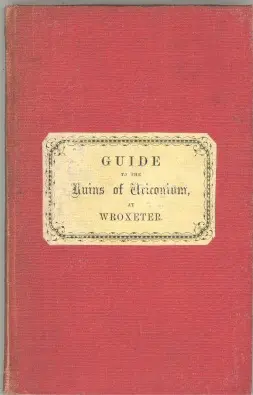
"The Ruins of the Roman City of Uriconium, at Wroxeter, near Shrewsbury" by Thomas Wright is a historical account written in the mid-19th century. The text serves as a guide and detailed examination of the archaeological findings at Wroxeter, particularly focusing on the remains of the ancient Roman city of Uriconium. It aims to provide popular information for visitors interested in understanding the significance of the excavations and the broader implications for Roman history in Britain. The opening of the book presents a preface and introductory context, laying out the author's intentions for the text. Wright discusses the historical significance of Uriconium, highlighting its long-standing presence as a Roman city and the recent excavations that have revealed its structures, including walls, hypocausts, and various artifacts. He emphasizes the importance of these findings in understanding the living conditions and culture of Roman Britain, as well as addressing superstitions that preserved the ruins for centuries after their decline. The beginning sets the stage for a more in-depth exploration of the city's archaeological remains and their relevance to historical research.
Introduction adapted from the source catalogue; source summaries may be automatically generated.
Free to read · English · 23,625 words · No account needed
MAKE TIME FOR A GOOD BOOK
On by default. Untick to stop anonymous reading totals. Each page counts after 10 seconds in view. How this works.
Anonymous counting is on unless you have switched it off.
4. In more than one instance, bones of very young children have been found; but in one instance, alluded to at page 68, almost an entire skeleton of a child was found, which has been preserved, and is in the Museum. This was found outside the semicircular end of the great hypocaust, where there must have been a small court. From the smallness of the bones of the skeleton, and from the circumstance of the teeth being still contained within the jaw-bone, it may be inferred that this was a very young infant—perhaps still in arms.
5. A thigh bone has been found, which, having been fractured, has become
united during life.
The most interesting circumstance connected with the human remains found at Wroxeter, is the large relative proportion of deformed skulls. Of the nineteen crania found in the orchard and since deposited in the Museum, eleven are more or less crooked. It has been supposed, and indeed the opinion is still entertained by some antiquarians, that this deformity was congenital and not posthumous, that is to say, that the persons to whom these skulls belonged lived and died with deformed heads. And this was my own view before I had learned that bones are capable of being bent by pressure in the ground. There can be little doubt that the deformity has been produced by posthumous pressure, aided by moisture and the solvent action of certain acids that always exist in vegetable mould. {99a} Other instances of a like effect have been described by Dr. Sherman, {99b} and, in America, by the Rev. D. Wilson. {99c}
ON November the 11th, 1858, at the General Meeting of the Shropshire and North Wales Natural History and Antiquarian Society, held at the Museum, Shrewsbury, the President, Beriah Botfield, Esq., M.P., proposed that excavations should be commenced at Wroxeter. He had written to the Duke of Cleveland, and obtained his Grace’s consent to do so. He also made the very liberal offer to give fifty guineas towards the expenses, provided that fifty other gentlemen could be found willing to subscribe one guinea each. A Committee was formed, consisting of the following noblemen and gentlemen to carry on the work:—
The Right Hon. the Earl of Powis, Powis Castle
Beriah Botfield, Esq., M.P., F.R.S., Decker Hill
R. A. Slaney, Esq., M.P., Walford Manor
Rev. B. H. Kennedy, D.D., Shrewsbury
Rev. E. Egremont, Wroxeter
Rev. R. W. Eyton, Ruyton, Shiffnal
Rev. H. M. Scarth, Bathwick
Samuel Ashdown, Esq., Uppington
W. H. Bayley, Esq., Shrewsbury
William F. F. Foulkes, Esq., Stanley Place, Chester
Henry Johnson, Esq., M.D., Hon. Sec., Shrewsbury
George Stanton, Esq., Shrewsbury
Your reading position is saved on this browser. Take it to another device with a library code. Reading pages adapt to text, rather than matching a printed edition.
BEHIND THE BOOK
This eBook is for the use of anyone anywhere in the United States and most other parts of the world at no cost and with almost no restrictions whatsoever. You may copy it, give it away or re-use it under the terms of the Project Gutenberg License included with this eBook or online at www.gutenberg.org. If you are not located in the United States, you will have to check the laws of the country where you are located before using this eBook. Read the source licence.
The original source file, including credits and licence, is retained by this library. Request an original-format copy at no charge. Please include the book title and Project Gutenberg identifier #62425.
KEEP YOUR CURIOSITY GOING
Cécile Tormay

Moritz Busch
John L. Ransom
Frances Wright
Cécile Tormay

Mabel Potter Daggett