THE CLASSIC COLLECTION✦A History of Domestic Manners and Sentiments in England During the Middle AgesCLASSIC FREE BOOKS
A History of Domestic Manners and Sentiments in England During the Middle Ages
Thomas Wright
THE CLASSIC COLLECTION · 1868
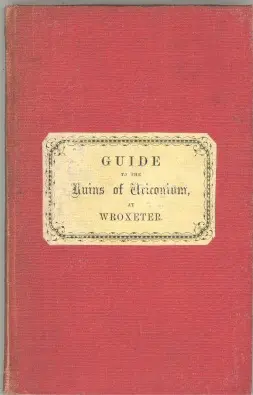
"The Ruins of the Roman City of Uriconium, at Wroxeter, near Shrewsbury" by Thomas Wright is a historical account written in the mid-19th century. The text serves as a guide and detailed examination of the archaeological findings at Wroxeter, particularly focusing on the remains of the ancient Roman city of Uriconium. It aims to provide popular information for visitors interested in understanding the significance of the excavations and the broader implications for Roman history in Britain. The opening of the book presents a preface and introductory context, laying out the author's intentions for the text. Wright discusses the historical significance of Uriconium, highlighting its long-standing presence as a Roman city and the recent excavations that have revealed its structures, including walls, hypocausts, and various artifacts. He emphasizes the importance of these findings in understanding the living conditions and culture of Roman Britain, as well as addressing superstitions that preserved the ruins for centuries after their decline. The beginning sets the stage for a more in-depth exploration of the city's archaeological remains and their relevance to historical research.
Introduction adapted from the source catalogue; source summaries may be automatically generated.
Free to read · English · 23,625 words · No account needed
MAKE TIME FOR A GOOD BOOK
On by default. Untick to stop anonymous reading totals. Each page counts after 10 seconds in view. How this works.
Anonymous counting is on unless you have switched it off.
In the passages alluded to, there is at y, a square pit, somewhat like what might be a cess-pool, of very good and substantial masonry, at the bottom of which runs north and south a very well formed drain, the bed of which is formed of large roof-tiles. To the south of this is a hypocaust, A, which differs from the other hypocausts yet opened in being partly formed of low parallel walls instead of rows of pillars. On the wall of the passage leading to this hypocaust from the east was found the inscription mentioned at page 45. Westward from the hypocaust A, but without any apparent communication between them, was another hypocaust, B, which had been constructed in the usual manner, the floor supported by rows of low columns formed of square thin bricks. It was in this hypocaust that the three skeletons mentioned before (p. 41,) were found, the man who possessed the money crouching in the north-west corner, and the two persons supposed to be women, extended along the side of the northern wall. The opening into this hypocaust was through its southern wall, from the interior court, so that the fugitives must have crept along the whole length of the hypocaust to reach their place of concealment. The part of this interior court, immediately adjacent to this hypocaust, which has been excavated to some extent, presents several interesting features. A breach in the eastern boundary wall had been newly repaired with much inferior masonry at the time when the city of Uriconium was taken and destroyed; and it is a curious circumstance that some large pieces of stone lie here on the floor of the court, unfinished by the masons, as though repairs and alterations in the buildings were going on at the very moment of the final catastrophe. Adjoining to this hypocaust, at its north-west corner, is a square room, c, with the herring-bone pavement, exactly like that at u in character and dimensions, which had opened into the room above the hypocaust B, much in the same manner as u opened in the room v. Separated from this room by a wall, but apparently without any communication with it, is an interesting staircase D, leading down, to the entrance to a larger and apparently more important series of hypocausts. This staircase descended from a square room, about the same size as the room C, which had a smooth pavement of cement. It is composed of three steps each formed of a large squared stone. A part of the space at the bottom, the north-eastern corner, appears to have been used by the later Roman inhabitants of this building as a receptacle for the sweeping of the floors, and when it was first opened the earth, to the height of about sixteen or eighteen inches from the floor, was filled with all kinds of objects, such as coins, hair-pins, fibulæ, needles in bone, nails, various articles in iron, bronze, and lead, glass, broken pottery, bones of edible animals and birds, stags’ horns, tusks and hoofs of wild boars, oyster shells, in one of which lay the shell of a large nut, &c. A large shaft of a column lay across the steps. The Roman masonry here is very good. To the right hand, towards the south, a rather large arch, turned in Roman bricks, led into the hypocaust E, a doorway in the southern wall of which formed the communication between this hypocaust and the still larger hypocaust F. The latter had supported what must have been a handsome room, which was about fifty feet long, including the semicircular northern end, by thirty-five feet in breadth. When first opened, this hypocaust was in a state of preservation in which such buildings are seldom found in this country. A hundred and twenty columns of bricks were counted, most of them at their original height of rather more than three feet. At the north-eastern corner, the columns supported a small portion of the floor in its original position. It is a mass of cement, eight inches thick, with the upper surface, which no doubt had formed the floor, perfectly smooth. During the time that the Excavation Committee were excluded from the field, all the pillars of this interesting hypocaust were thrown to the ground, and a great part of the bricks which formed the supporting columns were broken to pieces—even the piece of the floor and its supports at the north-east corner were overthrown. A very exact drawing of the latter, however, had been preserved, which served as a pattern for restoring it; and it is to the ingenuity and labour of Dr. Henry Johnson that the public owes the restoration of this hypocaust as far as it was possible to restore it.
Your reading position is saved on this browser. Take it to another device with a library code. Reading pages adapt to text, rather than matching a printed edition.
BEHIND THE BOOK
This eBook is for the use of anyone anywhere in the United States and most other parts of the world at no cost and with almost no restrictions whatsoever. You may copy it, give it away or re-use it under the terms of the Project Gutenberg License included with this eBook or online at www.gutenberg.org. If you are not located in the United States, you will have to check the laws of the country where you are located before using this eBook. Read the source licence.
The original source file, including credits and licence, is retained by this library. Request an original-format copy at no charge. Please include the book title and Project Gutenberg identifier #62425.
KEEP YOUR CURIOSITY GOING
Cécile Tormay

Moritz Busch
John L. Ransom
Frances Wright
Cécile Tormay

Mabel Potter Daggett