THE CLASSIC COLLECTION✦A History of Domestic Manners and Sentiments in England During the Middle AgesCLASSIC FREE BOOKS
A History of Domestic Manners and Sentiments in England During the Middle Ages
Thomas Wright
THE CLASSIC COLLECTION · 1868
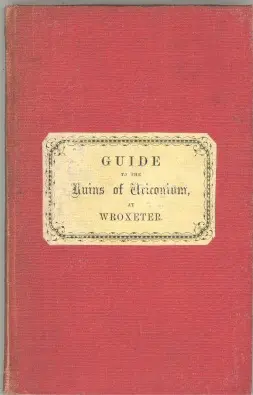
"The Ruins of the Roman City of Uriconium, at Wroxeter, near Shrewsbury" by Thomas Wright is a historical account written in the mid-19th century. The text serves as a guide and detailed examination of the archaeological findings at Wroxeter, particularly focusing on the remains of the ancient Roman city of Uriconium. It aims to provide popular information for visitors interested in understanding the significance of the excavations and the broader implications for Roman history in Britain. The opening of the book presents a preface and introductory context, laying out the author's intentions for the text. Wright discusses the historical significance of Uriconium, highlighting its long-standing presence as a Roman city and the recent excavations that have revealed its structures, including walls, hypocausts, and various artifacts. He emphasizes the importance of these findings in understanding the living conditions and culture of Roman Britain, as well as addressing superstitions that preserved the ruins for centuries after their decline. The beginning sets the stage for a more in-depth exploration of the city's archaeological remains and their relevance to historical research.
Introduction adapted from the source catalogue; source summaries may be automatically generated.
Free to read · English · 23,625 words · No account needed
MAKE TIME FOR A GOOD BOOK
On by default. Untick to stop anonymous reading totals. Each page counts after 10 seconds in view. How this works.
Anonymous counting is on unless you have switched it off.
The visitor is introduced into this space by a gateway from the road, nearly at its north-western corner. Opposite this gateway he will see an apartment, which the excavators are now in the course of exploring. It is nearly a square, and is about thirty-four feet in its longest dimension. The side towards the street seems to have been open, or at least the masonry of the wall presents the appearance of having had wide folding doors, or a framework of wood of some kind in two compartments 6, 6. In the centre of the room is a large pier of masonry (1), perhaps a table for workmen. More towards the north-western corner, a sort of furnace or forge (2) was found, built of red clay, with a hole or cavity in the upper part sufficiently large for a man to thrust his head in. As the surface of the cavity, internally, is completely vitrified, and as there was much charcoal strewed about, there can be no doubt that the cavity had been occupied by a very fierce fire. A low wall has been traced, running across the room east and west in a line with this furnace; and two transverse low walls of similar character. Upon the low wall a little behind the forge (at 3), the excavators came upon what was supposed to be the lower part of a column with its base; but it is formed roughly, and I think it more probable that it was a stone table for the use of the workman at the furnace. It was at first supposed that this might belong to a colonnade running along the wall; but no trace of such a colonnade has been found, although a large piece of a shaft of a column lies in the middle of the room. This column, however, is of larger dimensions than the supposed base (3). Had such a colonnade existed, it seems so little in accordance with the existence of a forge, that we might be led to suspect that the room had, at some late period, been diverted from its original purpose, and occupied by a worker in metals, or even in glass, as fine specimens of glass were found scattered about, and also many fragments of metal. But objects of all kinds seem to have been thrown about in such a manner, when the town was plundered, that it would be unsafe to argue upon the purpose of any particular building, merely from moveable articles found in it. Among other things found in this room were nearly a dozen hair-pins, two of which were much more ornamental than any we had found before; a much greater quantity of fragments of Samian ware, and of higher artistic merit, than had previously been met with in one spot; a portion of a large bronze fibula; a number of coins, and other things. One of the vessels of Samian ware is a fine bowl, with figures in high relief, representing a stag-hunt. Upon the low wall of the sill (6) a number of copper Roman coins (about sixty) were found together; and near them the fragment of a small earthen vessel, in which probably they had been carried by some one who dropped them here as he was hurrying out of the place. Turning from the gate of the field to the right, or south, along the inside of the hedge, the visitor will come to a portion of uncovered wall, h h, running north and south, upwards of eighty feet, in which there are two entrance gateways, i, p. The first of these is about twelve feet wide, and was approached by a sort of inclined plane, formed of three large squared masses of stone, each about four feet square by eleven inches in thickness. The other entrance which was only five feet wide, was approached by two steps, each similarly formed of one mass of stone; of which the lower step is worn very much at its south-west corner, in a manner to lead us to believe that the great majority of the people who passed through this entrance came up the street from the south. The upper step, or stone, is so much worn by the feet of those who passed over it, that it broke into three pieces under the workmen’s picks. On one side of it there is a deep hollow, representing nearly the form of a small human foot, which seems to have been scooped into the stone for some purpose with which we are not acquainted. These two entrances lead into one square court, the floor of which, proved by the steps and inclined plane to have been on a higher level than the street without, was paved with small bricks laid in herring-bone work, like the great inclosure to the north of the Old Wall. It is found to have been much damaged and mended in ancient times, which seems to countenance the supposition that the wide entrance and the inclined plane by which it was approached were intended for horses and perhaps for carts or for heavy barrows. Among the objects found in excavating here was a portion of a horse-shoe. On each side of this court a row of chambers is found, m m m, four on the north side and four on the south, from ten to twelve feet square. The westernmost of these chambers, on the north side of the court, has been cleared out, and was found to be ten feet deep, with a low transverse wall at the bottom, the object of which is at present quite inexplicable. A quantity of charcoal was found in this room, as though it had been a store-room for that article. One of the other rooms, on each side of the court, seemed to have been a receptacle for bones, horns, &c.; and as some of these had evidently been sawn and cut, and others partly turned on a lathe, they suggested the idea of having belonged to manufacturers of the various objects made of this material which are found so commonly in the course of the excavations. They may, therefore, have been the magazines of manufacturers and tradesmen, a notion which is somewhat confirmed by the circumstance of several weights of different sizes having been found in this part of the excavations; or they may have been mere depots for the stores and refuse of a large mansion or other establishment. These rooms are, perhaps, all deep like the one already cleared out, but it is remarkable that, as high as the walls remain, that is, about two feet above the floor of the court, there is no trace of entrances to them, which must, therefore, have been rather high in the wall, and they were entered perhaps by a ladder.
Your reading position is saved on this browser. Take it to another device with a library code. Reading pages adapt to text, rather than matching a printed edition.
BEHIND THE BOOK
This eBook is for the use of anyone anywhere in the United States and most other parts of the world at no cost and with almost no restrictions whatsoever. You may copy it, give it away or re-use it under the terms of the Project Gutenberg License included with this eBook or online at www.gutenberg.org. If you are not located in the United States, you will have to check the laws of the country where you are located before using this eBook. Read the source licence.
The original source file, including credits and licence, is retained by this library. Request an original-format copy at no charge. Please include the book title and Project Gutenberg identifier #62425.
KEEP YOUR CURIOSITY GOING
Cécile Tormay

Moritz Busch
John L. Ransom
Frances Wright
Cécile Tormay

Mabel Potter Daggett