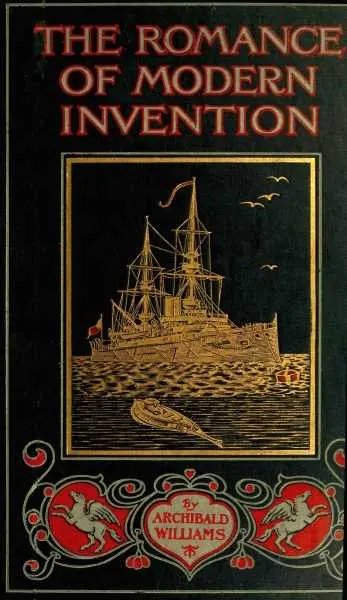
The Romance of Modern Invention Containing Interesting Descriptions in Non-technical Language of Wireless Telegraphy, Liquid Air, Modern Artillery, Submarines, Dirigible Torpedoes, Solar Motors, Airships, &c. &c.
Archibald Williams
THE CLASSIC COLLECTION · 1906
"The Romance of Modern Mechanism" by Archibald Williams is a scientific publication written in the early 20th century. The book explores the fascinating world of modern machinery and mechanical devices, presenting descriptions in accessible, non-technical language for a general audience. It delves into the evolution of technology, highlighting how various mechanisms have transformed everyday life and industry. At the start of the book, the author sets the scene by tracing the development of mechanisms from early human tools to the sophisticated machines of the modern era. He begins by emphasizing the essential role that machinery plays in contemporary society, detailing the countless ways in which mechanical devices influence our daily routines. Williams briefly introduces various subjects that will be explored, from delicate instruments like watches and chronometers to complex industrial machinery, painting a vivid picture of our reliance on machines and the ingenuity behind their creation.
Introduction adapted from the source catalogue; source summaries may be automatically generated.
Free to read · English · 95,428 words · No account needed
MAKE TIME FOR A GOOD BOOK
On by default. Untick to stop anonymous reading totals. Each page counts after 10 seconds in view. How this works.
Anonymous counting is on unless you have switched it off.
Diving being a profession which can be carried on in its simplest form with the simplest possible apparatus--merely a rope and a stone--its history reaches back into the dim and inexplorable past. We may well believe that the first man who explored the depths of the sea for treasure lived as long ago as the first seeker for minerals in the bosom of the earth. Even when we come to the various appliances which have been gradually developed in the course of centuries, our records are very imperfect. Alexander the Great is said to have descended in a machine which kept him dry, while he sought for fresh worlds to conquer below the waves. Aristotle mentions a device enabling men to remain some time under water. This is all the information, and a very meagre total, too, that we get from classical times.
Stepping across 1,500 years we reach the thirteenth century, about the middle of which Roger Bacon is said to have invented the diving-bell. But like some other discoveries attributed to that Middle-Age physicist, the authenticity of this rests on very slender foundations. In a book published early in the sixteenth century there appears an illustration of a diver wearing a cap or helmet, to which is attached a leather tube floated on the surface of the water by an inflated bag. This is evidently the diving dress in its crudest form; and when we read how, in 1538, two Greeks made a submarine trip under a huge inverted chamber, which kept them dry, in the presence of the great Emperor Charles V. and some 12,000 spectators, we recognise the diving-bell, now so well known.
The latter device did not reach a really practical form till 1717, when Dr. Halley, a member of the Royal Society, built a bell of wood lined with lead. The divers were supplied with air by having casks-full lowered to them as required. To quote his own words: "To supply air to this bell under water, I caused a couple of barrels of about thirty gallons each to be cased with lead, so as to sink empty, each of them having a bunghole in its lowest parts to let in the water, as the air in them condensed on their descent, and to let it out again when they were drawn up full from below. And to a hole in the uppermost parts of these barrels I fixed a leathern hose, long enough to fall below the bunghole, being kept down by a weight appended, so that the air in the upper parts of the barrels could not escape, unless the lower ends of these hose were first lifted up. The air-barrels being thus prepared, I fitted them with tackle proper to make them rise and fall alternately, after the manner of two buckets in a well; and in their descent they were directed by lines fastened to the under edge of the bell, which passed through rings on both sides of the leathern hose in each barrel, so that, sliding down by these lines, they came readily to the hand of a man, who stood on purpose to receive them, and to take up the ends of the hose into the bell. Through these hose, as soon as their ends came above the surface of the water in the barrels, all the air that was included in the upper parts of them was blown with great force into the bell, whilst the water entered at the bungholes below and filled them, and as soon as the air of one barrel had been thus received, upon a signal given that was drawn up, and at the same time the other descended, and by an alternate succession, provided air so quick and in such plenty that I myself have been one of five who have been together at the bottom, in nine to ten fathoms water, for above an hour and a half at a time, without any sort of ill-consequence, and I might have continued there so long as I pleased for anything that appeared to the contrary." After referring to the fact that, when the sea was clear and the sun shining, he could see to read or write in the submerged bell, thanks to a glass window in it, the Doctor goes on to say: "This I take to be an invention applicable to various uses, such as fishing for pearls, diving for coral or sponges and the like, in far greater depths than has hitherto been thought possible; also for the fitting and placing of the foundations of moles, bridges, etc., in rocky bottoms, and for cleaning and scrubbing ships' bottoms when foul, in calm weather at sea. I shall only intimate that, by an additional contrivance, I have found it not impracticable for a diver to go out of an engine to a good distance from it, the air being conveyed to him with a continued stream by small flexible pipes, which pipes may serve as a clue to direct him back again when he would return to the bell."
Your reading position is saved on this browser. Take it to another device with a library code. Reading pages adapt to text, rather than matching a printed edition.
Archibald Williams
Archibald Williams
BEHIND THE BOOK
This eBook is for the use of anyone anywhere in the United States and most other parts of the world at no cost and with almost no restrictions whatsoever. You may copy it, give it away or re-use it under the terms of the Project Gutenberg License included with this eBook or online at www.gutenberg.org. If you are not located in the United States, you will have to check the laws of the country where you are located before using this eBook. Read the source licence.
The original source file, including credits and licence, is retained by this library. Request an original-format copy at no charge. Please include the book title and Project Gutenberg identifier #46094.
KEEP YOUR CURIOSITY GOING

Charles G. (Charles Griffith) Ross
Hannah Webster Foster

Emily Lawless
Edwin Hamlin Carr

Charles De Lano Hine
Andrew Ure