
Barren Ground
Ellen Anderson Gholson Glasgow
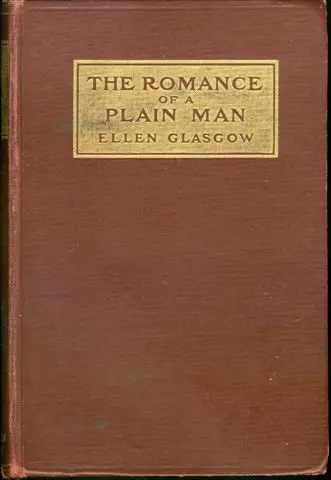
THE CLASSIC COLLECTION · 1909
"The Romance of a Plain Man" by Ellen Glasgow is a novel written in the early 20th century. The story launches the reader into the life of Ben Starr, a young boy from a struggling family in Richmond, as he navigates the challenges of his humble environment and the complexities of childhood, family, and societal class. Through Ben's perspective, the book explores themes of innocence, aspiration, and the longing for beauty and belonging in a world marked by poverty and hardship. The opening portion ushers us into Ben's world during a stormy October evening, where he engages in playful conversation with his father, showcasing their simple family life. As rain lashes against their home, the family dynamics are revealed, highlighting Ben's youthful curiosity and innocence. Soon, a mysterious woman and her daughter, Sally, interrupt their evening, introducing the complexities of social class distinctions that will shape Ben's experiences as he grows. Sally's disdainful use of the term "common" to describe Ben plants the seeds of his yearning to rise above his circumstances, setting the stage for his struggles with identity and aspiration. As the story unfolds, we glimpse the early indicators of how Ben's environment will impact his journey throughout the narrative.
Introduction adapted from the source catalogue; source summaries may be automatically generated.
Free to read · English · 126,677 words · No account needed
MAKE TIME FOR A GOOD BOOK
On by default. Untick to stop anonymous reading totals. Each page counts after 10 seconds in view. How this works.
Anonymous counting is on unless you have switched it off.
Turning from me, she walked slowly to the end of the room and bent over the box of sweet alyssum, which still blossomed under a canary cage on the window-sill. A cedar log was burning on the andirons, and the red light of the flames fell on the tapestried furniture, on the quaint inlaid spinet in one corner, and on the portrait above it of Miss Mitty and Miss Matoaca clasping hands under a garland of roses.
"Will you promise me, dearest?" I asked again, for she did not answer.
Lifting her head from the flowers, she stood with her hand on one of the delicate curtains, and her figure, in its straight black habit, drawn very erect.
"I'll ride him," she responded quietly, "if--if he kills me."
"But why--why--what on earth is the use of taking so great a risk?" I
demanded.
A humorous expression shot into her face, and I saw her full, red lips grow tremulous with laughter.
"That," she answered, after a moment, "is my ambition. All of us have an ambition, you know, women as well as men."
"An ambition?" I repeated, and looked in mystification at the portrait
above the spinet.
"It sounds strange to you," she went on, "but why shouldn't I have one? I was a very promising horsewoman before my marriage, and my ambition now is to--to go after Bonny. Only Bonny says I can't," she added regretfully, "because of my hands."
"They are too small?"
"Too small and too light. They can't hold things."
"Well, they've managed to hold one at any rate," I responded gaily, though I added seriously the minute afterward, "If you'll let me sell that horse, darling, I'll give you anything on God's earth that you want."
"But suppose I don't want anything on God's earth except that horse?"
"There's no sense in that," I blurted out, in bewilderment. "What in thunder is there about the brute that has so taken your fancy?"
Her hand fell from the curtain, and plucking a single blossom of sweet alyssum, she came back to the hearth holding it to her lips.
"He has taken my fancy," she replied, "because he is exciting--and I am
craving excitement."
"But you never used to want excitement."
"People change, all the poets and philosophers tell us. I've wanted it very badly indeed for the last six or eight months."
"Just since we've recovered our money?"
"Well, one can't have excitement without money, can one? It costs a good deal. Beauchamp sold for sixteen hundred dollars."
"He'd sell for sixteen to-morrow if I had my way."
Your reading position is saved on this browser. Take it to another device with a library code. Reading pages adapt to text, rather than matching a printed edition.
Ellen Anderson Gholson Glasgow

Ellen Anderson Gholson Glasgow

Ellen Anderson Gholson Glasgow

Ellen Anderson Gholson Glasgow
BEHIND THE BOOK
This eBook is for the use of anyone anywhere in the United States and most other parts of the world at no cost and with almost no restrictions whatsoever. You may copy it, give it away or re-use it under the terms of the Project Gutenberg License included with this eBook or online at www.gutenberg.org. If you are not located in the United States, you will have to check the laws of the country where you are located before using this eBook. Read the source licence.
The original source file, including credits and licence, is retained by this library. Request an original-format copy at no charge. Please include the book title and Project Gutenberg identifier #30299.
KEEP YOUR CURIOSITY GOING
Coulson Kernahan

Maurice Baring
Frances Wright
Cécile Tormay

Frederic Jesup Stimson

W. H. P. (William Henry Pope) Jarvis