
Barren Ground
Ellen Anderson Gholson Glasgow
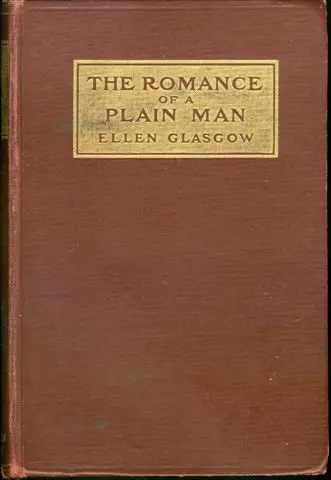
THE CLASSIC COLLECTION · 1909
"The Romance of a Plain Man" by Ellen Glasgow is a novel written in the early 20th century. The story launches the reader into the life of Ben Starr, a young boy from a struggling family in Richmond, as he navigates the challenges of his humble environment and the complexities of childhood, family, and societal class. Through Ben's perspective, the book explores themes of innocence, aspiration, and the longing for beauty and belonging in a world marked by poverty and hardship. The opening portion ushers us into Ben's world during a stormy October evening, where he engages in playful conversation with his father, showcasing their simple family life. As rain lashes against their home, the family dynamics are revealed, highlighting Ben's youthful curiosity and innocence. Soon, a mysterious woman and her daughter, Sally, interrupt their evening, introducing the complexities of social class distinctions that will shape Ben's experiences as he grows. Sally's disdainful use of the term "common" to describe Ben plants the seeds of his yearning to rise above his circumstances, setting the stage for his struggles with identity and aspiration. As the story unfolds, we glimpse the early indicators of how Ben's environment will impact his journey throughout the narrative.
Introduction adapted from the source catalogue; source summaries may be automatically generated.
Free to read · English · 126,677 words · No account needed
MAKE TIME FOR A GOOD BOOK
On by default. Untick to stop anonymous reading totals. Each page counts after 10 seconds in view. How this works.
Anonymous counting is on unless you have switched it off.
"There are worse things than a mollycoddle or a fop," she rejoined after a pause, and added quickly, while old Esdras left the dining-room to answer a ring at the bell, "That's either Bonny Page or George now. One of them is coming to take me out."
For a moment I hoped foolishly that the visitor might be Bonny Page, but the sound of George's pleasant drawling voice was heard speaking to old Esdras, and as the curtains swung back, he crossed the threshold and came over to take Sally's outstretched hand.
"You're lunching late to-day," he said. "I don't often find you here at
this hour, Ben."
"No, I'm not a man-about-town like you," I replied, pushing the cigars and the lamp toward him; "the business of living takes up too much of my time."
He leaned over, without replying to me, his hand on the back of Sally's chair, his eyes on her face.
"It's all right, Sally," he said in a low voice, and when he drew back, I saw that he had laid a spray of sweet alyssum on the table beside her plate.
Her eyes shone suddenly as if she were looking at sunlight, and when she smiled up at him, there was an expression in her face, half gratitude, half admiration, that made it very beautiful. While I watched her, I tried to overcome an ugly irrational resentment because George had been the one to call that tremulous new beauty into existence.
"How like you it was," she returned, almost in a whisper, with the spray of sweet alyssum held to her lips, "and how can I thank you?"
His slightly wooden features, flushed now with a fine colour, as if he had been riding in the March wind, softened until I hardly knew them. Standing there in his immaculate clothes, with his carefully groomed mustache hiding a trembling mouth, he had become, I realised vaguely, a George with whom the General and I possessed hardly so much as an acquaintance. The man before me was a man whom Sally had invoked into being, and it seemed to me, as I watched them, that she had awakened in George, who had lost her, some quality--inscrutable and elusive--that she had never aroused in the man to whom she belonged. What this quality was, or wherein it lay, I could not then define. Understanding, sympathy, perception, none of these words covered it, yet it appeared to contain and possess them all. The mere fact of its existence, and that I recognised without explaining it, had the effect of a barrier which separated me for the moment from my wife and the man to whom she was related by the ties of race and of class. Again I was aware of that sense of strangeness, of remoteness, which I had felt on the night of our home-coming when I had stood, spellbound, before Bonny Page's exquisite grooming and the shining gloss on her hair and boots. Something--a trifle, perhaps, had passed between Sally and George--and the reason I did not understand it was because I belonged to another order and had inherited different perceptions from theirs. The trifle--whatever it was--appeared visibly, I knew, before us; it was evident and on the surface, and if I failed to discern it what did that prove except the shortness of the vision through which I looked? A physical soreness, like that of a new bruise, attacked my heart, and rising hastily from the table, I made some hurried apology and went out, leaving them alone together. Glancing back as I got into my overcoat in the hall, I saw that Sally still held the spray of sweet alyssum to her lips, and that the look George bent on her was transfigured by the tenderness that flooded his face with colour. She loved me, she was mine, and yet at this instant she had turned to another man for a keener comprehension, a subtler sympathy, than I could give. A passion, not of jealousy, but of hurt pride, throbbed in my heart, and by some curious eccentricity of emotion, this pride was associated with a rush of ambition, with the impelling desire to succeed to the fullest in the things in which success was possible. If I could not give what George gave, I would give, I told myself passionately, something far better. When the struggle came closer between the class and the individual, I had little doubt that the claims of tradition would yield as they had always done to the possession of power. Only let that power find its fullest expression, and I should stand to George Bolingbroke as the living present of action stands to the dead past of history. After all, what I had to give was my own, hewn by my own strength out of life, while the thing in which he excelled was merely a web of delicate fibre woven by generations of hands that had long since crumbled to dust. Triumph over him, I resolved that I would in the end, and the way to triumph led, I knew, through a future of outward achievement to the dazzling presidency of the South Midland and Atlantic Railroad.
Your reading position is saved on this browser. Take it to another device with a library code. Reading pages adapt to text, rather than matching a printed edition.
Ellen Anderson Gholson Glasgow

Ellen Anderson Gholson Glasgow

Ellen Anderson Gholson Glasgow

Ellen Anderson Gholson Glasgow
BEHIND THE BOOK
This eBook is for the use of anyone anywhere in the United States and most other parts of the world at no cost and with almost no restrictions whatsoever. You may copy it, give it away or re-use it under the terms of the Project Gutenberg License included with this eBook or online at www.gutenberg.org. If you are not located in the United States, you will have to check the laws of the country where you are located before using this eBook. Read the source licence.
The original source file, including credits and licence, is retained by this library. Request an original-format copy at no charge. Please include the book title and Project Gutenberg identifier #30299.
KEEP YOUR CURIOSITY GOING
Coulson Kernahan

Maurice Baring
Frances Wright
Cécile Tormay

Frederic Jesup Stimson

W. H. P. (William Henry Pope) Jarvis