THE CLASSIC COLLECTION✦The WesternersCLASSIC FREE BOOKS
The Westerners
Stewart Edward White
THE CLASSIC COLLECTION · 1908
"The Riverman" by Stewart Edward White is a novel written during the late 19th century. The story is set in 1872 on a river bend near a dam, focusing on the lives of rivermen who drive logs downstream, emphasizing their rugged lifestyle and camaraderie. The narrative explores the challenges they face, including conflicts with the dam owner, Simeon Reed, as they strive to manage the river's flow and navigate obstacles that threaten their livelihood. The opening of "The Riverman" paints a vivid picture of a bustling camp of rivermen preparing for their daily work on the river. A lively crew of men, diverse in age and character, gathers around fires, exchanging banter as they deal with an unexpected wind that hampers their progress. The central character, Jack Orde, emerges as a capable and humorous leader, attempting to rally his crew to address the issues posed by the dam's sluice-gate. The tension escalates as conflicts arise with Reed, who is staunchly protective of his property. Through detailed descriptions of the camp dynamics and the men's interactions, the narrative sets the stage for a gripping tale of resilience against nature and authority in the rough-and-tumble world of river driving.
Introduction adapted from the source catalogue; source summaries may be automatically generated.
Free to read · English · 103,779 words · No account needed
MAKE TIME FOR A GOOD BOOK
On by default. Untick to stop anonymous reading totals. Each page counts after 10 seconds in view. How this works.
Anonymous counting is on unless you have switched it off.
But, as they moved toward the massive front doors, Mrs. Bishop came down the stairs behind them. She, too, was dressed for the street. She received Orde's greeting and congratulation over her improved health in rather an absent manner. Indeed, as soon as she could hurry this preliminary over, she plunged into what evidently she considered a more important matter.
“You aren't thinking of going out, are you?” she asked Carroll.
“I told you, mother; don't you remember? Mr. Orde and I are going to get a little air in the park.”
“I'm sorry,” said Mrs. Bishop, with great brevity and decision, “but I'm going to the rectory to help Mr. Merritt, and I shall want you to go too, to see about the silver.”
“But, mother,” expostulated Carroll, “wouldn't Marie do just as well?”
“You know very well she can't be trusted without direction.”
“I DO so want to go to the park,” said Carroll wistfully. Mrs. Bishop's thin, nervous figure jerked spasmodically. “There is very little asked of you from morning until night,” she said, with some asperity, “and I should think you'd have some slight consideration for the fact that I'm just up from a sick bed to spare me all you could. Besides which, you do very little for the church. I won't insist. Do exactly as you think best.”
Carroll threw a pathetic glance at Orde.
“How soon are you going?” she asked her mother.
“In about ten minutes,” replied Mrs. Bishop; “as soon as I've seen Honorine about the dinner.” She seemed abruptly to realise that the amenities demanded something of her. “I'm sorry we must go so soon,” she said briefly to Orde, “but of course church business--We shall hope to see you often.”
Once more Orde held aside the curtains. The flame-bird drooped from the twilight of the hall into the dimness of the parlour. All the brightness seemed to have drained from the day, and all the joy of life seemed to have faded from the girl's soul. She sank into a chair, and tried pathetically to smile across at Orde.
“I'm such a baby about disappointments,” said she.
“I know,” he replied, very gently.
“And it's such a blue and gold day.”
“I know,” he repeated.
She twisted her glove in her lap, a bright spot of colour burning in
each cheek.
“Mother is not well, and she has a great deal to try her. Poor mother!” she said softly, her head cast down.
“I know,” said Orde in his gentle tones.
After a moment he arose to go. She remained seated, her head down.
Your reading position is saved on this browser. Take it to another device with a library code. Reading pages adapt to text, rather than matching a printed edition.
Stewart Edward White
Stewart Edward White
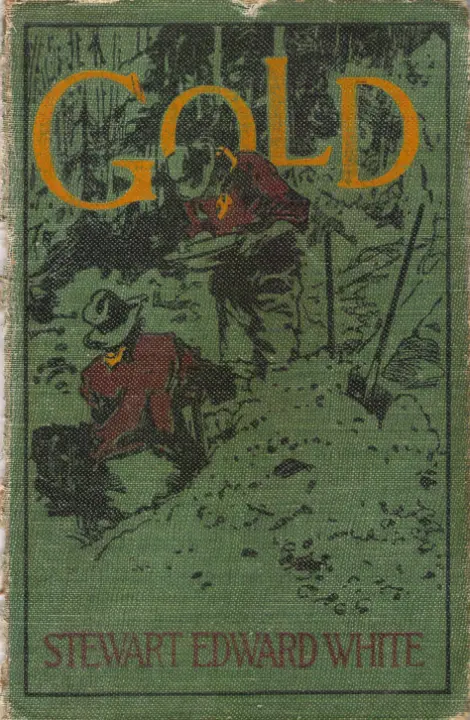
Stewart Edward White
Stewart Edward White
BEHIND THE BOOK
This eBook is for the use of anyone anywhere in the United States and most other parts of the world at no cost and with almost no restrictions whatsoever. You may copy it, give it away or re-use it under the terms of the Project Gutenberg License included with this eBook or online at www.gutenberg.org. If you are not located in the United States, you will have to check the laws of the country where you are located before using this eBook. Read the source licence.
The original source file, including credits and licence, is retained by this library. Request an original-format copy at no charge. Please include the book title and Project Gutenberg identifier #1099.
KEEP YOUR CURIOSITY GOING
Coulson Kernahan

Maurice Baring
Frances Wright
Cécile Tormay

Frederic Jesup Stimson

W. H. P. (William Henry Pope) Jarvis