The Westminster Alice
Saki
THE CLASSIC COLLECTION · 1900
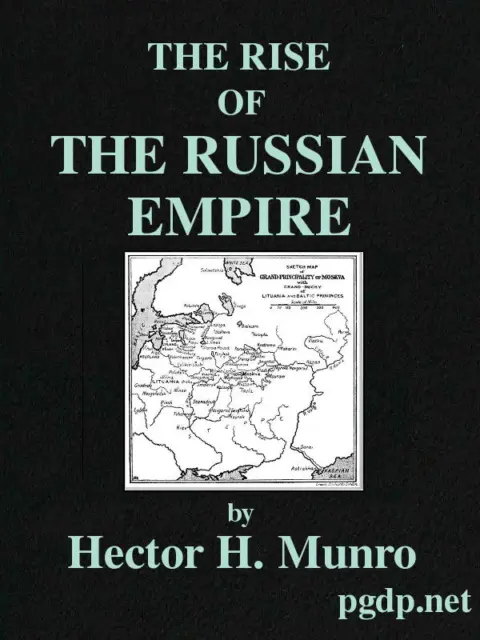
"The Rise of the Russian Empire" by Hector H. Munro is a historical account written in the late 19th century. This work aims to provide a detailed presentation of Russian history, exploring the nation’s evolution from its early beginnings, focusing particularly on the reigns of significant figures like Rurik and Oleg. It seeks to fill the gaps in English-language literature on Russian history, offering insights into the cultural, political, and geographical context of early Russia. The opening of the book introduces the landscape and geographical features of Russia, establishing a foundation for understanding its historical development. It paints a vivid picture of the diverse tribes inhabiting the region and highlights the unique challenges posed by the country's vast geography. As it delves into the early Slavic peoples, the narrative discusses their societal structures and interactions with neighboring tribes. This sets the stage for the arrival of the Varangians, who would significantly influence the formation of the Russian state, marking the beginning of a pivotal era in the nation's history.
Introduction adapted from the source catalogue; source summaries may be automatically generated.
Free to read · English · 115,731 words · No account needed
MAKE TIME FOR A GOOD BOOK
On by default. Untick to stop anonymous reading totals. Each page counts after 10 seconds in view. How this works.
Anonymous counting is on unless you have switched it off.
The next and most important event of an important reign was produced by an outside circumstance. The tidal wave of Islam which had swept over the cradle of the Orthodox faith, had also cut short the sphere of Papal influence, and threatened to make still further inroads on the Catholic lands of South-Eastern Europe. As Venice mourned her damaged trade so Rome sighed over her abbreviated authority and diminished Peter’s Pence. Pope after Pope cast anxious eyes around the sovereigns of Christendom to discover a possible champion against the Turk; but the days of the Crusades were over. One card there remained for the Vatican to play. Brought up in dependence on the Papal Court, and in conformity with the Latin faith, were the heritors of the dead empire; Sophie Paleologus and her two brothers, children of Thomas, brother of the last Emperor, were, body and soul, at the disposal of the Pope (Paul II.). Of the young Princes obviously nothing could be made, but by proclaiming Sophie as heiress of Constantinople a husband might be found for her who would be willing to break a lance with Mahomet for the possession of his wife’s inheritance. Ivan of Moskva, whose remote ancestors had turned their eyes so persistently towards the Tzargrad, seemed a likely candidate for the hand of the orphan exile, and an embassy from Paul sounded the Grand Prince on the subject. Ivan, whose first wife, Mariya of Tver, had died in 1467, lent favourable ear to the suggestion, and matters were satisfactorily arranged between the high contracting parties. The question of religion does not appear to have been raised as an obstacle, either by Paul or Sixtus IV., who succeeded to the Papal throne while the negotiations were proceeding. Whether Ivan’s ambassadors threw dust in the eyes of the Pontiffs, whether the latter hoped to win him, by means of his bride, over to the Latin faith, or whether the driving out of the Turk was for the moment more important than the genesis of the Holy Ghost, it is difficult to determine, but the betrothal was accomplished with the full blessing of the Church. Of Sophie the information available is curiously unequal, detailed on some points, vague to blankness on others. That, according to the chronicles, she charmed all beholders with her presence--a habit common with princesses--must be dispassionately compared with a contemporary Italian account, which likened her to a disgusting mountain of fat. That she left the Eternal City under the wing of the Pope’s legate; that she passed through Viterbo and Sienna; that the council of the latter city voted, by 124 voices to 42, fifty florins to defray the cost of her reception; that she made her way through Bologna and Nürnberg to Lubeck, and thence by sea to Revel; that she was well received at Pskov, and also at Novgorod, at which place the old bell of Yaroslav might yet salute the honoured guest; all this may be gathered from the records of the past.[94] Reared amid the warm and stately cities of Italy, with fond remembrance of the lost glories of Constantinople, there was much that must have seemed strange and wild, perhaps desolate, in the long sledge journey through the unending snow-choked forests towards Moskva; Moskva, which, even in its winter mantle, would compare but meagrely with most of the cities the traveller had passed through. For in those days and at that moment, with its cathedral in ruins, its buildings insignificant, and its limits eked out with meadows and copses, the capital of the grand principality did not make a very brave show.[95] The solemnity of her reception was marred by an awkward incident, which showed that, however the case might be at Rome, inter-Christian bitterness still ruled strong at Moskva. The legate, it was understood, not content with flaunting his scarlet robes in the face of the Orthodox, intended to have the Latin Cross borne before him into the city. Should such things be? Ivan held high counsel with his clergy and boyarins on the subject; the majority were in favour of “shutting their eyes” when the objectionable emblem should make its appearance on the scene, but this ostrich-like expedient did not recommend itself to the Metropolitan Filipp, who declared that if it came in at one gate he should go out at another. Happily the Cardinal showed a more accommodating spirit, and, when the situation had been explained to him by the Prince’s messengers, consented to have the Cross smuggled through in a sledge. This concession smoothed over the difficulty, and the catastrophe of the whole bridal train being kept waiting for days in the snow outside Moskva till one or other of the churchmen gave way, was happily averted.[96] [Sidenote: 1472] From the moment that Sophie Paleologus became mated with Ivan comparatively little is heard of her; her personality is swallowed up in that of the Grand Prince. But the influence of the Greek Princess can be traced in many of the important developments of this reign. Born amid the extravagant ceremonial of the Byzantine Court, and treasuring the memory of those splendid myths and vanities, the more perhaps because they were wholly lost, the exile transplanted to the rugged soil of Moskovy the ideals that had waxed to fantastic growth on the humid shores of the Bosphorus. The Velikie-kniaz of yore, moving freely among his boyarins and subjects, develops gradually into the heaven-born Sovereign, a being removed from contact with the ordinary sons of earth, withdrawn from profane touch into a Holy of Holies of pomp and ceremony. Here again Ivan was manifestly fitted to assist in working out this evolution. His cold-blooded, calculated policy, his pitiless, passionless judgment, his baleful glance, which is said to have caused women to faint, were meet attributes of a majesty that was accounted something more than human.
Your reading position is saved on this browser. Take it to another device with a library code. Reading pages adapt to text, rather than matching a printed edition.
Saki
Saki
Saki
Saki
BEHIND THE BOOK
This eBook is for the use of anyone anywhere in the United States and most other parts of the world at no cost and with almost no restrictions whatsoever. You may copy it, give it away or re-use it under the terms of the Project Gutenberg License included with this eBook or online at www.gutenberg.org. If you are not located in the United States, you will have to check the laws of the country where you are located before using this eBook. Read the source licence.
The original source file, including credits and licence, is retained by this library. Request an original-format copy at no charge. Please include the book title and Project Gutenberg identifier #45099.
KEEP YOUR CURIOSITY GOING
Cécile Tormay

Moritz Busch
John L. Ransom
Frances Wright
Cécile Tormay

Mabel Potter Daggett