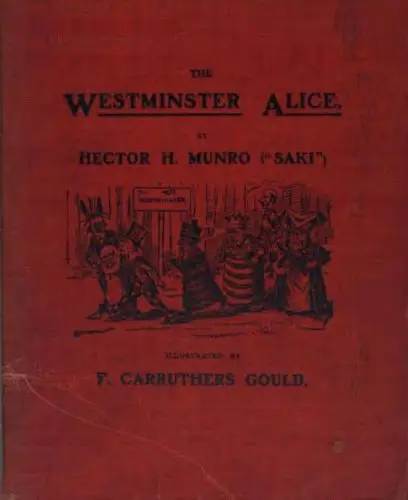
The Westminster Alice
Saki
THE CLASSIC COLLECTION · 1900
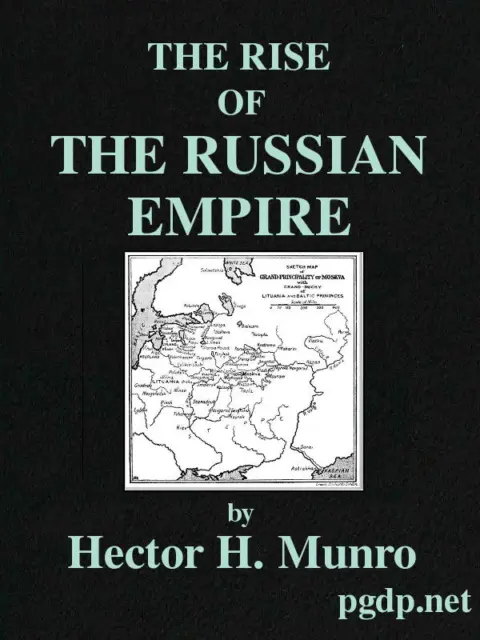
"The Rise of the Russian Empire" by Hector H. Munro is a historical account written in the late 19th century. This work aims to provide a detailed presentation of Russian history, exploring the nation’s evolution from its early beginnings, focusing particularly on the reigns of significant figures like Rurik and Oleg. It seeks to fill the gaps in English-language literature on Russian history, offering insights into the cultural, political, and geographical context of early Russia. The opening of the book introduces the landscape and geographical features of Russia, establishing a foundation for understanding its historical development. It paints a vivid picture of the diverse tribes inhabiting the region and highlights the unique challenges posed by the country's vast geography. As it delves into the early Slavic peoples, the narrative discusses their societal structures and interactions with neighboring tribes. This sets the stage for the arrival of the Varangians, who would significantly influence the formation of the Russian state, marking the beginning of a pivotal era in the nation's history.
Introduction adapted from the source catalogue; source summaries may be automatically generated.
Free to read · English · 115,731 words · No account needed
MAKE TIME FOR A GOOD BOOK
On by default. Untick to stop anonymous reading totals. Each page counts after 10 seconds in view. How this works.
Anonymous counting is on unless you have switched it off.
The late prince had guided the flood of monarchical principles and hereditary right in the desired direction; his successor had to struggle for the greater part of his reign with the back-wash of reaction. Moskva had been placed by persistent effort high above the position of her neighbours, but the elements of discord and disunion lay among her own princes, and it was inevitable that the surviving sons of Dimitri should seek to annul an order of succession which passed them over in favour of a mere boy. Nor had the young Vasili the support of a strong Metropolitan to sustain him in the stormy days that were coming. The Greek Photius who held that office did not exercise in the State the same influence as his forerunners Theognost and Aleksis had done, and even in his own department his authority was not undisputed. For Grand Duke Vitovt, an amateur dabbler in religions, had established at Kiev a Metropolitan of his own, and the faithful in the Russ-Lit’uanian lands paid their homage, and what was worse, their tithes, to this unauthorised rival. Hence Vasili had to depend on the protection of the Horde and the affections of his Moskovite subjects to defend him against the ambition of his uncle Urii. [Sidenote: 1430] The death of his powerful relative, the Lit’uanian Grand Duke, removed another possible supporter, and two years later the young prince had to appeal to the decision of the Khan Makhmet against the pretensions of his rival. By a grovelling affectation of submissiveness Vasili was able to emerge triumphant from the contest, and on his return was solemnly crowned at Moskva--the first coronation of a grand prince that had taken place in that city.[87]
The iarlikh of the Khan possessed, however, none of its old finality, and Vasili had to sustain a civil war against his uncle, and after his death (1434) with his sons, Vasili the Squinting, Dimitri Shemiaka, and Dimitri the Red. Although, apparently, not wanting in courage or energy (both of which deficiencies have been freely attributed to him), he possessed little skill in utilising his resources, and again and again suffered defeat, deposition, and imprisonment. The loyalty of Moskva brought him through many vicissitudes, and the tables were turned more than once upon his hostile relatives. [Sidenote: 1436] Repulsing an attack made upon the capital by Vasili the Squinting, the Grand Prince secured the person of that rebel, and supplemented the defect bestowed by nature by blinding the eyes of his hapless prisoner. The leadership of the disaffected party devolved henceforth upon Shemiaka, who became the implacable enemy of the Grand Prince, and roused for many a long year the fires of discord in the land. Meanwhile the bosom of the Church was heaving with agitation as profound as that which disturbed the State. [Sidenote: 1437] The new Metropolitan, Isidor of Salonika, had scarcely entered into his new duties when he was obliged to set off, by way of Novgorod, Riga, Lubeck, Braunschweig, Nurnberg, and the Tyrol, to attend the great Council which was to be held at Ferrara--subsequently at Florence--to unite the two Christian Churches in one communion. The immediate cause of this drawing together of the Latin and Greek rivals was the danger which was threatening the headquarters of the latter sect at the hands of the Infidel Turk. The Ottoman dynasty, rising upon the ruins of the Seljuk Empire, had slowly but steadily engorged the provinces which made up the dominion of the eastern Cæsars. Asia Minor, Bulgaria, Thessaly, Thrace, had been assimilated one by one, and now there remained but Constantinople, “a head without a body,” to resist the hitherto irresistible invader. Without substantial and speedy aid from Catholic Europe there was little probability that the city could long maintain its defence against the Ottoman armies, and Catholic Europe could not be expected to interest itself in the fate of a community which differed from itself in so many vital points of doctrine. The sole hope for Constantinople lay in the possibility of a reunion with the dominant factor of Christendom. [Sidenote: 1438] This was the motive power which had drawn to the Italian town men from Moskva, Trebizond, and the isles of the Adriatic, to discuss the vexed question of the genesis of the Holy Ghost, the exact degree of bliss and torment allotted to the souls of the departed, whether it was permissible to use leavened bread in the sacrament, and whether Pope or Patriarch should occupy the chiefest seat at feasts. These were the main points which separated the Churches, and on each of them the Greek prelates (Mark of Ephesos excepted) gave way--not that the arguments of the Latins had become suddenly convincing, but the looming vision of the Turk inclined the minds of the Orthodox to surrender. “Ils ne croyaient pas, mais ils craignaient.”
Your reading position is saved on this browser. Take it to another device with a library code. Reading pages adapt to text, rather than matching a printed edition.
Saki
Saki
Saki
Saki
BEHIND THE BOOK
This eBook is for the use of anyone anywhere in the United States and most other parts of the world at no cost and with almost no restrictions whatsoever. You may copy it, give it away or re-use it under the terms of the Project Gutenberg License included with this eBook or online at www.gutenberg.org. If you are not located in the United States, you will have to check the laws of the country where you are located before using this eBook. Read the source licence.
The original source file, including credits and licence, is retained by this library. Request an original-format copy at no charge. Please include the book title and Project Gutenberg identifier #45099.
KEEP YOUR CURIOSITY GOING
Cécile Tormay

Moritz Busch
John L. Ransom
Frances Wright
Cécile Tormay

Mabel Potter Daggett