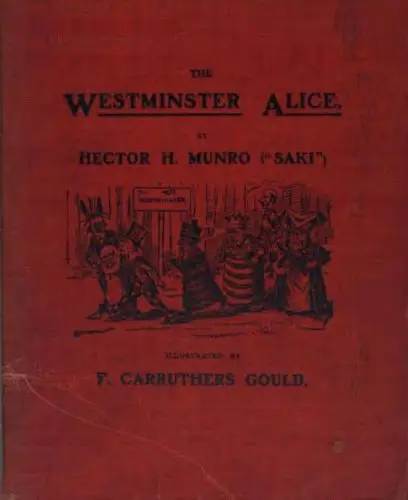
The Westminster Alice
Saki
THE CLASSIC COLLECTION · 1900
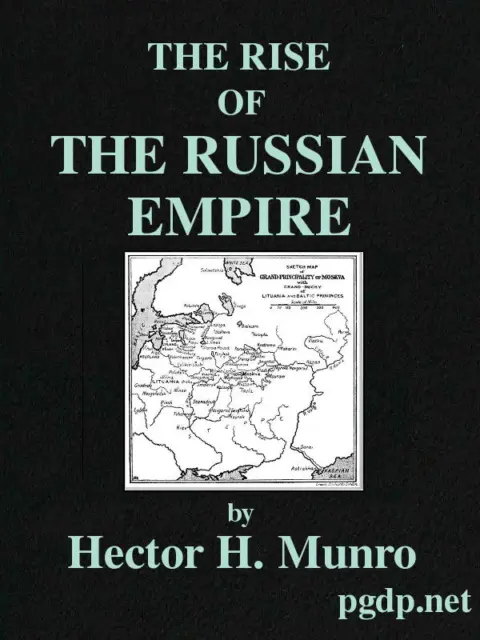
"The Rise of the Russian Empire" by Hector H. Munro is a historical account written in the late 19th century. This work aims to provide a detailed presentation of Russian history, exploring the nation’s evolution from its early beginnings, focusing particularly on the reigns of significant figures like Rurik and Oleg. It seeks to fill the gaps in English-language literature on Russian history, offering insights into the cultural, political, and geographical context of early Russia. The opening of the book introduces the landscape and geographical features of Russia, establishing a foundation for understanding its historical development. It paints a vivid picture of the diverse tribes inhabiting the region and highlights the unique challenges posed by the country's vast geography. As it delves into the early Slavic peoples, the narrative discusses their societal structures and interactions with neighboring tribes. This sets the stage for the arrival of the Varangians, who would significantly influence the formation of the Russian state, marking the beginning of a pivotal era in the nation's history.
Introduction adapted from the source catalogue; source summaries may be automatically generated.
Free to read · English · 115,731 words · No account needed
MAKE TIME FOR A GOOD BOOK
On by default. Untick to stop anonymous reading totals. Each page counts after 10 seconds in view. How this works.
Anonymous counting is on unless you have switched it off.
If Rome swept this valuable State into her fold, the Russian Church, despite the rather depressing circumstance of a confused succession to the Metropolitan office, was not without the triumph of extending her rites over heathen lands. A monk of Moskva carried the light of the Gospel into the lorn and benighted lands of the Permians, a Finn tribe which dwelt in the northern valley of the Kama, beneath the shadow of the Ourals. Supported by the authority of the Grand Prince, he overthrew the worship of the Old Golden Woman, a stone figure with two infants in her arms, before whose shrine reindeer were annually sacrificed; had she been more restricted in her family arrangements she might have been quietly incorporated in the new religion.
In 1389 Moskva mourned her prince, Dimitri Donskoi, who died while yet in his prime. A variant from the type of cold, stern princes who had built up the power of his house, Dimitri was a throw-back to the old light-hearted Slavonic kniaz, before the Norse blood had died out of his veins, or ever that of Turko or Mongol had crept in. And if he gained no fresh ground for Moskva, and left Tver and Souzdal and Riazan still under independent masters, at least he gave Russia a spasm of liberty and renown in an age of gloom and bondage, and obtained for his eldest son the undisputed succession to the Grand Principality.
Vasili Dmitrievitch Moskovskie, to give him his distinguishing title (since 1383 there had reigned a Vasili Dmitrievitch at Souzdal), ascended the throne under more favourable circumstances than had a few years earlier seemed probable. On the west, Vitovt, son of the murdered Kestout, had placed himself at the head of the Lit’uanian malcontents in opposition to the King of Poland, who in cultivating the goodwill of his new subjects had lost that of his old ones. Thus in that direction the threateners of Moskva’s existence were at strife among themselves. In the east Tokhtamitch was contemplating a rebellion against the authority of his lord and protector, Timur, a circumstance which lifted the position of the young Prince of Moskva at the Horde from that of a humble vassal to that of a desired ally. His father would probably have taken advantage of this fact to sever once more his dependence on the Khan; Vasili turned it to a more practical use. [Sidenote: 1391] With costly presents, and probably promises of future support, the Grand Prince bought an iarlikh which gave him possession of Nijhnie-Novgorod, a fief long since granted to Boris of the House of Souzdal.[80] Vasili was received with acclaim by the inhabitants, and Boris, deserted on all sides, had to bow to the decree of fate, represented in this instance by the iarlikh from Sarai. [Sidenote: 1394] On the death of the ousted prince his nephews, Vasili and Simeon of Souzdal, attempted to reunite Nijhnie-Novgorod with their hereditary appanage, with the result that Vasili of Moskva seized on both provinces and drove his cousins into exile. Many and fruitless were the efforts made by the brothers to recover their lost principalities; Vasili had developed a Habsburgian tenacity in holding to whatsoever he acquired, and the ex-princes of Souzdal had in the end to acquiesce in their spoliation. Events in the West meanwhile had taken an unforeseen and not altogether favourable turn. The Teutonic Order had been placed in an awkward position by the wholesale entrance of the Lit’uanians into the bosom of the Church, which event left the crusaders no more heathen to convert; hence the joy which they shared with the angels over the salvation of their long recalcitrant brothers was tinged with resentment towards the Poles, and especially towards Yagiello. The Grand Master sulkily refused to stand sponsor to the latter at his baptism,[81] and the Order prepared, from motives of self-defence, to give active support to the pretender Vitovt, who was enabled with its assistance to continually harry the domains of his royal kinsman, till at length Yagiello, set upon by Catholics, Orthodox, and pagans alike, ceded to him the grand duchy, under the direct suzerainty of the Polish Crown (1392),[82] an arrangement which did not bring repose either to the Order or to Moskovy. The Grand Duke Vitovt was another edition of his uncle and grandfather; his arms swept far beyond the ample limits of his principality, and under his vigorous rule Lit’uania attained her greatest extent, and perhaps her greatest power. Father-in-law to Vasili, he did not hesitate to continue the slow absorption of Russian territory commenced by his predecessors; Smolensk dropped from the feeble hands of its hereditary princes into the actual possession of the Grand Duke, who thus brought his dominions into contact with the principality of Tver, long the hatching-ground of disaffection to the supremacy of Moskva. Vitovt would probably have accomplished even more in the way of conquest and annexation if his ambition had not given too wide a scope to his efforts. While Vasili watched anxiously for the next move of this exciting father-in-law new troubles sprang up in the East; it seemed, indeed, as if Moskva was to reap no advantage from the dissensions of her neighbours. The vengeance of Timur the Lame had at length overtaken his o’erweening vassal, and Tokhtamitch had fled before the storm which his imprudence had raised. The conqueror did not seem disposed to confine his destroying wrath to the actual territories of the Golden Horde, but crossed the Volga and commenced to devastate the easternmost Russian lands. Moskovy quaked before the coming of another Batu; the churches were filled with wailing crowds, and the celebrated Mother-of-God of Vladimir was removed from thence to the capital. [Sidenote: 1395] By a train of reasoning not easy to follow, to this change of quarters was attributed the sudden turning aside of Timur Khan, who diverted his destructive abilities to the razing of Sarai, Astrakhan, and Azov, and left the Russian lands without further hurt. By modern historians this retreat has been set down to other causes than the translation of the Bogoroditza; “accustomed to the rich booty of Bokhara and Hindostan, and dreaming of Constantinople and Egypt, they found, no doubt, that the desert steppes and deep forests only offered a very meagre prey.”[83] However, the credit of the affair remained with the Bogoroditza, and what was more to the point, this respectable and extremely valuable ikon remained at Moskva--no mean asset, for that time and place, in the political importance of a city.
Your reading position is saved on this browser. Take it to another device with a library code. Reading pages adapt to text, rather than matching a printed edition.
Saki
Saki
Saki
Saki
BEHIND THE BOOK
This eBook is for the use of anyone anywhere in the United States and most other parts of the world at no cost and with almost no restrictions whatsoever. You may copy it, give it away or re-use it under the terms of the Project Gutenberg License included with this eBook or online at www.gutenberg.org. If you are not located in the United States, you will have to check the laws of the country where you are located before using this eBook. Read the source licence.
The original source file, including credits and licence, is retained by this library. Request an original-format copy at no charge. Please include the book title and Project Gutenberg identifier #45099.
KEEP YOUR CURIOSITY GOING
Cécile Tormay

Moritz Busch
John L. Ransom
Frances Wright
Cécile Tormay

Mabel Potter Daggett