The Westminster Alice
Saki
THE CLASSIC COLLECTION · 1900
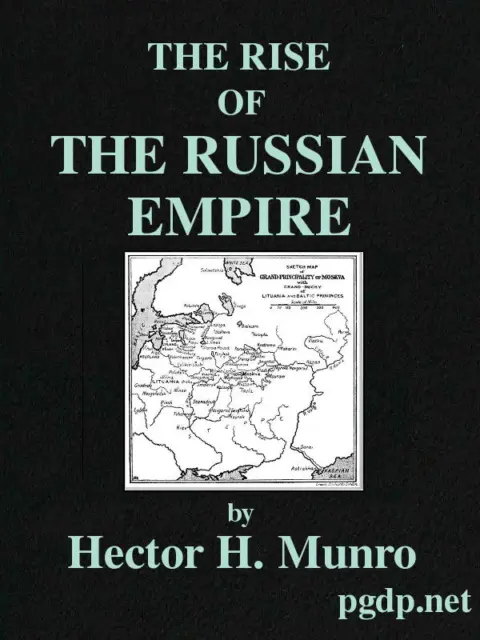
"The Rise of the Russian Empire" by Hector H. Munro is a historical account written in the late 19th century. This work aims to provide a detailed presentation of Russian history, exploring the nation’s evolution from its early beginnings, focusing particularly on the reigns of significant figures like Rurik and Oleg. It seeks to fill the gaps in English-language literature on Russian history, offering insights into the cultural, political, and geographical context of early Russia. The opening of the book introduces the landscape and geographical features of Russia, establishing a foundation for understanding its historical development. It paints a vivid picture of the diverse tribes inhabiting the region and highlights the unique challenges posed by the country's vast geography. As it delves into the early Slavic peoples, the narrative discusses their societal structures and interactions with neighboring tribes. This sets the stage for the arrival of the Varangians, who would significantly influence the formation of the Russian state, marking the beginning of a pivotal era in the nation's history.
Introduction adapted from the source catalogue; source summaries may be automatically generated.
Free to read · English · 115,731 words · No account needed
MAKE TIME FOR A GOOD BOOK
On by default. Untick to stop anonymous reading totals. Each page counts after 10 seconds in view. How this works.
Anonymous counting is on unless you have switched it off.
In the dreary steppe-land of the Gobi desert, south of the Baikal Sea, where flows the Onon, a tributary of the Amur, history first locates the Mongols, in the sixth century, under the name Mongu, possibly derived from the word “mong,” signifying bold, daring. At that period they are indicated as a sub-tribe of the Shi-wei, who dwelt to the north-west of Manchuria, and did not enjoy any considerable importance. This insignificance continued till the accession, in 1175, to the Mongol Khanate, of Temudjin, known later under the world-famous name of Jingis Khan, when the number of his subjects did not exceed 40,000 families. A series of successful wars with the tribes in his immediate neighbourhood paved the way for more ambitious undertakings, and he soon carried his victorious standard, the Tuk with nine yak tails, into the northern empire of China, which was ruled over by the Kin, or Tartar dynasty (South China being separately governed by the Sung dynasty). From this point Jingis carried on campaign after campaign with almost uniform success, till the greater part of Asia grovelled beneath his yoke. Pitilessly cruel, this “cormorant of conquest” marked each fresh advance, whether resisted or unopposed, with wholesale massacres, which, after allowing for Oriental exaggeration, swell to a ghastly total. “From 1211 to 1223, 18,470,000 human beings perished in China and Tangut alone at the hands of Jingis and his followers,”[35] a record which would have turned the early kings of Israel green with envy. The Mongolian policy was to scatter, ruin, and, if possible, exterminate existing civilisations and communities wherever their victorious armies passed.[36] The terror which the Mongol cruelties inspired unnerved their opponents and disinclined nations with whom they were at peace from combining against them, while their hardy desert horses, light equipment, and powers of endurance enabled them to travel enormous distances in all conditions of weather. Powerful empires like those of China and Persia writhed beneath their yoke; lesser states, such as Great Bulgaria and Georgia, were almost wiped out of existence. The conquest of this latter country by a division of the Horde, under the leadership of Chepe and Subatai, two of the Mongol chiefs, was followed by an incursion into the land occupied by the Kumans, or Polovtzi, which brought the destroying hosts on to the verge of the Russian dominion. Southward the flying Kumans were pursued as far as the Krim peninsula, at which point the Mongols first came into contact with Western civilisation, burning Sudak, where the Genoese had a flourishing commercial station. Now were ten ambassadors sent to the alarmed Russian princes, assuring them that they had nothing to fear from the Horde, but warning them against showing any support to the Polovtzi. Fear and resentment made the princes forget the customs of civilisation, and the messengers were put to death, an inauspicious opening for the coming struggle. Having thus defied the gathering storm, the Russians crossed the Dniepr and marched to the banks of the Kalka, where they prepared to meet these new foes from the east, as they had aforetime met the Polovtzi and the Petchenigs before them. But even at this critical moment the princes were not in complete accord; each was jealous of the other, each fought for his own hand. Mstislav of Galitz thought he could win the fight with his own forces and the assistance of the Polovtzi, but the latter were unable to withstand the Mongol onset and broke in wild confusion. The Russians fought well, but they fought apart and without cohesion, and were only united in one overwhelming ruin. The battle of the Kalka, on the 31st May 1224, was a terrible catastrophe in Russian history, and fitly heralded a disastrous epoch in her annals. An army of over 80,000 men was scattered like chaff before the exulting Mongols, and to add to the horror of the flight the treacherous Polovtzi, on behalf of whom the Russians had entered into the quarrel, slew and plundered as they fled. From the fatal banks of the Kalka to those of the Dniepr raced the broken bands of Russians, the laggards falling beneath the lances and sabres of their grim pursuers. Six princes, many boyarins, and thousands of soldiers were numbered among the slain. The young Daniel Romanovitch of Volhynia escaped wounded from the woeful field, while Mstislav of Kiev with two other princes defended themselves for three days in a fortified camp on the bank of the Kalka. Deluded by a false promise of security, they at length fell into the power of the Mongols, who slaughtered the men and smothered the princes under planks, holding wild carousal over their swollen bodies--a scene which recalls the “night of Cannae’s raging field.” Southern Russia lay helpless at the pleasure of these merciless enemies, who ravaged unchecked in the villages and homesteads near the scene of their victory. Then they did a most unexpected thing; they went. Retiring through Great Bulgaria, they vanished as suddenly as they had come; of their arrival and departure might almost be said what was said of their attack on Bokhara: “They came, dug, burnt, killed, robbed, went.” The Russian lands awoke as from a nightmare to find their unwelcome guests had departed.
Your reading position is saved on this browser. Take it to another device with a library code. Reading pages adapt to text, rather than matching a printed edition.
Saki
Saki
Saki
Saki
BEHIND THE BOOK
This eBook is for the use of anyone anywhere in the United States and most other parts of the world at no cost and with almost no restrictions whatsoever. You may copy it, give it away or re-use it under the terms of the Project Gutenberg License included with this eBook or online at www.gutenberg.org. If you are not located in the United States, you will have to check the laws of the country where you are located before using this eBook. Read the source licence.
The original source file, including credits and licence, is retained by this library. Request an original-format copy at no charge. Please include the book title and Project Gutenberg identifier #45099.
KEEP YOUR CURIOSITY GOING
Cécile Tormay

Moritz Busch
John L. Ransom
Frances Wright
Cécile Tormay

Mabel Potter Daggett