The Westminster Alice
Saki
THE CLASSIC COLLECTION · 1900
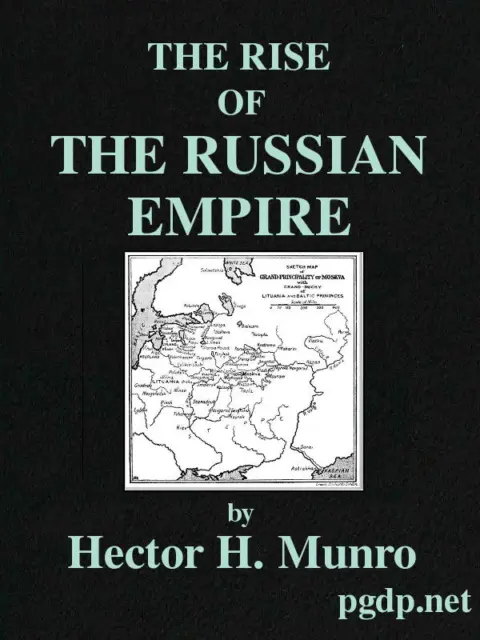
"The Rise of the Russian Empire" by Hector H. Munro is a historical account written in the late 19th century. This work aims to provide a detailed presentation of Russian history, exploring the nation’s evolution from its early beginnings, focusing particularly on the reigns of significant figures like Rurik and Oleg. It seeks to fill the gaps in English-language literature on Russian history, offering insights into the cultural, political, and geographical context of early Russia. The opening of the book introduces the landscape and geographical features of Russia, establishing a foundation for understanding its historical development. It paints a vivid picture of the diverse tribes inhabiting the region and highlights the unique challenges posed by the country's vast geography. As it delves into the early Slavic peoples, the narrative discusses their societal structures and interactions with neighboring tribes. This sets the stage for the arrival of the Varangians, who would significantly influence the formation of the Russian state, marking the beginning of a pivotal era in the nation's history.
Introduction adapted from the source catalogue; source summaries may be automatically generated.
Free to read · English · 115,731 words · No account needed
MAKE TIME FOR A GOOD BOOK
On by default. Untick to stop anonymous reading totals. Each page counts after 10 seconds in view. How this works.
Anonymous counting is on unless you have switched it off.
In other quarters the zeal and activity of the Roman Church brought her into contact with Russian “spheres of influence,” to use a modern term. [Sidenote: 1201] Albrecht, Bishop of the new Livlandish see of Riga, had instituted in that district the Order of the Warriors of Christ, or Sword Brethren, whose mission was to convert the pagan Livlanders by fire, and steel, and thong to the worship of Jesus, and teach them the lesson of peace on earth and goodwill towards men with which His name was associated. As the scope of their endeavours included a temporal as well as a spiritual ascendancy over the lands they were able to conquer, their arms soon clashed with those of Vladimir, Prince of Polotzk, who claimed the over-lordship of Livland. Reinforced by Danish warmen, sent to their assistance by King Waldemar at the instance of the Pope, the knights of the Order were able to hold their own against the Russian kniaz, and the Catholic Church scored another triumph in Europe to make up for her disappointments in Asia Minor.
Vsevolod left to his successors the heritage of a ready-made feud, in which the members of his family took different sides, some supporting Urii, who held Souzdal and Vladimir, others ranging themselves with Konstantin, who kept his grasp on Rostov. After a campaign in which neither side could obtain a decided advantage, the brothers agreed to divide the principality between them, Urii retaining the largest share, which included Vladimir, Souzdal, and Moskva. Another brother, Yaroslav, became in an unlucky hour the choice of the people of Novgorod. In course of time they quarrelled with him, as was their wont. Yaroslav shook the dust of the ungovernable city off his feet, and settled himself down at Torjhok to starve it into submission. Its imports of grain were systematically cut off, supplies of every kind were intercepted, and famine stalked through the streets of Novgorod. Want, in its most fearful form, the starvation of an entire populace, tamed the spirit of the proud citizens. Pine-bark and moss were chewed in place of the bread that could not be bought for money; the bodies of those who died of hunger lined the streets--the dogs at least were fed. What manner of man was this who sat gloating, vampire-like, over the misery of a province which he would neither govern nor renounce? Vainly embassies and petitions were sent by the stricken citizens, who tendered their submission and besought him to take up his rule over them; the spokesmen were cast into prison and the dearth continued. Then like a god from the blue appeared to the famishing and despairing Novgorodskie their erstwhile prince, Mstislav of Toropetz. The bitter cry of their extremity had reached him in Southern Russia and drawn him to their succour. After vainly attempting to bring Yaroslav to reason, Mstislav took up arms against him. The first-named prince could count on the support of Urii, but on the other hand Mstislav had engaged Konstantin on his side, so that the province of Souzdal was drawn, town against town, into this local quarrel. The armies of the two leagues, burning with resentment against each other, met on the plain of Lipetsk. [Sidenote: 1216] After a desperate battle the troops of Rostov, Smolensk, and Novgorod scored a decisive victory and hewed down their scattering foes during an April afternoon with the fierce joy that a triumph in civil warfare inspires. Over 9000 of the vanquished are stated to have fallen in the fight and subsequent slaughter. Four days later the inhabitants of Vladimir, consisting for the most part of women, children, monks, and priests, and men too old to have marched to the war, saw in the gray distance a single horseman making with weary speed for the city--a courier, they fondly imagined, sent to announce their Prince’s victory. The Prince (Urii) himself rode in through the startled crowd, the forlorn herald of the disaster which had overwhelmed his army. The depleted province was in no plight to withstand the victors, and the Grand Principality was practically at the disposal of the upstart Kniaz of Toropetz. Konstantin, by his decree, became Prince of Vladimir-Souzdal, naming Urii, however, to succeed him at his death. Mstislav returned in triumph to Novgorod, where he was hailed with acclamations by the citizens, to whom he had been a friend in need. It was a bitter irony of circumstance that almost the only prince for whom they had had a lasting affection could not find it well to stay with them. Perhaps he was fearful of outstaying his welcome, or wished to secure for himself a more assured possession than the government of the fickle republic, and the foreign encroachments which disturbed Russia on her western marches attracted his adventure-loving spirit to play the rescuer in that direction. In Livland, Volquin von Winterstadt, Grand Master of the Sword Order, was ever seeking to push forward his military outposts; the Lit’uanians, harassed by Catholics on one side and Orthodox neighbours on the other, were drawing closer together in self-defence, and becoming more formidable to Polotzk and Pskov, while Red Russia was a prey to Hungarian domination and Polish interference. It was by invitation of the latter power, in the person of Duke Lesko, that Mstislav undertook to drive the Hungarians out of Galicia, and in consequence bade an affectionate farewell to the people of Novgorod, the tomb of his father, and the Cathedral of S. Sofia.
Your reading position is saved on this browser. Take it to another device with a library code. Reading pages adapt to text, rather than matching a printed edition.
Saki
Saki
Saki
Saki
BEHIND THE BOOK
This eBook is for the use of anyone anywhere in the United States and most other parts of the world at no cost and with almost no restrictions whatsoever. You may copy it, give it away or re-use it under the terms of the Project Gutenberg License included with this eBook or online at www.gutenberg.org. If you are not located in the United States, you will have to check the laws of the country where you are located before using this eBook. Read the source licence.
The original source file, including credits and licence, is retained by this library. Request an original-format copy at no charge. Please include the book title and Project Gutenberg identifier #45099.
KEEP YOUR CURIOSITY GOING
Cécile Tormay

Moritz Busch
John L. Ransom
Frances Wright
Cécile Tormay

Mabel Potter Daggett