The Westminster Alice
Saki
THE CLASSIC COLLECTION · 1900
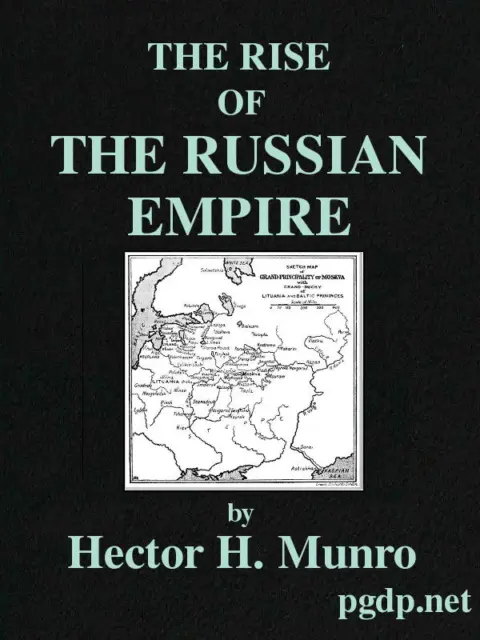
"The Rise of the Russian Empire" by Hector H. Munro is a historical account written in the late 19th century. This work aims to provide a detailed presentation of Russian history, exploring the nation’s evolution from its early beginnings, focusing particularly on the reigns of significant figures like Rurik and Oleg. It seeks to fill the gaps in English-language literature on Russian history, offering insights into the cultural, political, and geographical context of early Russia. The opening of the book introduces the landscape and geographical features of Russia, establishing a foundation for understanding its historical development. It paints a vivid picture of the diverse tribes inhabiting the region and highlights the unique challenges posed by the country's vast geography. As it delves into the early Slavic peoples, the narrative discusses their societal structures and interactions with neighboring tribes. This sets the stage for the arrival of the Varangians, who would significantly influence the formation of the Russian state, marking the beginning of a pivotal era in the nation's history.
Introduction adapted from the source catalogue; source summaries may be automatically generated.
Free to read · English · 115,731 words · No account needed
MAKE TIME FOR A GOOD BOOK
On by default. Untick to stop anonymous reading totals. Each page counts after 10 seconds in view. How this works.
Anonymous counting is on unless you have switched it off.
In no country was the transition from paganism to Christianity effected in so remarkable a manner as in Russia. Vladimir, who had shown much zeal in erecting and ornamenting statues of Peroun at Kiev and Novgorod, grew suddenly dissatisfied with the national worship, without at the same time feeling special attraction towards any substitute. While contemplating a desertion of the old religion he naturally wished to replace it with the most reliable form of faith obtainable, and for this purpose trusty counsellors were sent on a mission of inquiry to Rome, to Constantinople, to the Volga-Bulgarians (who had embraced Islam), and to the Jews--probably those dwelling among the Khazars. When the scattered envoys returned, the result of their investigations was laid before Vladimir, and this young man in search of a religion examined and compared the pretensions of the competing creeds. Circumcision and abstinence from wine put the cult of the Prophet out of court; the first of these objections applied equally to the Jewish doctrine, and the vagabond condition of its votaries offended the monarch’s idea of an established religion. The Romish faith was unacceptable by reason of the claims, which her head was beginning to assert, of supreme dominion in things spiritual and active interference in temporal matters; moreover, her ritual, especially as the Russians may have seen it practised in the infant churches of Bohemia, Poland, and Eastern Germany, was overshadowed and eclipsed by the splendid ceremonial of the Greek Church, particularly in the services of S. Sophia at Constantinople. “The magnificence of the temple, the presence of all the Greek clergy, the richness of the sacerdotal vestments, the ornaments of the altar, the exquisite odour of the incense, the sweet singing of the choirs, the silence of the people, in short, the holy and mysterious majesty of the ceremonies, all struck the Russians with admiration.”[15] The recital of these splendours inclined the Prince to a favourable consideration of the Greek faith, if indeed he had not previously had leanings towards that religion, and the finishing touch was added by an argument which appealed to his family pride. “If the Greek religion had not been the true religion, would your grandmother Olga, the wisest of mortals, have adopted it?” asked the partisans of the new doctrines; and the matter was settled. But Vladimir had a procedure of his own for the delicate process of changing his religion: not as a humble penitent was he going to enter the true Church. For the baptism of a sovereign prince an archbishop was an indispensable requisite, and it did not suit his ideas of dignity to apply for the loan of such a functionary to the Greek Emperors, who would have been only too glad to oblige him in the matter. Vladimir chose rather to capture his archbishop. For this purpose he engaged in one of the most extraordinary expeditions which history has furnished. Setting out from Kiev with a large host, he made his way down the Dniepr and along the Black Sea coast to the ancient town of Kherson, a self-governing dependency of the Eastern Empire. Closely besieging it, he was met with a desperate resistance, and only made himself master of the place by cutting off the springs which supplied it with water. From this position of vantage he sent to the brothers Basil and Constantine, who shared the Greek Imperial throne, a request or demand for the hand of their sister Anne. The circumstances of these princes did not admit of a refusal; the celebrated generals Bardas Sclerus and Phocas were in active revolt against the successors of John Zimisces, and another change of dynasty seemed imminent; consequently Vladimir’s suggested alliance was agreed to on the stipulation that he became a Christian and furnished the Imperial family with some Russian auxiliaries. The Princess Anne was despatched to join her destined husband, who was forthwith baptized by the Archbishop of Kherson in the church of S. Basil, and the marriage ceremony followed. The Prince returned to Kiev with his bride and a strange booty of priests, sacred vessels, and saintly relics, having restored unfortunate Kherson, for which he had no further use, to the Greek Emperors, and sent them the promised succours. By this satisfactory arrangement Basil and Constantine were able to conserve their possession of the Byzantine Empire, while Vladimir on his part “obtained the hand of the princess and the kingdom of heaven.”
Your reading position is saved on this browser. Take it to another device with a library code. Reading pages adapt to text, rather than matching a printed edition.
Saki
Saki
Saki
Saki
BEHIND THE BOOK
This eBook is for the use of anyone anywhere in the United States and most other parts of the world at no cost and with almost no restrictions whatsoever. You may copy it, give it away or re-use it under the terms of the Project Gutenberg License included with this eBook or online at www.gutenberg.org. If you are not located in the United States, you will have to check the laws of the country where you are located before using this eBook. Read the source licence.
The original source file, including credits and licence, is retained by this library. Request an original-format copy at no charge. Please include the book title and Project Gutenberg identifier #45099.
KEEP YOUR CURIOSITY GOING
Cécile Tormay

Moritz Busch
John L. Ransom
Frances Wright
Cécile Tormay

Mabel Potter Daggett