READ · DISCOVER · ENJOYClassic literature · Always free
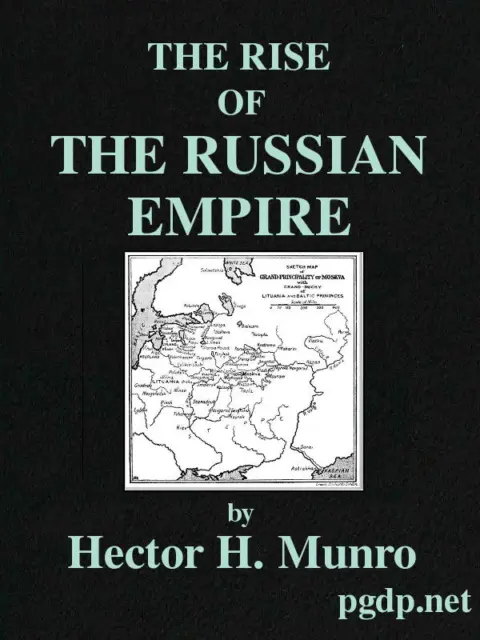
The Rise of the Russian Empire — digital edition cover

THE CLASSIC COLLECTION · 1900

The Rise of the Russian Empire

"The Rise of the Russian Empire" by Hector H. Munro is a historical account written in the late 19th century. This work aims to provide a detailed presentation of Russian history, exploring the nation’s evolution from its early beginnings, focusing particularly on the reigns of significant figures like Rurik and Oleg. It seeks to fill the gaps in English-language literature on Russian history, offering insights into the cultural, political, and geographical context of early Russia. The opening of the book introduces the landscape and geographical features of Russia, establishing a foundation for understanding its historical development. It paints a vivid picture of the diverse tribes inhabiting the region and highlights the unique challenges posed by the country's vast geography. As it delves into the early Slavic peoples, the narrative discusses their societal structures and interactions with neighboring tribes. This sets the stage for the arrival of the Varangians, who would significantly influence the formation of the Russian state, marking the beginning of a pivotal era in the nation's history.

Introduction adapted from the source catalogue; source summaries may be automatically generated.

Start reading ↓

Free to read · English · 115,731 words · No account needed

MAKE TIME FOR A GOOD BOOK

The Rise of the Russian Empire

On by default. Untick to stop anonymous reading totals. Each page counts after 10 seconds in view. How this works.

Anonymous counting is on unless you have switched it off.

The Rise of the Russian Empire

In the following year the centre of interest shifts from the south-east to the south-west. The Greek Emperor, Nicephorus Phocas, irritated against his vassal Peter, King or Tzar of Bulgaria, in that he had not exerted himself against the Magyars, who were raiding the Imperial dominions, turned for help, according to the approved Byzantine policy, to another neighbour, and commissioned Sviatoslav to march against Bulgaria. A large sum of Greek gold was conveyed to Kiev by an ambassador from the Emperor, and in return the Russian Prince set out for the Danube with a following of 60,000 men. The onset of the invaders was irresistible, and the Bulgarians scattered and fled, leaving their capital, Péréyaslavetz, and Dristr, a strongly fortified place on the Danube, in the hands of the conqueror. To complete the good fortune of Sviatoslav the Tzar Peter died at this critical moment, and the Russian Prince settled down in his newly-acquired city, undisputed master of Bulgaria. East and west his arms had been successful, but in the very heart of his realm he had left a dread and watchful enemy, who would not fail to take advantage of his absence. While his army was at quarters in the head city of the Bulgarians, his own capital was being besieged and closely pressed by the Petchenigs, that “greedy people, devouring the bodies of men, corrupt and impure, bloody and cruel beasts,” as the monk of Edessa portrays them; in which certificate it is to be hoped they were over-described. The folk in the beleaguered city, among the rest the aged Olga and the young sons of Sviatoslav, were in straits from want of food, and must have succumbed if one of their number had not made his way by means of a feint through the enemy’s camp, and carried news of their desperate condition to a boyarin named Prititch who was luckily at hand with a small force. On his approach the Petchenigs drew off, thinking that the Prince himself had returned with his army, and Kiev was relieved from the straits of famine. Sviatoslav meanwhile had learned of the danger which threatened his realm and household and hastened back from Bulgaria. Even this narrowly staved-off disaster did not open his eyes to the menace which these undesirable neighbours ever held over him and his, and he contented himself with inflicting a severe defeat on them and concluding a worthless peace. Possibly he found it hard to arouse among his followers any enthusiasm for a campaign against an enemy who had no wealthy cities to plunder or riches of any kind available for spoil. In any case he was bitten with the desire, to which rulers of Russia seem to have been periodically subject, of shifting the seat of his government to a fresh capital. Before his mother and his boyarins he declared his project of fixing his seat at Péréyaslavetz in preference to Kiev, and enumerated the advantages of the former. From the Greeks came gold, fabrics, wine, and fruits; from Bohemia and Hungary horses and silver; from Russia furs, wax, honey, and slaves. To Olga, with the hand of death already on her, the question was not one of great moment, and four days later she had made her last journey to a vault in the cathedral of Kiev. A certain compassion is excited by the contemplation of the aged queen, dying lonely in a faith that her husband had never known, which her son had not accepted, just as the realm over which she had ruled so actively was to be enlarged and its political centre shifted. Her death removed the last obstacle to Sviatoslav’s design, the last that is to say with which he reckoned. Before departing for Bulgaria the Prince set his sons, who could not at this date (970) have been of a very mature age, in responsible positions, Yaropalk, the elder, becoming governor of Kiev, and Oleg prince of the Drevlians. The Novgorodskie, who had been left for many years to the hireling care of Sviatoslav’s deputies, demanded a son of the princely house as ruler, threatening in case of refusal to choose one from elsewhere for themselves; here the stormy spirit of Velikie Novgorod shows itself for the first time. Happily the supply of sons was equal to the demand; by one of Olga’s maidens named Malousha the Prince had become father of Vladimir, destined to play an important part in the history of Russia, and to him, under the guardianship of his mother’s brother Drobuinya, was confided the government of the northern town. Having thus arranged for the present security and future confusion of his territories by instituting the system of separate appanages, Sviatoslav set out for his new possession beyond the Danube. “A prince should, if possible, live in the country he has conquered,” wrote the political codist of mediæval Italy, and the Russian monarch found that even his brief absence had lost him much of the fruits of his victory. The Bulgarians mustered to oppose his march with a large force, and a desperate battle ensued, in which defeat was only staved off from the invaders by the heroic exertions of their leader. Péréyaslavetz was retaken, and Sviatoslav again became master of the Balkan land, permitting, however, Boris, son of the late Tzar, to keep the gold crown, frontlet, and red buskins which were the Bulgarian marks of royalty. The Greeks now repented their folly in having established in their immediate neighbourhood, within a few short marches of Constantinople, a prince who was far more dangerous to them than ever the Bulgarian Tzars had been. John Zimisces, who had succeeded the ill-fated Nicephorus on the precarious throne of the Eastern Empire, called upon Sviatoslav to fulfil the engagement made with his predecessor and evacuate the Imperial dependency. The Prince in possession contemptuously refused to comply with this demand, and threatened instead to march against Constantinople and drive the Greeks into Asia. Fortunately for the Empire at this crisis her new ruler was a soldier of proved ability, and knew also who were the right men to rely on for active support and co-operation. On the other hand Sviatoslav prepared for the coming struggle by enlisting the aid of the Bulgarians themselves, the Magyars, and even roving bodies of Petchenigs. With this mixed force he burst into Thrace, ravaging the country up to the walls of Adrianople, where the Imperial general Bardas-Scleras, brother-in-law of Zimisces, had entrenched himself. Here in the autumn of 970 the fierce bravery of the Russians and their allies was matched against the Greek generalship, with the result that Sviatoslav was forced to retire into Bulgaria. The recall of Bardas to suppress an insurrection in Capadocia prevented him from following up his advantage, and gave the Russians an opportunity for retiring from a position which was no longer safe. Sviatoslav, however, either did not see his danger, or chose to disregard it rather than return home baffled and empty-handed. Accordingly he spent the year 971 in aimless raids into Macedonia, while his wily enemy made the most elaborate preparations for his destruction. In the spring of 972 Zimisces advanced with a large army into Bulgaria, while a Greek fleet blocked the mouths of the Danube, cutting off the Russian line of retreat. Sviatoslav with the bulk of his army was encamped at Dristr, and here tidings came that the Emperor had crossed the Balkans and, after a stubborn resistance, taken Péréyaslavetz--“the Town of Victory”--and possessed himself of the person of Prince Boris. Nothing daunted, Sviatoslav led his army against that of Zimisces, and a battle ensued which, from the heroic valour with which it was contested and the important issues involved, deserves to be recognised as one of the decisive battles of history. Both leaders showed the utmost personal courage, and victory for a long while hung doubtful, but at length the Greek forces prevailed and Sviatoslav was driven back upon Dristr, his last stronghold in Bulgaria. This time the Imperial success was followed up, and the town was attacked with a vigour and determination which was only equalled by the stubbornness of the defence. The Russians made sorties by day, retreating when outnumbered, under the protection of their huge bucklers, to within the walls of the town, from whence they issued at night, to burn by the light of the moon the bodies of their fallen comrades, and sacrifice over their ashes the prisoners they had taken. By way of propitiating their gods, or possibly the Danube, which was covered with the boats of their enemies, they drowned in its waters cocks and little children.[14] The Magister John, a relation of the Emperor, having fallen into their hands in a skirmish, was torn in pieces and his head exposed on the battlements. The besieged, however, were daily reduced in numbers and weakened by want, and Sviatoslav resolved on a last bid for victory. Swarming forth from behind their battered ramparts, the men of the North met their foes in open field, and the wager of battle was staunchly and obstinately contested. Sviatoslav was struck off his horse and nearly killed, but the Russians did not give way until mid-day, when a dust-storm blew into their faces and forced them to yield the fight, leaving outside the walls of Dristr, according to the Byzantine annalists, 15,000 slain. The monkish chroniclers, as usual, attributed the hard-won victory to supernatural intervention, and while the Imperial soldiers were resting from their exertions a story was circulated throughout the camp giving the credit of the day to an apparition of S. Theodore of Stratilat, who had appeared in the thick of the battle mounted on a white horse. The Russian defeat, whether due to saint, army, or dust-storm, was sufficiently decisive to bring the Prince to sue for terms, which were readily granted by the Emperor. The Russians engaged to withdraw from Bulgaria and to live at peace with the Eastern Empire; the Greeks on their part engaged to permit Russian merchants free commercial intercourse at Constantinople. More than this, the Emperor requested the Petchenigs to allow Sviatoslav and his thinned host unmolested passage to his own territories. Whether this was done in good faith, or whether secret instructions were given to the contrary, is a matter of opinion, or at most of induction; it is pleasanter to set against the general treachery of Byzantine statecraft the fact that Zimisces was a brave man, and to give him credit for the honour which is the usual accompaniment of courage.

Your reading position is saved on this browser. Take it to another device with a library code. Reading pages adapt to text, rather than matching a printed edition.

More from this author

BEHIND THE WORDS

About Saki

Saki (1870–1916). Explore The Westminster Alice, The Rise of the Russian Empire, When William Came and other works in this collection. These books span adventure, classic fiction, drama & theatre.

Explore this author’s books →

THE READERS’ VERDICT

How did this story stay with you?

Not rated yet
Your rating for The Rise of the Russian Empire

Be the first to share your verdict.

One rating per browser, which you can change or remove. A necessary browser identifier remembers your vote. How ratings work

A GOOD STORY DESERVES COMPANY

Pass this book along.

A great read is even better when it’s shared.

SEND A LITTLE INSPIRATION

Share this book

BEHIND THE BOOK

Edition & source details.

Title
The Rise of the Russian Empire
Author
Saki
First publication (Open Library catalogue match)
1900
Digital edition publisher
Project Gutenberg
Gutenberg release date
2014-03-09
Language
English
Source edition imprint
Not stated in source catalogue
Source identifier
Project Gutenberg #45099
Contributors
No additional named contributors in source metadata

Public-domain source & licence

This eBook is for the use of anyone anywhere in the United States and most other parts of the world at no cost and with almost no restrictions whatsoever. You may copy it, give it away or re-use it under the terms of the Project Gutenberg License included with this eBook or online at www.gutenberg.org. If you are not located in the United States, you will have to check the laws of the country where you are located before using this eBook. Read the source licence.

Full source licence and obtaining an original copy

The original source file, including credits and licence, is retained by this library. Request an original-format copy at no charge. Please include the book title and Project Gutenberg identifier #45099.

the full Project Gutenberg License must appear
prominently whenever any copy of a Project Gutenberg work (any work
on which the phrase “Project Gutenberg” appears, or with which the
phrase “Project Gutenberg” is associated) is accessed, displayed,
performed, viewed, copied or distributed:

This eBook is for the use of anyone anywhere in the United States and most
other parts of the world at no cost and with almost no restrictions
whatsoever. You may copy it, give it away or re-use it under the terms
of the Project Gutenberg™ License included with this eBook or online
at www.gutenberg.org. If you
are not located in the United States, you will have to check the laws
of the country where you are located before using this eBook.

1.E.2. If an individual Project Gutenberg electronic work is
derived from texts not protected by U.S. copyright law (does not
contain a notice indicating that it is posted with permission of the
copyright holder), the work can be copied and distributed to anyone in
the United States without paying any fees or charges. If you are
redistributing or providing access to a work with the phrase “Project
Gutenberg” associated with or appearing on the work, you must comply
either with the requirements of paragraphs 1.E.1 through 1.E.7 or
obtain permission for the use of the work and the Project Gutenberg
trademark as set forth in paragraphs 1.E.8 or 1.E.9.

1.E.3. If an individual Project Gutenberg electronic work is posted
with the permission of the copyright holder, your use and distribution
must comply with both paragraphs 1.E.1 through 1.E.7 and any
additional terms imposed by the copyright holder. Additional terms
will be linked to the Project Gutenberg License for all works
posted with the permission of the copyright holder found at the
beginning of this work.

1.E.4. Do not unlink or detach or remove the full Project Gutenberg
License terms from this work, or any files containing a part of this
work or any other work associated with Project Gutenberg.

1.E.5. Do not copy, display, perform, distribute or redistribute this
electronic work, or any part of this electronic work, without
prominently displaying the sentence set forth in paragraph 1.E.1 with
active links or immediate access to the full terms of the Project
Gutenberg License.

1.E.6. You may convert to and distribute this work in any binary,
compressed, marked up, nonproprietary or proprietary form, including
any word processing or hypertext form. However, if you provide access
to or distribute copies of a Project Gutenberg work in a format
other than “Plain Vanilla ASCII” or other format used in the official
version posted on the official Project Gutenberg website
(www.gutenberg.org), you must, at no additional cost, fee or expense
to the user, provide a copy, a means of exporting a copy, or a means
of obtaining a copy upon request, of the work in its original “Plain
Vanilla ASCII” or other form. Any alternate format must include the
full Project Gutenberg License as specified in paragraph 1.E.1.

1.E.7. Do not charge a fee for access to, viewing, displaying,
performing, copying or distributing any Project Gutenberg works
unless you comply with paragraph 1.E.8 or 1.E.9.

1.E.8. You may charge a reasonable fee for copies of or providing
access to or distributing Project Gutenberg electronic works
provided that:

• You pay a royalty fee of 20% of the gross profits you derive from
the use of Project Gutenberg works calculated using the method
you already use to calculate your applicable taxes. The fee is owed
to the owner of the Project Gutenberg trademark, but he has
agreed to donate royalties under this paragraph to the Project
Gutenberg Literary Archive Foundation. Royalty payments must be paid
within 60 days following each date on which you prepare (or are
legally required to prepare) your periodic tax returns. Royalty
payments should be clearly marked as such and sent to the Project
Gutenberg Literary Archive Foundation at the address specified in
Section 4, “Information about donations to the Project Gutenberg
Literary Archive Foundation.”

• You provide a full refund of any money paid by a user who notifies
you in writing (or by e-mail) within 30 days of receipt that s/he
does not agree to the terms of the full Project Gutenberg™
License. You must require such a user to return or destroy all
copies of the works possessed in a physical medium and discontinue
all use of and all access to other copies of Project Gutenberg™
works.

• You provide, in accordance with paragraph 1.F.3, a full refund of
any money paid for a work or a replacement copy, if a defect in the
electronic work is discovered and reported to you within 90 days of
receipt of the work.

• You comply with all other terms of this agreement for free
distribution of Project Gutenberg™ works.


1.E.9. If you wish to charge a fee or distribute a Project
Gutenberg™ electronic work or group of works on different terms than
are set forth in this agreement, you must obtain permission in writing
from the Project Gutenberg Literary Archive Foundation, the manager of
the Project Gutenberg™ trademark. Contact the Foundation as set
forth in Section 3 below.

1.F.

1.F.1. Project Gutenberg volunteers and employees expend considerable
effort to identify, do copyright research on, transcribe and proofread
works not protected by U.S. copyright law in creating the Project
Gutenberg™ collection. Despite these efforts, Project Gutenberg™
electronic works, and the medium on which they may be stored, may
contain “Defects,” such as, but not limited to, incomplete, inaccurate
or corrupt data, transcription errors, a copyright or other
intellectual property infringement, a defective or damaged disk or
other medium, a computer virus, or computer codes that damage or
cannot be read by your equipment.

1.F.2. LIMITED WARRANTY, DISCLAIMER OF DAMAGES - Except for the “Right
of Replacement or Refund” described in paragraph 1.F.3, the Project
Gutenberg Literary Archive Foundation, the owner of the Project
Gutenberg™ trademark, and any other party distributing a Project
Gutenberg™ electronic work under this agreement, disclaim all
liability to you for damages, costs and expenses, including legal
fees. YOU AGREE THAT YOU HAVE NO REMEDIES FOR NEGLIGENCE, STRICT
LIABILITY, BREACH OF WARRANTY OR BREACH OF CONTRACT EXCEPT THOSE
PROVIDED IN PARAGRAPH 1.F.3. YOU AGREE THAT THE FOUNDATION, THE
TRADEMARK OWNER, AND ANY DISTRIBUTOR UNDER THIS AGREEMENT WILL NOT BE
LIABLE TO YOU FOR ACTUAL, DIRECT, INDIRECT, CONSEQUENTIAL, PUNITIVE OR
INCIDENTAL DAMAGES EVEN IF YOU GIVE NOTICE OF THE POSSIBILITY OF SUCH
DAMAGE.

1.F.3. LIMITED RIGHT OF REPLACEMENT OR REFUND - If you discover a
defect in this electronic work within 90 days of receiving it, you can
receive a refund of the money (if any) you paid for it by sending a
written explanation to the person you received the work from. If you
received the work on a physical medium, you must return the medium
with your written explanation. The person or entity that provided you
with the defective work may elect to provide a replacement copy in
lieu of a refund. If you received the work electronically, the person
or entity providing it to you may choose to give you a second
opportunity to receive the work electronically in lieu of a refund. If
the second copy is also defective, you may demand a refund in writing
without further opportunities to fix the problem.

1.F.4. Except for the limited right of replacement or refund set forth
in paragraph 1.F.3, this work is provided to you ‘AS-IS’, WITH NO
OTHER WARRANTIES OF ANY KIND, EXPRESS OR IMPLIED, INCLUDING BUT NOT
LIMITED TO WARRANTIES OF MERCHANTABILITY OR FITNESS FOR ANY PURPOSE.

1.F.5. Some states do not allow disclaimers of certain implied
warranties or the exclusion or limitation of certain types of
damages. If any disclaimer or limitation set forth in this agreement
violates the law of the state applicable to this agreement, the
agreement shall be interpreted to make the maximum disclaimer or
limitation permitted by the applicable state law. The invalidity or
unenforceability of any provision of this agreement shall not void the
remaining provisions.

1.F.6. INDEMNITY - You agree to indemnify and hold the Foundation, the
trademark owner, any agent or employee of the Foundation, anyone
providing copies of Project Gutenberg™ electronic works in
accordance with this agreement, and any volunteers associated with the
production, promotion and distribution of Project Gutenberg™
electronic works, harmless from all liability, costs and expenses,
including legal fees, that arise directly or indirectly from any of
the following which you do or cause to occur: (a) distribution of this
or any Project Gutenberg work, (b) alteration, modification, or
additions or deletions to any Project Gutenberg work, and (c) any
Defect you cause.

Section 2. Information about the Mission of Project Gutenberg

Project Gutenberg is synonymous with the free distribution of
electronic works in formats readable by the widest variety of
computers including obsolete, old, middle-aged and new computers. It
exists because of the efforts of hundreds of volunteers and donations
from people in all walks of life.

Volunteers and financial support to provide volunteers with the
assistance they need are critical to reaching Project Gutenberg’s
goals and ensuring that the Project Gutenberg collection will
remain freely available for generations to come. In 2001, the Project
Gutenberg Literary Archive Foundation was created to provide a secure
and permanent future for Project Gutenberg and future
generations. To learn more about the Project Gutenberg Literary
Archive Foundation and how your efforts and donations can help, see
Sections 3 and 4 and the Foundation information page at www.gutenberg.org.

Section 3. Information about the Project Gutenberg Literary Archive Foundation

The Project Gutenberg Literary Archive Foundation is a non-profit
501(c)(3) educational corporation organized under the laws of the
state of Mississippi and granted tax exempt status by the Internal
Revenue Service. The Foundation’s EIN or federal tax identification
number is 64-6221541. Contributions to the Project Gutenberg Literary
Archive Foundation are tax deductible to the full extent permitted by
U.S. federal laws and your state’s laws.

The Foundation’s business office is located at 41 Watchung Plaza #516,
Montclair NJ 07042, USA, +1 (862) 621-9288. Email contact links and up
to date contact information can be found at the Foundation’s website
and official page at www.gutenberg.org/contact

Section 4. Information about Donations to the Project Gutenberg
Literary Archive Foundation

Project Gutenberg™ depends upon and cannot survive without widespread
public support and donations to carry out its mission of
increasing the number of public domain and licensed works that can be
freely distributed in machine-readable form accessible by the widest
array of equipment including outdated equipment. Many small donations
($1 to $5,000) are particularly important to maintaining tax exempt
status with the IRS.

The Foundation is committed to complying with the laws regulating
charities and charitable donations in all 50 states of the United
States. Compliance requirements are not uniform and it takes a
considerable effort, much paperwork and many fees to meet and keep up
with these requirements. We do not solicit donations in locations
where we have not received written confirmation of compliance. To SEND
DONATIONS or determine the status of compliance for any particular state
visit www.gutenberg.org/donate.

While we cannot and do not solicit contributions from states where we
have not met the solicitation requirements, we know of no prohibition
against accepting unsolicited donations from donors in such states who
approach us with offers to donate.

International donations are gratefully accepted, but we cannot make
any statements concerning tax treatment of donations received from
outside the United States. U.S. laws alone swamp our small staff.

Please check the Project Gutenberg web pages for current donation
methods and addresses. Donations are accepted in a number of other
ways including checks, online payments and credit card donations. To
donate, please visit: www.gutenberg.org/donate.

Section 5. General Information About Project Gutenberg electronic works

Professor Michael S. Hart was the originator of the Project
Gutenberg concept of a library of electronic works that could be
freely shared with anyone. For forty years, he produced and
distributed Project Gutenberg eBooks with only a loose network of
volunteer support.

Project Gutenberg eBooks are often created from several printed
editions, all of which are confirmed as not protected by copyright in
the U.S. unless a copyright notice is included. Thus, we do not
necessarily keep eBooks in compliance with any particular paper
edition.

Most people start at our website which has the main PG search
facility: www.gutenberg.org.

This website includes information about Project Gutenberg,
including how to make donations to the Project Gutenberg Literary
Archive Foundation, how to help produce our new eBooks, and how to
subscribe to our email newsletter to hear about new eBooks.


KEEP YOUR CURIOSITY GOING

Your next chapter awaits.

Your privacy choices

Reading is always free. You can change these settings at any time.

Book banners link to our books on simonward.net. They do not use advertising cookies or tracking.

Privacy & cookie policy · Reading data and privacy controls