The Westminster Alice
Saki
THE CLASSIC COLLECTION · 1900
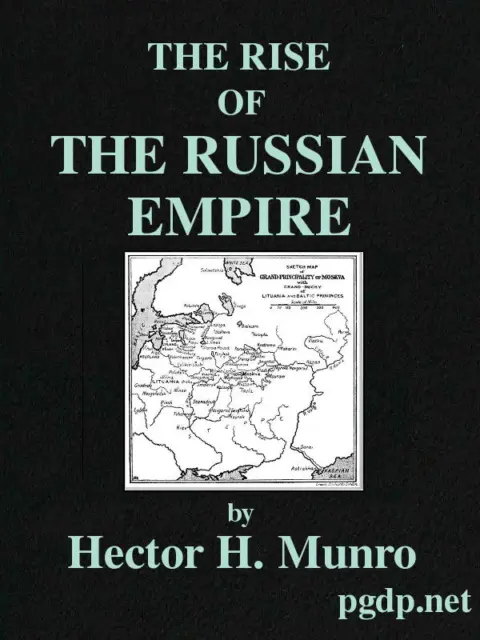
"The Rise of the Russian Empire" by Hector H. Munro is a historical account written in the late 19th century. This work aims to provide a detailed presentation of Russian history, exploring the nation’s evolution from its early beginnings, focusing particularly on the reigns of significant figures like Rurik and Oleg. It seeks to fill the gaps in English-language literature on Russian history, offering insights into the cultural, political, and geographical context of early Russia. The opening of the book introduces the landscape and geographical features of Russia, establishing a foundation for understanding its historical development. It paints a vivid picture of the diverse tribes inhabiting the region and highlights the unique challenges posed by the country's vast geography. As it delves into the early Slavic peoples, the narrative discusses their societal structures and interactions with neighboring tribes. This sets the stage for the arrival of the Varangians, who would significantly influence the formation of the Russian state, marking the beginning of a pivotal era in the nation's history.
Introduction adapted from the source catalogue; source summaries may be automatically generated.
Free to read · English · 115,731 words · No account needed
MAKE TIME FOR A GOOD BOOK
On by default. Untick to stop anonymous reading totals. Each page counts after 10 seconds in view. How this works.
Anonymous counting is on unless you have switched it off.
In long-suffering Moskva murmurs began to be heard against the Poles and against the Jesuits, and hints of armed opposition to Vladislav were wafted about the country. The Patriarch Hermogen, irritated by the sound of Latin chants in the high places of Orthodoxy, sedulously fanned the smouldering spirit of revolt and became so outspoken in his exhortations that he was seized by the Poles in the Cathedral of the Assumption and placed in confinement. Released on Palm Sunday in order to take his place astride an ass in the customary procession, he was soon afterwards sent back to his captivity and displaced from the Patriarchal throne, which was filled by the counter-Patriarch Ignasie; the third, counting Filarete Romanov, who disputed that office. If the State was without a head, the Church enjoyed in that respect a Cerberus-like superfluity. This persecution of their Vladuika did not dispose the people more favourably towards the Poles; Liapounov began to collect troops in the Riazan country, and in the capital an outbreak between the citizens and foreign garrison was only a matter of opportunity. [Sidenote: 1611] In Passion week the tension between the two elements found vent in a massacre, but on this occasion it was the Poles who set on foot the butchery. Mistaking an accidental brawl for a preconcerted rising, the hetman’s troops, including the Germans serving under him, attacked the defenceless inhabitants of the Kreml and Kitai-gorod and slew, by all accounts, some 7000 men. The alarm spread into the Biel-gorod, where the people, under the direction of Kniaz Pojharskie, prepared to resist the foreigners. The streets were hastily barricaded with timber and furniture, and furious fighting went on round the several gates of the Kitai-gorod, while flames broke forth in various quarters. The city was soon a blazing mass, and amid the roar and crash of conflagration the Poles were driven back on all sides into the Kitai-gorod and Kreml. Pojharskie, wounded in the fray, was carried to the Troitza monastery, which became a base of operations for the Russians, who held the Biel-gorod and all the approaches to the city. The situation of the garrison during the Dis-like night which succeeded the furious day has been vividly pictured by the historian of Moskva. “Darkly gazed the Poles from the walls of the Kreml and Kitai-gorod on the burnt ashes of Moskva, awaiting the arming people and listening through the night to the howling of dogs, that gnawed human bones.”[196] For days the city blazed, and within their quarters the foreign soldiery plundered and ransacked the houses of boyarins and merchants. Outside, the Moskvitchi, swarming like burnt-out bees, were reinforced by drafts of Liapounov’s Riazan levies. The arrival of the chief Zaroutzkie with a following of Don Kozaks was a source of weakness rather than strength, and the quarrels of the ill-disciplined children of the steppes with the Riazan troops served to inflame the jealousy existing between their respective leaders. While the wardens of Polish occupation were being hemmed within the walls of the Russian citadel, Sigismund was steadily discharging his cannon against the battered bulwarks of Smolensk. On the 3rd of June a breach was effected and the city won. The voevoda Shein defended himself with a small body of men in a tower, and only surrendered on a promise of the King’s mercy. The mercy of Sigismund Vasa might be likened to the “gentle dew from Heaven” only in the sense of a tendency to rapid evaporation, and neither his sense of honour nor a regard for brave constancy came to the rescue; the man who had held his forces so long at bay was put to the torture and afterwards dispatched in fetters to a Lit’uanian prison. This besmirched victory was celebrated by a triumphant entry into Warszawa, graced by the presence, in the King’s train, of the befrocked and discrowned Tzar, Vasili Shouyskie. According to the Russian historians, who see the trail of Jesuit intrigue throughout the duration of the Troubles, this success of the Poles had the significance of a Papal triumph. “The success of Poland over Russia brought joy to all the Catholic world. In Rome festival succeeded festival.”[197] Rome was thankful for small mercies in those days. The King found it easier to celebrate his victory than to follow it up by any vigorous action against the Russians who were in armed opposition to his son’s pretensions to the throne. The gosoudarstvo at this moment was in a state of bewildering chaos, and nowhere could be seen the elements of re-organisation. Around the Pole-held inner city of Moskva was quartered an army of some 100,000 men, strielitz, dieti-boyarins and their followings, and Don Kozaks, the whole under the separate leadership of three voevodas, Prokope Liapounov, Dimitri Troubetzkoi, and Zaroutzkie. Besides the personal jealousy which existed between the leaders, it was impossible to say what common cause, except the negative one of opposition to Vladislav, brought and held their forces together. There was not even a phantom to set against the claim of the Polish prince. It almost seems as if, like the Germans who nursed the legend that their Red King still slept in his Untersberg and would come forth with all his knights in the hour of his country’s greatest need, the Moskovites persistently hoped that the real Dimitri would at last emerge from his obscurity and give Russia once more an Orthodox sovereign. Beyond the immediate neighbourhood of the capital, confusion and uncertainty were naturally intensified; no town knew whom to acknowledge and could at most only defend itself against the attacks of the plundering bands which swarmed everywhere. The inhabitants of Velikie-Novgorod, in the midst of their indecision, were suddenly startled by the arrival before their gates of a Swedish army under de la Gardie, who demanded their allegiance to Karl, his king. [Sidenote: 1611] The old spirit of the Novgorodskie answered defiance to their old enemies, and the Swedes were held awhile in check; on the night of the 16th July, however, de la Gardie was admitted by treachery into the town, and effected his entrance so stealthily that the citizens first learned of the unexpected stroke by seeing the Swedish guards patrolling the walls. After a faint attempt at resistance the city submitted with as good grace as was possible to the Swedish occupation, and swore fealty to Karl-Filip, the King’s second son, as their sovereign. Meanwhile the army around Moskva showed serious signs of breaking up in confusion. A forged letter, supposed to have been concocted by the Poles, calling upon the Moskovites to destroy the Kozaks and signed with the name of Liapounov, was found in Zaroutzkie’s camp. Despite his denial of the authorship, the enraged Kozaks hewed the voevoda down with their sabres, a deed which increased the ill-feeling and distrust with which the country people and citizens regarded them.
Your reading position is saved on this browser. Take it to another device with a library code. Reading pages adapt to text, rather than matching a printed edition.
Saki
Saki
Saki
Saki
BEHIND THE BOOK
This eBook is for the use of anyone anywhere in the United States and most other parts of the world at no cost and with almost no restrictions whatsoever. You may copy it, give it away or re-use it under the terms of the Project Gutenberg License included with this eBook or online at www.gutenberg.org. If you are not located in the United States, you will have to check the laws of the country where you are located before using this eBook. Read the source licence.
The original source file, including credits and licence, is retained by this library. Request an original-format copy at no charge. Please include the book title and Project Gutenberg identifier #45099.
KEEP YOUR CURIOSITY GOING
Cécile Tormay

Moritz Busch
John L. Ransom
Frances Wright
Cécile Tormay

Mabel Potter Daggett