The Westminster Alice
Saki
THE CLASSIC COLLECTION · 1900
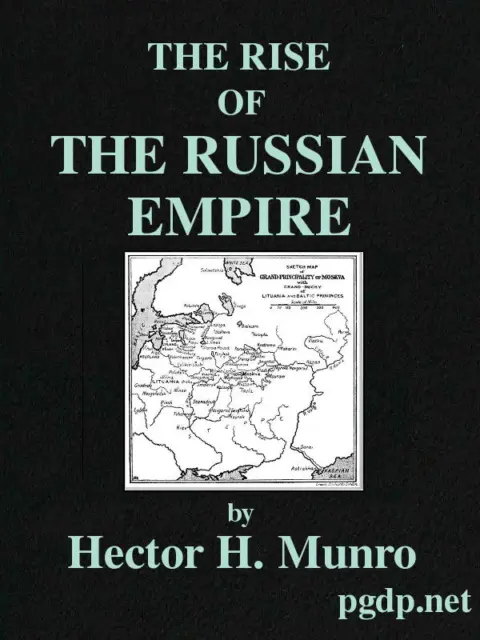
"The Rise of the Russian Empire" by Hector H. Munro is a historical account written in the late 19th century. This work aims to provide a detailed presentation of Russian history, exploring the nation’s evolution from its early beginnings, focusing particularly on the reigns of significant figures like Rurik and Oleg. It seeks to fill the gaps in English-language literature on Russian history, offering insights into the cultural, political, and geographical context of early Russia. The opening of the book introduces the landscape and geographical features of Russia, establishing a foundation for understanding its historical development. It paints a vivid picture of the diverse tribes inhabiting the region and highlights the unique challenges posed by the country's vast geography. As it delves into the early Slavic peoples, the narrative discusses their societal structures and interactions with neighboring tribes. This sets the stage for the arrival of the Varangians, who would significantly influence the formation of the Russian state, marking the beginning of a pivotal era in the nation's history.
Introduction adapted from the source catalogue; source summaries may be automatically generated.
Free to read · English · 115,731 words · No account needed
MAKE TIME FOR A GOOD BOOK
On by default. Untick to stop anonymous reading totals. Each page counts after 10 seconds in view. How this works.
Anonymous counting is on unless you have switched it off.
His first action after his election, before even his coronation had taken place, was one which bespoke alike vigour and calculation. A rumour, possibly not without some foundation, but such as was current at Moskva every summer, credited the Krim Khan with designs for an immediate invasion of Russian territory. Boris did not wait for more exact information, but forthwith assembled from all parts of the gosoudarstvo a splendidly equipped army which was estimated at 500,000 men. This demonstration of potential fighting power and resource not only awed the Khan into good behaviour, but served as a hint to the Swedes and Poles that the new sovereign of Russia, albeit of comparatively humble origin, was not a factor to be despised in the affairs of North-eastern Europe; it fulfilled too another purpose, that of bringing the voevodas, boyarins, Tartar vassals, and Kozak hetmans from distant parts of the realm into immediate contact with their new ruler. The development of the quarrel between Sigismund and his uncle Karl, which gradually became a struggle between Poland and Sweden, freed Moskovy from the danger of attack from either power, and had Boris been able to wholly shake off the cautious traditions of his predecessors and enter into aggressive alliance with one or other of the combatants, Riga or Revel might have fallen into his hands and the coveted eye-hole into Europe have been secured. The Tzar, however, clung too faithfully to the old policy which had borne so little fruit. Nothing but sheer force would move the Swedes out of Estland or the Poles out of Livland, and nothing short of compulsion would make the inhabitants of these provinces receive the Russians as saviours; yet the same blind of a vassal kinglet which had failed disastrously in the case of Magnus was tried again, with a Swedish prince, Gustav (son of the late Erik XIV.), as its figure-head. Gustav created no enthusiasm among the Livlanders--who were not in a position indeed to show any--and ended by inspiring disgust in his patrons at Moskva. It is probable that Boris was merely staying his hand while Poles and Swedes fought out their domestic quarrels, and hoped to profit by the exhaustion which such conflict must necessarily entail by plundering both parties. The opportunity never came. Little by little the sovereign became aware that he was scarcely possessed of the love of the people for whom he had done so much; the clergy were offended at his suggestion of founding a university, the citizens were aggrieved that he introduced skilled foreigners, who were so badly needed to reorganise the sciences and arts of the country, all classes were scandalised because he shaved off his beard. A terrible famine, caused by inclement weather in the spring and summer of 1601, brought out the good qualities of the Tzar, who disbursed immense sums ungrudgingly among the starving poor, and grappled vigorously and with partial success against the prevailing scarcity. The people, however, saw in the calamity only the wrath of God against a prince who had caused sacred blood to be shed; with their eyes strained upwards to the frescoed roofs of their churches they missed the human endeavour and the open-hearted charity which was striving to alleviate their misfortunes. Portents of disaster and bodings of coming trouble succeeded the famine, for the most part of a very understandable nature. Beasts of the chase became scarce in the forests, packs of famished dogs and wolves roamed round the villages, eagles screamed over Moskva, and black foxes were caught about the city, in addition to which, unknown birds and beasts, strange and therefore marvellous, were observed throughout the country. As there had been a general scarcity of vegetation, and as the towns were honeycombed by the hastily-dug graves of those who had died of want--numbering some hundreds of thousands--this sudden invasion of the forest-folk was not inexplicable. It was also said that women and animals gave birth to monsters; certainly about this time rumour gave birth to extraordinary reports, of more disquieting omen than any of the rest, that Dimitri Ivanovitch had survived the evil designs of his would-be murderers and was yet alive. The people who had credited an irritated Deity with exacting hecatombs of victims for the foul death of a Tzarevitch, were equally prone to believe that the Tzarevitch was not dead, and it only remained for the rumour to take concrete shape for Boris’s throne to be seriously imperilled. With the taint of disaffection visible around him, his government began to take a harsher tone. Although never verging upon the savagery of the later Moskovite sovereigns, the clemency of the first years of his reign was laid aside as useless. Bogdan Bielskie, who had earned the hatred of the citizens in the days of the Terrible, now incurred the displeasure of Boris by alleged contumacy; it was said that his beard was plucked piecemeal from his chin by the Tzar’s orders, but beyond this he was only banished to another district more remote than the one he had formerly administered. More thorough was the swoop upon the Romanov family; the five sons of the late member of Thedor’s Douma, Nikita Romanov, stood high in the public esteem, and stood also very near the throne. An elected prince had some cause to fear the competition of such a powerful and popular family, albeit they were not of Rurikovitch blood. The charge which was suddenly brought against them, of a design to remove the sovereign by means of poison, was probably one of those whispered calumnies which bred freely in the half-Asiatic, wholly mediæval atmosphere of Moskva. It was nevertheless a convenient excuse for destroying the influence of this dangerous party; the head of the house, Thedor, was constrained to enter a monastery, where, as the monk Filarete, he seemed safely out of the way. The other brothers underwent more or less rigorous imprisonment (the severities of which were eventually relaxed), while a crowd of allied or sympathetic boyarins were ordered into captivity or received governorships in remote parts of the country. No blood was spilt except incidentally that of serfs and servants, tortured to disclose incriminating information concerning their masters. That the Tzar, who had received his earliest impressions at the Court of Ivan the Terrible, did not act more in the spirit of his times is a circumstance which may stand to his credit, especially when regard is had to the influences which surrounded him. The Moskva of those days was an environment which in itself propagated monstrous and reactionary ideas. Here were to be seen on every hand wretched hovels, “dwelling-places for human beings,” dark suspicion-speaking bazaars, crowded rookeries of cramped caravansaries, wide open spaces, bleak and untenanted, chill and massive boyarin palaces, weird and awesome temples; and in the Kreml itself “violent juxtaposition of the German Gothic style with those of India, of Byzantium, of Italy--the same tangle of edifices, packed one within another like a Chinese puzzle; the same strange wild orgy of decoration, of form, of colour; a delirium and fever, a veritable surfeit of plastic fancy. Small rooms, surbased vaulted roofs, gloomy corridors, lamps twinkling out of the darkness, on the walls the lurid glow of mingled ochres and vermilions, iron bars to every window, armed men at every door; a swarming population of monks and warriors everywhere.”[182] Such was the capital of Russia in the last days of the Rurikovitch dynasty; such it remained throughout the seventeenth century.
Your reading position is saved on this browser. Take it to another device with a library code. Reading pages adapt to text, rather than matching a printed edition.
Saki
Saki
Saki
Saki
BEHIND THE BOOK
This eBook is for the use of anyone anywhere in the United States and most other parts of the world at no cost and with almost no restrictions whatsoever. You may copy it, give it away or re-use it under the terms of the Project Gutenberg License included with this eBook or online at www.gutenberg.org. If you are not located in the United States, you will have to check the laws of the country where you are located before using this eBook. Read the source licence.
The original source file, including credits and licence, is retained by this library. Request an original-format copy at no charge. Please include the book title and Project Gutenberg identifier #45099.
KEEP YOUR CURIOSITY GOING
Cécile Tormay

Moritz Busch
John L. Ransom
Frances Wright
Cécile Tormay

Mabel Potter Daggett