READ · DISCOVER · ENJOYClassic literature · Always free
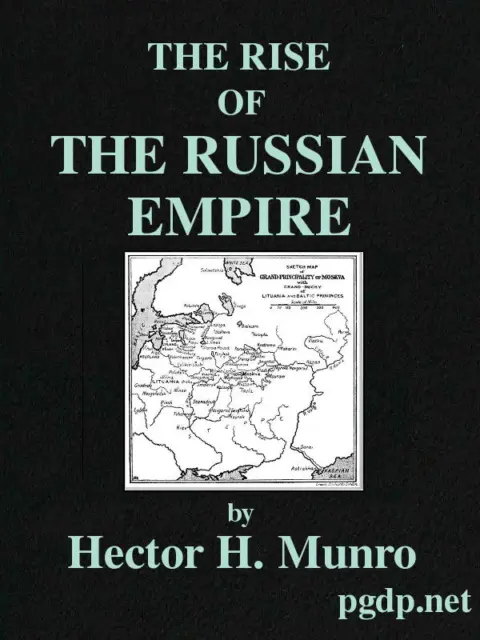
The Rise of the Russian Empire — digital edition cover

THE CLASSIC COLLECTION · 1900

The Rise of the Russian Empire

"The Rise of the Russian Empire" by Hector H. Munro is a historical account written in the late 19th century. This work aims to provide a detailed presentation of Russian history, exploring the nation’s evolution from its early beginnings, focusing particularly on the reigns of significant figures like Rurik and Oleg. It seeks to fill the gaps in English-language literature on Russian history, offering insights into the cultural, political, and geographical context of early Russia. The opening of the book introduces the landscape and geographical features of Russia, establishing a foundation for understanding its historical development. It paints a vivid picture of the diverse tribes inhabiting the region and highlights the unique challenges posed by the country's vast geography. As it delves into the early Slavic peoples, the narrative discusses their societal structures and interactions with neighboring tribes. This sets the stage for the arrival of the Varangians, who would significantly influence the formation of the Russian state, marking the beginning of a pivotal era in the nation's history.

Introduction adapted from the source catalogue; source summaries may be automatically generated.

Start reading ↓

Free to read · English · 115,731 words · No account needed

MAKE TIME FOR A GOOD BOOK

The Rise of the Russian Empire

On by default. Untick to stop anonymous reading totals. Each page counts after 10 seconds in view. How this works.

Anonymous counting is on unless you have switched it off.

The Rise of the Russian Empire

Amid the troubles pressing upon him from without, the sovereign still found time for marrying and giving in marriage. [Sidenote: (1575)] The bride for whose espousal he had obtained the dispensation of the Church had proved sterile, at least she had not increased his family, and she was, like his father’s first wife, dispatched to a convent, while another Anna replaced her; on this occasion the episcopal blessing was not asked for. [Sidenote: 1580] Now, while the flames of disastrous war were blazing over the lands which a century of patient effort had reclaimed from the west, Ivan celebrated at Aleksandrov his nuptials with Mariya, daughter of the boyarin Thedor Nagoi, and those of his second son, Thedor, with Irena, sister of the voevoda Boris Godounov.

The insatiate Stefan continued to employ both pen and sword against his hard-pressed adversary. In a letter rejecting Ivan’s renewed offers of peace, with which he prefaced a new campaign, he taunted the Tzar with his ill-sitting correctitude; “You reproach me with having mutilated the dead; it is false, but certain is it that you torture the living.” Entering thoroughly into the style and spirit of Ivan’s controversial essays, he further recommended him to re-read the fiftieth Psalm in order to acquaint himself with the duty of a Christian. The Tzar had found his match.

[Sidenote: 1581]

As in the two preceding years, the month of August brought with it Batory, thundering his cannon this time against the walls of Pskov. The reputation of the great captain had drawn to him warriors from many lands, and the white-eagle standard flapped in the van of an army, 100,000 strong, mustering in its ranks Poles, Letts, Magyars, Austrians, Kourlanders, Prussians, Lubeckers, Danes, and Scots. The ancient city on the Peipus shore, which for many a stormy hundred years had been a bulwark of the Russian land against the aggressions of the west folk, opposed a heroic resistance to the mighty efforts which were made for its subjection, and the flood of Polish conquest received a timely check. The stupor of fear and helplessness which seemed to have settled down on the Tzar and his voevodas neutralised to a great extent the effect of this stubborn defence; the Swedes captured Habsal, Narva, and other places of less importance in Estland, and later, led by de la Gardie, one of those brilliant soldiers with whom France periodically fascinated the world, penetrated into Russian territory and took Ivangorod, Yam, and Kopor’e. [Sidenote: Jan. 1582] Soon after these disasters Ivan effected a ten years’ truce with Batory, a composition being brought about largely by the diplomatic efforts of Pope Gregory XIII., who was fascinated, as many an astute Pontiff had been, with the prospect of alluring Russia into the Catholic fold. The terms of the truce were ruinously disadvantageous to the gosoudarstvo, and Ivan could scarcely have been forced to sacrifice more if he had staked and lost a series of pitched battles against his foe. Velikie-Louki was restored to him, but Polotzk remained in the hands of the victors, and Livland, snatched piecemeal from the Teutonic knights and contested inch by inch for a quarter of a century, was yielded at one wrench to Poland. The patient and persistent efforts of a long reign, the dogged struggle towards the shores of the Baltic and free intercourse with Western Europe, were relinquished as the price of a temporary and uncertain peace, and the Moskovite Empire was thrown back upon itself, like a conquered Titan thrust down into his chasm. And in another direction Ivan had with his own hand fatally shattered, in a fit of unrestrained passion, the dynastic hopes and strivings which had been advanced and safeguarded with such ruthless severities. Side by side with the gloomy Tzar in his later years, partaker of his amusements and debauches, sharer of his labours of State, had grown up the young Ivan Ivanovitch, designed to carry on the holy line of Moskva when his father should be no more. And in one respect at least he had shown himself an apt pupil; he had already married three wives “without having been a widower.”[171] It was no part of the Moskovite theory of government that the Princes of the Blood should expose their sacred persons in the forefront of their country’s battles, and the young Ivan does not appear to have departed from the prevailing custom of passive aloofness; the humiliations and losses which the Russian State was suffering at the hands of Batory stung the Tzarevitch, however, into a desire to show a bolder front to the oppressor, and he requested his father to let him lead an army to the relief of Pskov, then the centre-point of the Polish attack. A natural and proper request, under the circumstances, but to the suspicion-haunted old Tzar, on that fatal November day, it was the bursting-in of the dreaded summons, “the younger generation knocking at the door.” Wildly he accused his son of desiring to supplant him, wildly struck at him with his terrible iron-tipped staff; Boris Godounov, rushing in to save the Tzarevitch, received most of the blows, but one had crashed upon the youth’s head, which would never now wear the crown of all the Russias. The heavy thuds suddenly ceased and a wail of anguish rang through the silent palace: “Unhappy me, I have killed my son!” The terrified attendants, rushing into the chamber, found the wretched father weeping over the body of the dying Tzarevitch. In one moment of blind fury the primeval ape-instinct had leaped forth and had destroyed the weaving and toiling of a lifetime of specialised effort. Ivan Ivanovitch died a few days later (19th November 1581) from the effects of the blow, and Greek monks at Constantinople, Jerusalem, Antioch, and Alexandria chanted subsidised prayers for the repose of his soul. As in the preceding generation, the next heir (Thedor)[172] was a weakling, and the Tzar’s mad act had opened up the possibility of his throne passing to one of the boyarin families upon whose repression so much savage ingenuity had been expended. The dreary outlook with which the old man was confronted may have largely influenced his supine surrender to Polish demands, and the equally humiliating truce with Sweden, effected a year later, by the terms of which not only Estland, but Narva, Ivangorod, Yam, and Kopor’e were left in the possession of the victors. [Sidenote: 1583] Moskovy was still further shut in from the sea, and the Peipus, which had been a Russian lake, became a natural barrier between three converging monarchies. One ray of success and aggrandisement pierced through the miasma gloom that shrouded the Moskovite land and gathered thickest around the tzarskie palace. In the last quarter of a century which had witnessed the opening up of far scarce-dreamt-of regions by daring European explorers, the century of Cortez and Pizarro, of the bold sea-captains who shed lustre on “the spacious days of great Elizabeth,” the Russian Tzarstvo was swollen by the haphazard conquest of the vast Sibirian “province;” a province which “comprises about a thirteenth part of the globe, and is almost 3,000,000 square miles larger than the whole of Russia in Europe, including both Poland and Finland.”[173] Nor was this huge region of the north, this “land of the long nights,” as the Chinese had called it in the remote past of their history, a barren and unprofitable possession; mines of salt, copper, and silver, forests stocked with valuable fur-bearing animals, and watered by navigable rivers and large fish-yielding lakes, and in some districts tracts of fertile arable land, compensate for the awful desolation which spreads over the greater part of it during the long winter. For many centuries the Russians had tapped at the outer fringe of this unexplored wilderness, and the enterprising folk of Novgorod had brought some of its produce into their markets; the later Grand Princes had put forward claims to a shadowy sovereignty over the principality or khanate of Sibir (a town on the Irtuish), and Ivan himself had kept an eye on this ultima Thule of the Moskovite forests. The Stroganovs, descendants of a merchant family of Tartar extraction who had settled in the oblast of Perm, were granted powers of administration over as much territory as they could reclaim from the tribes on their frontier, and a system of patient pioneering was carried on for some twenty years. The happy idea of utilising the restless military energies of the Don Kozaks, who were a scourge alike to their Tartar and Russian neighbours, in more thoroughly exploiting the Sibirian country, occurred to the administrators of the Moskovite outpost; an invitation was sent to a band of these freebooters, who had made their own country too hot to hold them, to turn their weapons against the “infidels” who were resisting the encroachments of the White-Russian traders. [Sidenote: 1579] The Kozaks, headed by a chief named Ermak, responded readily to an offer which promised them full indulgence of their fighting and marauding instincts, with the additional advantage of official sanction. They were outlaws most of them, and would have been put to lingering deaths if they had strayed into the clutches of Moskva, and the Tzar was highly scandalised at their employment in his service; he showed himself, however, to be of a forgiving disposition when, with a few hundred followers, the intrepid Ermak had conquered for him the vast north-eastern province. [Sidenote: 1581] The Kozak chief, still struggling to hold and extend the territories he had won, received as a mark of Ivan’s approval a cuirass which had once adorned the monarch’s person. As if symbolical of the ruin which so often attended the Tzar’s favour, the present was the contributing cause of Ermak’s destruction; plunging one night into the waters of the Irtuish, to escape from a surprise attack of his enemies, the weight of the armour bore him down, and he sank in the icy flood. Ivan’s reign had opened auspiciously with the conquest of Kazan and Astrakhan; it closed with the acquisition of Sibiria, by which Russia made her first giant stride into Asia.

Your reading position is saved on this browser. Take it to another device with a library code. Reading pages adapt to text, rather than matching a printed edition.

More from this author

BEHIND THE WORDS

About Saki

Saki (1870–1916). Explore The Westminster Alice, The Rise of the Russian Empire, When William Came and other works in this collection. These books span adventure, classic fiction, drama & theatre.

Explore this author’s books →

THE READERS’ VERDICT

How did this story stay with you?

Not rated yet
Your rating for The Rise of the Russian Empire

Be the first to share your verdict.

One rating per browser, which you can change or remove. A necessary browser identifier remembers your vote. How ratings work

A GOOD STORY DESERVES COMPANY

Pass this book along.

A great read is even better when it’s shared.

SEND A LITTLE INSPIRATION

Share this book

BEHIND THE BOOK

Edition & source details.

Title
The Rise of the Russian Empire
Author
Saki
First publication (Open Library catalogue match)
1900
Digital edition publisher
Project Gutenberg
Gutenberg release date
2014-03-09
Language
English
Source edition imprint
Not stated in source catalogue
Source identifier
Project Gutenberg #45099
Contributors
No additional named contributors in source metadata

Public-domain source & licence

This eBook is for the use of anyone anywhere in the United States and most other parts of the world at no cost and with almost no restrictions whatsoever. You may copy it, give it away or re-use it under the terms of the Project Gutenberg License included with this eBook or online at www.gutenberg.org. If you are not located in the United States, you will have to check the laws of the country where you are located before using this eBook. Read the source licence.

Full source licence and obtaining an original copy

The original source file, including credits and licence, is retained by this library. Request an original-format copy at no charge. Please include the book title and Project Gutenberg identifier #45099.

the full Project Gutenberg License must appear
prominently whenever any copy of a Project Gutenberg work (any work
on which the phrase “Project Gutenberg” appears, or with which the
phrase “Project Gutenberg” is associated) is accessed, displayed,
performed, viewed, copied or distributed:

This eBook is for the use of anyone anywhere in the United States and most
other parts of the world at no cost and with almost no restrictions
whatsoever. You may copy it, give it away or re-use it under the terms
of the Project Gutenberg™ License included with this eBook or online
at www.gutenberg.org. If you
are not located in the United States, you will have to check the laws
of the country where you are located before using this eBook.

1.E.2. If an individual Project Gutenberg electronic work is
derived from texts not protected by U.S. copyright law (does not
contain a notice indicating that it is posted with permission of the
copyright holder), the work can be copied and distributed to anyone in
the United States without paying any fees or charges. If you are
redistributing or providing access to a work with the phrase “Project
Gutenberg” associated with or appearing on the work, you must comply
either with the requirements of paragraphs 1.E.1 through 1.E.7 or
obtain permission for the use of the work and the Project Gutenberg
trademark as set forth in paragraphs 1.E.8 or 1.E.9.

1.E.3. If an individual Project Gutenberg electronic work is posted
with the permission of the copyright holder, your use and distribution
must comply with both paragraphs 1.E.1 through 1.E.7 and any
additional terms imposed by the copyright holder. Additional terms
will be linked to the Project Gutenberg License for all works
posted with the permission of the copyright holder found at the
beginning of this work.

1.E.4. Do not unlink or detach or remove the full Project Gutenberg
License terms from this work, or any files containing a part of this
work or any other work associated with Project Gutenberg.

1.E.5. Do not copy, display, perform, distribute or redistribute this
electronic work, or any part of this electronic work, without
prominently displaying the sentence set forth in paragraph 1.E.1 with
active links or immediate access to the full terms of the Project
Gutenberg License.

1.E.6. You may convert to and distribute this work in any binary,
compressed, marked up, nonproprietary or proprietary form, including
any word processing or hypertext form. However, if you provide access
to or distribute copies of a Project Gutenberg work in a format
other than “Plain Vanilla ASCII” or other format used in the official
version posted on the official Project Gutenberg website
(www.gutenberg.org), you must, at no additional cost, fee or expense
to the user, provide a copy, a means of exporting a copy, or a means
of obtaining a copy upon request, of the work in its original “Plain
Vanilla ASCII” or other form. Any alternate format must include the
full Project Gutenberg License as specified in paragraph 1.E.1.

1.E.7. Do not charge a fee for access to, viewing, displaying,
performing, copying or distributing any Project Gutenberg works
unless you comply with paragraph 1.E.8 or 1.E.9.

1.E.8. You may charge a reasonable fee for copies of or providing
access to or distributing Project Gutenberg electronic works
provided that:

• You pay a royalty fee of 20% of the gross profits you derive from
the use of Project Gutenberg works calculated using the method
you already use to calculate your applicable taxes. The fee is owed
to the owner of the Project Gutenberg trademark, but he has
agreed to donate royalties under this paragraph to the Project
Gutenberg Literary Archive Foundation. Royalty payments must be paid
within 60 days following each date on which you prepare (or are
legally required to prepare) your periodic tax returns. Royalty
payments should be clearly marked as such and sent to the Project
Gutenberg Literary Archive Foundation at the address specified in
Section 4, “Information about donations to the Project Gutenberg
Literary Archive Foundation.”

• You provide a full refund of any money paid by a user who notifies
you in writing (or by e-mail) within 30 days of receipt that s/he
does not agree to the terms of the full Project Gutenberg™
License. You must require such a user to return or destroy all
copies of the works possessed in a physical medium and discontinue
all use of and all access to other copies of Project Gutenberg™
works.

• You provide, in accordance with paragraph 1.F.3, a full refund of
any money paid for a work or a replacement copy, if a defect in the
electronic work is discovered and reported to you within 90 days of
receipt of the work.

• You comply with all other terms of this agreement for free
distribution of Project Gutenberg™ works.


1.E.9. If you wish to charge a fee or distribute a Project
Gutenberg™ electronic work or group of works on different terms than
are set forth in this agreement, you must obtain permission in writing
from the Project Gutenberg Literary Archive Foundation, the manager of
the Project Gutenberg™ trademark. Contact the Foundation as set
forth in Section 3 below.

1.F.

1.F.1. Project Gutenberg volunteers and employees expend considerable
effort to identify, do copyright research on, transcribe and proofread
works not protected by U.S. copyright law in creating the Project
Gutenberg™ collection. Despite these efforts, Project Gutenberg™
electronic works, and the medium on which they may be stored, may
contain “Defects,” such as, but not limited to, incomplete, inaccurate
or corrupt data, transcription errors, a copyright or other
intellectual property infringement, a defective or damaged disk or
other medium, a computer virus, or computer codes that damage or
cannot be read by your equipment.

1.F.2. LIMITED WARRANTY, DISCLAIMER OF DAMAGES - Except for the “Right
of Replacement or Refund” described in paragraph 1.F.3, the Project
Gutenberg Literary Archive Foundation, the owner of the Project
Gutenberg™ trademark, and any other party distributing a Project
Gutenberg™ electronic work under this agreement, disclaim all
liability to you for damages, costs and expenses, including legal
fees. YOU AGREE THAT YOU HAVE NO REMEDIES FOR NEGLIGENCE, STRICT
LIABILITY, BREACH OF WARRANTY OR BREACH OF CONTRACT EXCEPT THOSE
PROVIDED IN PARAGRAPH 1.F.3. YOU AGREE THAT THE FOUNDATION, THE
TRADEMARK OWNER, AND ANY DISTRIBUTOR UNDER THIS AGREEMENT WILL NOT BE
LIABLE TO YOU FOR ACTUAL, DIRECT, INDIRECT, CONSEQUENTIAL, PUNITIVE OR
INCIDENTAL DAMAGES EVEN IF YOU GIVE NOTICE OF THE POSSIBILITY OF SUCH
DAMAGE.

1.F.3. LIMITED RIGHT OF REPLACEMENT OR REFUND - If you discover a
defect in this electronic work within 90 days of receiving it, you can
receive a refund of the money (if any) you paid for it by sending a
written explanation to the person you received the work from. If you
received the work on a physical medium, you must return the medium
with your written explanation. The person or entity that provided you
with the defective work may elect to provide a replacement copy in
lieu of a refund. If you received the work electronically, the person
or entity providing it to you may choose to give you a second
opportunity to receive the work electronically in lieu of a refund. If
the second copy is also defective, you may demand a refund in writing
without further opportunities to fix the problem.

1.F.4. Except for the limited right of replacement or refund set forth
in paragraph 1.F.3, this work is provided to you ‘AS-IS’, WITH NO
OTHER WARRANTIES OF ANY KIND, EXPRESS OR IMPLIED, INCLUDING BUT NOT
LIMITED TO WARRANTIES OF MERCHANTABILITY OR FITNESS FOR ANY PURPOSE.

1.F.5. Some states do not allow disclaimers of certain implied
warranties or the exclusion or limitation of certain types of
damages. If any disclaimer or limitation set forth in this agreement
violates the law of the state applicable to this agreement, the
agreement shall be interpreted to make the maximum disclaimer or
limitation permitted by the applicable state law. The invalidity or
unenforceability of any provision of this agreement shall not void the
remaining provisions.

1.F.6. INDEMNITY - You agree to indemnify and hold the Foundation, the
trademark owner, any agent or employee of the Foundation, anyone
providing copies of Project Gutenberg™ electronic works in
accordance with this agreement, and any volunteers associated with the
production, promotion and distribution of Project Gutenberg™
electronic works, harmless from all liability, costs and expenses,
including legal fees, that arise directly or indirectly from any of
the following which you do or cause to occur: (a) distribution of this
or any Project Gutenberg work, (b) alteration, modification, or
additions or deletions to any Project Gutenberg work, and (c) any
Defect you cause.

Section 2. Information about the Mission of Project Gutenberg

Project Gutenberg is synonymous with the free distribution of
electronic works in formats readable by the widest variety of
computers including obsolete, old, middle-aged and new computers. It
exists because of the efforts of hundreds of volunteers and donations
from people in all walks of life.

Volunteers and financial support to provide volunteers with the
assistance they need are critical to reaching Project Gutenberg’s
goals and ensuring that the Project Gutenberg collection will
remain freely available for generations to come. In 2001, the Project
Gutenberg Literary Archive Foundation was created to provide a secure
and permanent future for Project Gutenberg and future
generations. To learn more about the Project Gutenberg Literary
Archive Foundation and how your efforts and donations can help, see
Sections 3 and 4 and the Foundation information page at www.gutenberg.org.

Section 3. Information about the Project Gutenberg Literary Archive Foundation

The Project Gutenberg Literary Archive Foundation is a non-profit
501(c)(3) educational corporation organized under the laws of the
state of Mississippi and granted tax exempt status by the Internal
Revenue Service. The Foundation’s EIN or federal tax identification
number is 64-6221541. Contributions to the Project Gutenberg Literary
Archive Foundation are tax deductible to the full extent permitted by
U.S. federal laws and your state’s laws.

The Foundation’s business office is located at 41 Watchung Plaza #516,
Montclair NJ 07042, USA, +1 (862) 621-9288. Email contact links and up
to date contact information can be found at the Foundation’s website
and official page at www.gutenberg.org/contact

Section 4. Information about Donations to the Project Gutenberg
Literary Archive Foundation

Project Gutenberg™ depends upon and cannot survive without widespread
public support and donations to carry out its mission of
increasing the number of public domain and licensed works that can be
freely distributed in machine-readable form accessible by the widest
array of equipment including outdated equipment. Many small donations
($1 to $5,000) are particularly important to maintaining tax exempt
status with the IRS.

The Foundation is committed to complying with the laws regulating
charities and charitable donations in all 50 states of the United
States. Compliance requirements are not uniform and it takes a
considerable effort, much paperwork and many fees to meet and keep up
with these requirements. We do not solicit donations in locations
where we have not received written confirmation of compliance. To SEND
DONATIONS or determine the status of compliance for any particular state
visit www.gutenberg.org/donate.

While we cannot and do not solicit contributions from states where we
have not met the solicitation requirements, we know of no prohibition
against accepting unsolicited donations from donors in such states who
approach us with offers to donate.

International donations are gratefully accepted, but we cannot make
any statements concerning tax treatment of donations received from
outside the United States. U.S. laws alone swamp our small staff.

Please check the Project Gutenberg web pages for current donation
methods and addresses. Donations are accepted in a number of other
ways including checks, online payments and credit card donations. To
donate, please visit: www.gutenberg.org/donate.

Section 5. General Information About Project Gutenberg electronic works

Professor Michael S. Hart was the originator of the Project
Gutenberg concept of a library of electronic works that could be
freely shared with anyone. For forty years, he produced and
distributed Project Gutenberg eBooks with only a loose network of
volunteer support.

Project Gutenberg eBooks are often created from several printed
editions, all of which are confirmed as not protected by copyright in
the U.S. unless a copyright notice is included. Thus, we do not
necessarily keep eBooks in compliance with any particular paper
edition.

Most people start at our website which has the main PG search
facility: www.gutenberg.org.

This website includes information about Project Gutenberg,
including how to make donations to the Project Gutenberg Literary
Archive Foundation, how to help produce our new eBooks, and how to
subscribe to our email newsletter to hear about new eBooks.


KEEP YOUR CURIOSITY GOING

Your next chapter awaits.

Your privacy choices

Reading is always free. You can change these settings at any time.

Book banners link to our books on simonward.net. They do not use advertising cookies or tracking.

Privacy & cookie policy · Reading data and privacy controls