READ · DISCOVER · ENJOYClassic literature · Always free
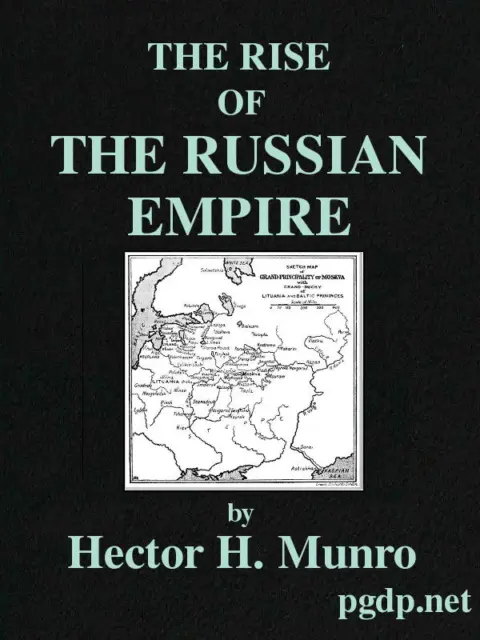
The Rise of the Russian Empire — digital edition cover

THE CLASSIC COLLECTION · 1900

The Rise of the Russian Empire

"The Rise of the Russian Empire" by Hector H. Munro is a historical account written in the late 19th century. This work aims to provide a detailed presentation of Russian history, exploring the nation’s evolution from its early beginnings, focusing particularly on the reigns of significant figures like Rurik and Oleg. It seeks to fill the gaps in English-language literature on Russian history, offering insights into the cultural, political, and geographical context of early Russia. The opening of the book introduces the landscape and geographical features of Russia, establishing a foundation for understanding its historical development. It paints a vivid picture of the diverse tribes inhabiting the region and highlights the unique challenges posed by the country's vast geography. As it delves into the early Slavic peoples, the narrative discusses their societal structures and interactions with neighboring tribes. This sets the stage for the arrival of the Varangians, who would significantly influence the formation of the Russian state, marking the beginning of a pivotal era in the nation's history.

Introduction adapted from the source catalogue; source summaries may be automatically generated.

Start reading ↓

Free to read · English · 115,731 words · No account needed

MAKE TIME FOR A GOOD BOOK

The Rise of the Russian Empire

On by default. Untick to stop anonymous reading totals. Each page counts after 10 seconds in view. How this works.

Anonymous counting is on unless you have switched it off.

The Rise of the Russian Empire

The Tzar’s return to health was accompanied by a return of Moskovite prosperity. Another Tzarevitch, Ivan, replaced the dead Dimitri; Kazan was gradually Kozaked into submission, and received a bishop as a mark of special favour. Another conquest equally important was achieved without bloodshed. The Astrakhanese having insulted the envoys of Moskovy, a small but well-equipped army was sent against them, with the result that this khanate, once the head-country of the redoubtable Golden Horde, acknowledged Ivan’s sovereignty and yielded equal rights in the Volga fishery to his Great Russian subjects. [Sidenote: 1554]The Nogai Tartars, occupying the intermediate steppes, submitted at the same time to the Moskovite dominion, and the Russian state, still cut off from the Black Sea, to which in the tenth century it had given its name,[143] wriggled its way down to the Kaspian.

The acquisition of the two Tartar sovereignties, while giving increased importance and security to Ivan’s dominions, and opening up a valuable trade with Persia and other eastern countries, did not tend to make Moskovy less Asiatic, or bring her closer into the European family. The Tzar’s political ambitions turned naturally towards the west. With a sagacity equal to that of his most celebrated successor, and in opposition to the advice of his counsellors, he wished to find a free outlet for communication with the great Empire-Republic (which, though decaying in organisation, was at this moment so instinct with life), and with Europe generally. The death of Sigismund of Poland (1548) and the accession of his son, Sigismund-August, had scarcely affected the grudgingly pacific relations between the two countries, though their common grievance against the Krim Tartars seemed to warrant the hope of a more cordial understanding. With Sweden the Moskovites waged one of those short inconclusive wars, in which neither party seemed to have any definite object in view, beyond the fact that they “lived unhappily” as neighbours. [Sidenote: 1557] A forty years’ truce concluded the hostilities between these ancient enemies. It was about this time that some adventurous merchant-seamen of the city of London “discovered” Moskovy, by way of the White Sea, and opened up a commercial and diplomatic intercourse between the two isolated nations who were one day to come face to face with each other on the roof of the world. The country, however, towards which Ivan’s thoughts were chiefly turned was the uniquely governed Baltic land, comprising Estland, Livland, and Kourland, and the adjacent islands of Dago and Oesel. The extinction of the Prussian section of the Order had necessarily weakened the Livlandish branch, and the spread of Lutheran ideas had further added to the confusion which reigned throughout the Baltic burghs. Nowhere, perhaps, in Europe did bishops wield such extensive temporal powers, and the fact that local opinion ran strongly in the direction of the reformed principles and of secularisation made the immediate future of these districts a very open question. Ivan had a solution of the difficulty which he was not loth to put into practice. A grievance he undoubtedly had against the Livlanders, who had hindered his intercourse with the Hansa League and prevented free immigration of artificers and craftsmen from the Empire into Russia. Consequently he suddenly bethought him of the clause in the original truce with von Plettenberg, whereby an annual tribute from the town of Dorpat had been agreed to, and promptly lost sight of. The Tzar reminded the Livlandish envoys of this unremembered pledge, and refused to renew the truce until the arrears had been paid in full. [Sidenote: 1557] The representatives of the Land-Master and the sovereign bishops argued and promised, but they did not pay, and Ivan prepared for war. Von Fürstenberg vainly endeavoured to rouse his subordinates and coadjutors to a sense of the coming danger. The Bishop of Dorpat hastily declined the offer of a few companies of lanzknechts, whose loosely disciplined habits he well remembered; he had forgotten the Russians. [Sidenote: 1558] In January three divisions of Moskovite, Tartar, and Tcherkess troops, under the command of a Glinski, a Romanov, and an erstwhile Khan of Kazan, rode into the Order territory and wasted Livland and Estland to within four miles of Revel.[144] The outskirts of Dorpat were burnt, and the invaders returned from this preliminary winter campaign with a heavy spoil of cannons, church bells, treasure, and captives. A contemporary account accuses the Tartars of fiendish cruelties upon the hapless inhabitants who fell into their clutches; among other fantastically devised tortures, men were fastened on to the ground, holes punctured into their sides, and gunpowder poured therein, which being ignited, sent the victims into shreds.[145] Ivan’s object in sending war and desolation careering through the land was to bring the various factors which composed its government into subjection to his authority, as the Prussian State had been brought under the sovereignty of Poland. The Livlanders still imagined that peace might be bought, and at a Landtag held at Wolmar in March it was resolved to send envoys to the Tzar with an offer of 60,000 thalers. Ivan refused to receive the ambassadors, and the chances of reconciliation were still further lessened by an outbreak of hostilities between the opposing fortresses of Narva and Ivangorod, the former of which was captured by the Russians. The war recommenced with renewed vigour on the part of the invaders; the defending forces were too hopelessly disorganised to offer an effective resistance to the Moskovite attack. Churchmen and Ordermen, nobles and burghers, blamed each other mutually, and the luckless peasantry (who since their conversion to Christianity by the Sword Brethren had scarcely been surfeited with the peace and goodwill which had been officially promised them) suffered at the hands of all. Dorpat, Neuhausen, Ringen, and many other strongholds fell before the assaults of the Moskovites, and Ivan’s troops extended their ravages into Kourland. But meanwhile significant events had been taking place at the headquarters of the Order. Von Fürstenberg had resigned his office to a younger man, Gotthard Kettler, and this new chief had inaugurated vigorous measures whereby to save, if possible, some fragment from the ruin of the rapidly dissolving anachronism which had held together for over 300 years. The Kings of Poland, Sweden, and Denmark were appealed to for assistance, and a more spirited opposition was shown to the Tzar’s voevodas. A half-hearted irruption of the Krim Khan, Devlet Girei, into Moskovite territory towards the close of the year did not materially weaken Ivan’s grip upon the struggling provinces, but in the following May, through the mediation of the new King of Denmark (Frederick II.), an armistice of six months was granted to the distressed Livlanders. [Sidenote: 1559] Kettler, the Archbishop of Riga (Wilhelm Hohenzollern), and the various representatives of the Order, the cathedral lands, and the cities sought to turn this respite to good account. Like vultures swooping down from an empty sky, the agents of the neighbouring northern powers appeared suddenly on the scene now that they understood that the Baltic Bund really meant dying. The Empire, torn and exhausted by the religious warfare which had attended the progress of the Reformation, was unable to take effective part in the obsequies of its detached colony. Other interested waiters upon Providence, however, there were in plenty. Magnus of Holstein, brother of the King of Denmark, was elected successor to Johann Munchausen, Bishop of Oesel and Wiek, who was willing, for a substantial recompense, to evacuate a bishopric which had become neither Catholic nor safe. Revel and the Estlandish barons turned their eyes Swedenward, while in September an alliance was formed between Poland and the expiring Order, which showed in which direction Kourland and Livland were likely to fall. The truce came abruptly to an end in the midst of all these schemings, and the Order knights fought their last campaign amid depressing circumstances. The strongly fortified town of Fellin, in which ex-Master von Fürstenberg had entrenched himself, was captured--or bought--by the Moskovite voevoda Kourbski, and another disaster overtook the Cross warriors at Ermes, where a whole detachment was surrounded by an overpowering force of the enemy and all who were not slain taken as prisoners to Moskva. The Tzar who had wept over the dead Kazanese did not on this occasion permit his triumph to soften his feelings towards the wretched captives, who were flogged through the streets of the capital with whips of wire and then beheaded.[146] Hatred and fear of the Tartar-tinged and autocratic Moskovite sovereignty, heightened by acts such as this, drove the Baltic folk more speedily into the arms of the various foreign powers who were able and willing to absorb them. Oesel had already come under Danish influence; in June 1561 Erik XIV. of Sweden (who had succeeded Gustavus Vasa the preceding September) took Estland formally under his protection. Sigismund-August completed the partition by taking over from the Order Kourland and as much of Livland as was not in the hands of the Russians. [Sidenote: Mar. 1562] The former province was erected into a hereditary duchy dependent on the Polish crown, and bestowed upon the ci-devant Master, Gotthard Kettler, who was transformed into Duke of Kourland; the ecclesiastical lands of the Kourlandish bishopric of Pilten, however, “went with” the territory of Oesel, which also comprised the church-lands of Wiek in Estland. Riga remained for the present a free city, depending more or less upon Poland, and the archbishopric was extinguished on the death of its last prelate, Wilhelm Hohenzollern, in 1563.[147] Thus passed away in violent dissolution the strange anomalous time-honoured Baltic Bund, that missionary outpost of western Christianity and civilisation, which had crammed its commerce and its Christ swordwise down the throats of the Liv tribes, had led an existence of intermittent strife with its neighbours and within itself, and dying, left a legacy of two hundred years’ warfare behind it.

Your reading position is saved on this browser. Take it to another device with a library code. Reading pages adapt to text, rather than matching a printed edition.

More from this author

BEHIND THE WORDS

About Saki

Saki (1870–1916). Explore The Westminster Alice, The Rise of the Russian Empire, When William Came and other works in this collection. These books span adventure, classic fiction, drama & theatre.

Explore this author’s books →

THE READERS’ VERDICT

How did this story stay with you?

Not rated yet
Your rating for The Rise of the Russian Empire

Be the first to share your verdict.

One rating per browser, which you can change or remove. A necessary browser identifier remembers your vote. How ratings work

A GOOD STORY DESERVES COMPANY

Pass this book along.

A great read is even better when it’s shared.

SEND A LITTLE INSPIRATION

Share this book

BEHIND THE BOOK

Edition & source details.

Title
The Rise of the Russian Empire
Author
Saki
First publication (Open Library catalogue match)
1900
Digital edition publisher
Project Gutenberg
Gutenberg release date
2014-03-09
Language
English
Source edition imprint
Not stated in source catalogue
Source identifier
Project Gutenberg #45099
Contributors
No additional named contributors in source metadata

Public-domain source & licence

This eBook is for the use of anyone anywhere in the United States and most other parts of the world at no cost and with almost no restrictions whatsoever. You may copy it, give it away or re-use it under the terms of the Project Gutenberg License included with this eBook or online at www.gutenberg.org. If you are not located in the United States, you will have to check the laws of the country where you are located before using this eBook. Read the source licence.

Full source licence and obtaining an original copy

The original source file, including credits and licence, is retained by this library. Request an original-format copy at no charge. Please include the book title and Project Gutenberg identifier #45099.

the full Project Gutenberg License must appear
prominently whenever any copy of a Project Gutenberg work (any work
on which the phrase “Project Gutenberg” appears, or with which the
phrase “Project Gutenberg” is associated) is accessed, displayed,
performed, viewed, copied or distributed:

This eBook is for the use of anyone anywhere in the United States and most
other parts of the world at no cost and with almost no restrictions
whatsoever. You may copy it, give it away or re-use it under the terms
of the Project Gutenberg™ License included with this eBook or online
at www.gutenberg.org. If you
are not located in the United States, you will have to check the laws
of the country where you are located before using this eBook.

1.E.2. If an individual Project Gutenberg electronic work is
derived from texts not protected by U.S. copyright law (does not
contain a notice indicating that it is posted with permission of the
copyright holder), the work can be copied and distributed to anyone in
the United States without paying any fees or charges. If you are
redistributing or providing access to a work with the phrase “Project
Gutenberg” associated with or appearing on the work, you must comply
either with the requirements of paragraphs 1.E.1 through 1.E.7 or
obtain permission for the use of the work and the Project Gutenberg
trademark as set forth in paragraphs 1.E.8 or 1.E.9.

1.E.3. If an individual Project Gutenberg electronic work is posted
with the permission of the copyright holder, your use and distribution
must comply with both paragraphs 1.E.1 through 1.E.7 and any
additional terms imposed by the copyright holder. Additional terms
will be linked to the Project Gutenberg License for all works
posted with the permission of the copyright holder found at the
beginning of this work.

1.E.4. Do not unlink or detach or remove the full Project Gutenberg
License terms from this work, or any files containing a part of this
work or any other work associated with Project Gutenberg.

1.E.5. Do not copy, display, perform, distribute or redistribute this
electronic work, or any part of this electronic work, without
prominently displaying the sentence set forth in paragraph 1.E.1 with
active links or immediate access to the full terms of the Project
Gutenberg License.

1.E.6. You may convert to and distribute this work in any binary,
compressed, marked up, nonproprietary or proprietary form, including
any word processing or hypertext form. However, if you provide access
to or distribute copies of a Project Gutenberg work in a format
other than “Plain Vanilla ASCII” or other format used in the official
version posted on the official Project Gutenberg website
(www.gutenberg.org), you must, at no additional cost, fee or expense
to the user, provide a copy, a means of exporting a copy, or a means
of obtaining a copy upon request, of the work in its original “Plain
Vanilla ASCII” or other form. Any alternate format must include the
full Project Gutenberg License as specified in paragraph 1.E.1.

1.E.7. Do not charge a fee for access to, viewing, displaying,
performing, copying or distributing any Project Gutenberg works
unless you comply with paragraph 1.E.8 or 1.E.9.

1.E.8. You may charge a reasonable fee for copies of or providing
access to or distributing Project Gutenberg electronic works
provided that:

• You pay a royalty fee of 20% of the gross profits you derive from
the use of Project Gutenberg works calculated using the method
you already use to calculate your applicable taxes. The fee is owed
to the owner of the Project Gutenberg trademark, but he has
agreed to donate royalties under this paragraph to the Project
Gutenberg Literary Archive Foundation. Royalty payments must be paid
within 60 days following each date on which you prepare (or are
legally required to prepare) your periodic tax returns. Royalty
payments should be clearly marked as such and sent to the Project
Gutenberg Literary Archive Foundation at the address specified in
Section 4, “Information about donations to the Project Gutenberg
Literary Archive Foundation.”

• You provide a full refund of any money paid by a user who notifies
you in writing (or by e-mail) within 30 days of receipt that s/he
does not agree to the terms of the full Project Gutenberg™
License. You must require such a user to return or destroy all
copies of the works possessed in a physical medium and discontinue
all use of and all access to other copies of Project Gutenberg™
works.

• You provide, in accordance with paragraph 1.F.3, a full refund of
any money paid for a work or a replacement copy, if a defect in the
electronic work is discovered and reported to you within 90 days of
receipt of the work.

• You comply with all other terms of this agreement for free
distribution of Project Gutenberg™ works.


1.E.9. If you wish to charge a fee or distribute a Project
Gutenberg™ electronic work or group of works on different terms than
are set forth in this agreement, you must obtain permission in writing
from the Project Gutenberg Literary Archive Foundation, the manager of
the Project Gutenberg™ trademark. Contact the Foundation as set
forth in Section 3 below.

1.F.

1.F.1. Project Gutenberg volunteers and employees expend considerable
effort to identify, do copyright research on, transcribe and proofread
works not protected by U.S. copyright law in creating the Project
Gutenberg™ collection. Despite these efforts, Project Gutenberg™
electronic works, and the medium on which they may be stored, may
contain “Defects,” such as, but not limited to, incomplete, inaccurate
or corrupt data, transcription errors, a copyright or other
intellectual property infringement, a defective or damaged disk or
other medium, a computer virus, or computer codes that damage or
cannot be read by your equipment.

1.F.2. LIMITED WARRANTY, DISCLAIMER OF DAMAGES - Except for the “Right
of Replacement or Refund” described in paragraph 1.F.3, the Project
Gutenberg Literary Archive Foundation, the owner of the Project
Gutenberg™ trademark, and any other party distributing a Project
Gutenberg™ electronic work under this agreement, disclaim all
liability to you for damages, costs and expenses, including legal
fees. YOU AGREE THAT YOU HAVE NO REMEDIES FOR NEGLIGENCE, STRICT
LIABILITY, BREACH OF WARRANTY OR BREACH OF CONTRACT EXCEPT THOSE
PROVIDED IN PARAGRAPH 1.F.3. YOU AGREE THAT THE FOUNDATION, THE
TRADEMARK OWNER, AND ANY DISTRIBUTOR UNDER THIS AGREEMENT WILL NOT BE
LIABLE TO YOU FOR ACTUAL, DIRECT, INDIRECT, CONSEQUENTIAL, PUNITIVE OR
INCIDENTAL DAMAGES EVEN IF YOU GIVE NOTICE OF THE POSSIBILITY OF SUCH
DAMAGE.

1.F.3. LIMITED RIGHT OF REPLACEMENT OR REFUND - If you discover a
defect in this electronic work within 90 days of receiving it, you can
receive a refund of the money (if any) you paid for it by sending a
written explanation to the person you received the work from. If you
received the work on a physical medium, you must return the medium
with your written explanation. The person or entity that provided you
with the defective work may elect to provide a replacement copy in
lieu of a refund. If you received the work electronically, the person
or entity providing it to you may choose to give you a second
opportunity to receive the work electronically in lieu of a refund. If
the second copy is also defective, you may demand a refund in writing
without further opportunities to fix the problem.

1.F.4. Except for the limited right of replacement or refund set forth
in paragraph 1.F.3, this work is provided to you ‘AS-IS’, WITH NO
OTHER WARRANTIES OF ANY KIND, EXPRESS OR IMPLIED, INCLUDING BUT NOT
LIMITED TO WARRANTIES OF MERCHANTABILITY OR FITNESS FOR ANY PURPOSE.

1.F.5. Some states do not allow disclaimers of certain implied
warranties or the exclusion or limitation of certain types of
damages. If any disclaimer or limitation set forth in this agreement
violates the law of the state applicable to this agreement, the
agreement shall be interpreted to make the maximum disclaimer or
limitation permitted by the applicable state law. The invalidity or
unenforceability of any provision of this agreement shall not void the
remaining provisions.

1.F.6. INDEMNITY - You agree to indemnify and hold the Foundation, the
trademark owner, any agent or employee of the Foundation, anyone
providing copies of Project Gutenberg™ electronic works in
accordance with this agreement, and any volunteers associated with the
production, promotion and distribution of Project Gutenberg™
electronic works, harmless from all liability, costs and expenses,
including legal fees, that arise directly or indirectly from any of
the following which you do or cause to occur: (a) distribution of this
or any Project Gutenberg work, (b) alteration, modification, or
additions or deletions to any Project Gutenberg work, and (c) any
Defect you cause.

Section 2. Information about the Mission of Project Gutenberg

Project Gutenberg is synonymous with the free distribution of
electronic works in formats readable by the widest variety of
computers including obsolete, old, middle-aged and new computers. It
exists because of the efforts of hundreds of volunteers and donations
from people in all walks of life.

Volunteers and financial support to provide volunteers with the
assistance they need are critical to reaching Project Gutenberg’s
goals and ensuring that the Project Gutenberg collection will
remain freely available for generations to come. In 2001, the Project
Gutenberg Literary Archive Foundation was created to provide a secure
and permanent future for Project Gutenberg and future
generations. To learn more about the Project Gutenberg Literary
Archive Foundation and how your efforts and donations can help, see
Sections 3 and 4 and the Foundation information page at www.gutenberg.org.

Section 3. Information about the Project Gutenberg Literary Archive Foundation

The Project Gutenberg Literary Archive Foundation is a non-profit
501(c)(3) educational corporation organized under the laws of the
state of Mississippi and granted tax exempt status by the Internal
Revenue Service. The Foundation’s EIN or federal tax identification
number is 64-6221541. Contributions to the Project Gutenberg Literary
Archive Foundation are tax deductible to the full extent permitted by
U.S. federal laws and your state’s laws.

The Foundation’s business office is located at 41 Watchung Plaza #516,
Montclair NJ 07042, USA, +1 (862) 621-9288. Email contact links and up
to date contact information can be found at the Foundation’s website
and official page at www.gutenberg.org/contact

Section 4. Information about Donations to the Project Gutenberg
Literary Archive Foundation

Project Gutenberg™ depends upon and cannot survive without widespread
public support and donations to carry out its mission of
increasing the number of public domain and licensed works that can be
freely distributed in machine-readable form accessible by the widest
array of equipment including outdated equipment. Many small donations
($1 to $5,000) are particularly important to maintaining tax exempt
status with the IRS.

The Foundation is committed to complying with the laws regulating
charities and charitable donations in all 50 states of the United
States. Compliance requirements are not uniform and it takes a
considerable effort, much paperwork and many fees to meet and keep up
with these requirements. We do not solicit donations in locations
where we have not received written confirmation of compliance. To SEND
DONATIONS or determine the status of compliance for any particular state
visit www.gutenberg.org/donate.

While we cannot and do not solicit contributions from states where we
have not met the solicitation requirements, we know of no prohibition
against accepting unsolicited donations from donors in such states who
approach us with offers to donate.

International donations are gratefully accepted, but we cannot make
any statements concerning tax treatment of donations received from
outside the United States. U.S. laws alone swamp our small staff.

Please check the Project Gutenberg web pages for current donation
methods and addresses. Donations are accepted in a number of other
ways including checks, online payments and credit card donations. To
donate, please visit: www.gutenberg.org/donate.

Section 5. General Information About Project Gutenberg electronic works

Professor Michael S. Hart was the originator of the Project
Gutenberg concept of a library of electronic works that could be
freely shared with anyone. For forty years, he produced and
distributed Project Gutenberg eBooks with only a loose network of
volunteer support.

Project Gutenberg eBooks are often created from several printed
editions, all of which are confirmed as not protected by copyright in
the U.S. unless a copyright notice is included. Thus, we do not
necessarily keep eBooks in compliance with any particular paper
edition.

Most people start at our website which has the main PG search
facility: www.gutenberg.org.

This website includes information about Project Gutenberg,
including how to make donations to the Project Gutenberg Literary
Archive Foundation, how to help produce our new eBooks, and how to
subscribe to our email newsletter to hear about new eBooks.


KEEP YOUR CURIOSITY GOING

Your next chapter awaits.

Your privacy choices

Reading is always free. You can change these settings at any time.

Book banners link to our books on simonward.net. They do not use advertising cookies or tracking.

Privacy & cookie policy · Reading data and privacy controls