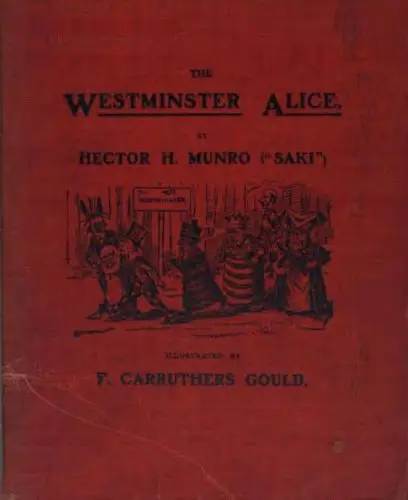
The Westminster Alice
Saki
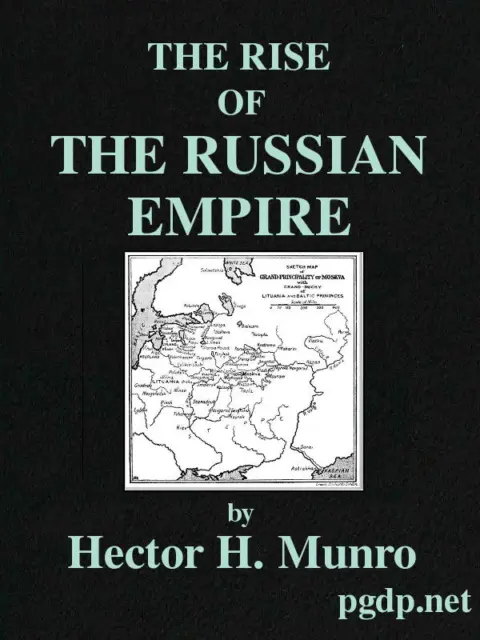
THE CLASSIC COLLECTION · 1900
"The Rise of the Russian Empire" by Hector H. Munro is a historical account written in the late 19th century. This work aims to provide a detailed presentation of Russian history, exploring the nation’s evolution from its early beginnings, focusing particularly on the reigns of significant figures like Rurik and Oleg. It seeks to fill the gaps in English-language literature on Russian history, offering insights into the cultural, political, and geographical context of early Russia. The opening of the book introduces the landscape and geographical features of Russia, establishing a foundation for understanding its historical development. It paints a vivid picture of the diverse tribes inhabiting the region and highlights the unique challenges posed by the country's vast geography. As it delves into the early Slavic peoples, the narrative discusses their societal structures and interactions with neighboring tribes. This sets the stage for the arrival of the Varangians, who would significantly influence the formation of the Russian state, marking the beginning of a pivotal era in the nation's history.
Introduction adapted from the source catalogue; source summaries may be automatically generated.
Free to read · English · 115,731 words · No account needed
MAKE TIME FOR A GOOD BOOK
On by default. Untick to stop anonymous reading totals. Each page counts after 10 seconds in view. How this works.
Anonymous counting is on unless you have switched it off.
[Sidenote: 1522]
During the greater part of the following year the Moskovite army remained in camp at Kolomna, awaiting a fresh attack from the Krimskie, who, however, remained within the shelter of their wide-stretching steppes. Negotiations were going on at the same time with Poland, and in December a truce of five years was effected, which left Smolensk still in the hands of the Grand Prince.
The strife between Poland and the Order now entered upon a new development of great historical importance. The Roman Papacy, ever glowering at the irruption of the Faithful (or the Infidel, according to Christian label), into the domains of Christendom, sought to raise enthusiasm and money among the piously disposed princes and people of the Empire and neighbouring lands, in order to float a crusade against the Ottomans. Among the expedients for obtaining the latter commodity which met with the approval of Christ’s Vicegerent, was the barter of indulgences, conducted in such wholesale manner that none but the very poor, who could not afford luxuries, were excluded from the attainment of eternal glory. Adversity and competition have an unmistakably broadening effect, and the sixteenth-century camel went through the eye of the once exclusive needle with absolute comfort, and took all its relations, dead and living, with it if so minded. The enterprising Pontiff, however, experienced the bitter perversion of fate which too often mocks the best directed efforts; not only did the traffic in souls fail in its original purpose of financing a crusade, but its injudicious prosecution among the cities of Northern Germany, where men had grown somewhat doubtful of the accumulated truths of the Church, resulted in the springing up of a new enemy, more formidable even than Islam. Without going into the dogmatical issues involved in the agitation which sprang out of the original “monks’ quarrel,” it is necessary to note that the “Reformation” owed much of its success to the secularising theories which it put forward, and which exercised a fascinating influence upon the princes and petty sovereigns of the Empire. The Houses of Wettin and Hohenzollern especially, lent favourable ear to the new doctrines, and the Grand-Master Albrecht, while roaming Germany in search of possible assistance against his ever imminent enemy, came in contact with the leaders of the anti-Catholic movement, from whom he imbibed principles which he immediately proceeded to put into practice.[125] The fundamental stumbling-block to a composition with Poland was the question of homage insisted on by Sigismund as due from the Grand-Master of the Order. Albrecht had made gigantic efforts to resist this obligation, and to preserve the independence of his office, but he now saw a way by which both his own ambitions and the requirements of the King of Poland might be accommodated. This was nothing less than the secularisation of the Order-lands into a hereditary duchy, dependent on the Polish crown; Albrecht, needless to say, being the proposed Duke thereof. The suggestion, which offered a solution to what had seemed a hopeless quarrel, met with approval from Sigismund, and was embodied in the Peace of Krakow (April 1525), whereby the Grand-Master was transformed “from the head of a Catholic religious order into a Lutheran temporal prince.”[126] The required oath of vassalage was tendered by Albrecht and in return the King presented him with a new blazon for his new-born duchy of Prussia; “the old Order changeth,” and the black cross is laid aside for a black eagle, crowned, beaked, and membered gold. In days to come, what time the white eagle of Poland shall droop its failing wings in feebleness, this sable eaglet which it has helped to hatch, grown lusty with maturity, shall snap its hungry beak in unison with the other birds of prey that hover round the doomed one. For the present, it is worthy of remark that the first political result of the religious schism which was to plunge the greater part of Europe, and especially the Empire, into a paroxysm of strife, was the closing of a long and bitter quarrel in the Baltic lands. As regards the immediate effect of the disappearance of the Order from Prussia, Moskva was chiefly concerned in the isolation which that event entailed upon the Teutonic colony in Livland and Estland. In return for the valuable help von Plettenberg had afforded the Grand-Master during the war, the latter had already granted him complete independence from the control of the Prussian executive; hence, when the secular revolution was effected, the knights of Livland retained their organisation and temporal possessions.[127]
Your reading position is saved on this browser. Take it to another device with a library code. Reading pages adapt to text, rather than matching a printed edition.
Saki
Saki
Saki
Saki
BEHIND THE BOOK
This eBook is for the use of anyone anywhere in the United States and most other parts of the world at no cost and with almost no restrictions whatsoever. You may copy it, give it away or re-use it under the terms of the Project Gutenberg License included with this eBook or online at www.gutenberg.org. If you are not located in the United States, you will have to check the laws of the country where you are located before using this eBook. Read the source licence.
The original source file, including credits and licence, is retained by this library. Request an original-format copy at no charge. Please include the book title and Project Gutenberg identifier #45099.
KEEP YOUR CURIOSITY GOING
Cécile Tormay

Moritz Busch
John L. Ransom
Frances Wright
Cécile Tormay

Mabel Potter Daggett