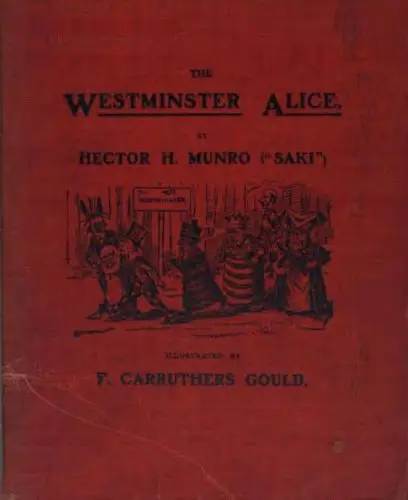
The Westminster Alice
Saki
THE CLASSIC COLLECTION · 1900
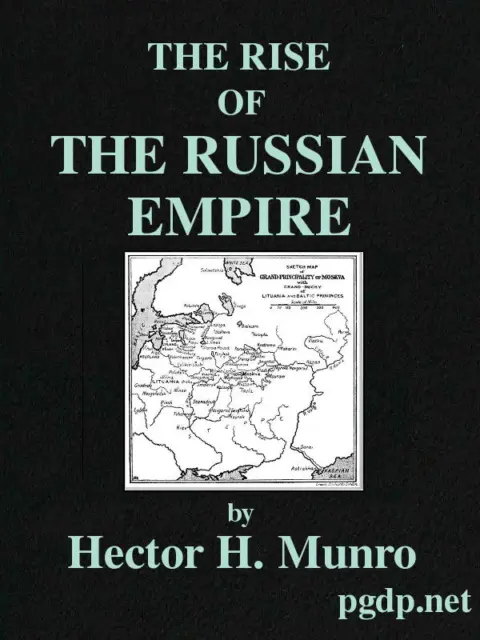
"The Rise of the Russian Empire" by Hector H. Munro is a historical account written in the late 19th century. This work aims to provide a detailed presentation of Russian history, exploring the nation’s evolution from its early beginnings, focusing particularly on the reigns of significant figures like Rurik and Oleg. It seeks to fill the gaps in English-language literature on Russian history, offering insights into the cultural, political, and geographical context of early Russia. The opening of the book introduces the landscape and geographical features of Russia, establishing a foundation for understanding its historical development. It paints a vivid picture of the diverse tribes inhabiting the region and highlights the unique challenges posed by the country's vast geography. As it delves into the early Slavic peoples, the narrative discusses their societal structures and interactions with neighboring tribes. This sets the stage for the arrival of the Varangians, who would significantly influence the formation of the Russian state, marking the beginning of a pivotal era in the nation's history.
Introduction adapted from the source catalogue; source summaries may be automatically generated.
Free to read · English · 115,731 words · No account needed
MAKE TIME FOR A GOOD BOOK
On by default. Untick to stop anonymous reading totals. Each page counts after 10 seconds in view. How this works.
Anonymous counting is on unless you have switched it off.
As in a rookery at the approach of nesting-time certain early birds may be seen quietly pursuing their constructive operations amid the turmoil and racket of their less provident fellows, so all over Europe at this epoch, amid the anarchy which attended the decay of feudalism, the work of building was in full progress. The Habsburgs and Hohenzollerns in the Empire, the Valois in France, the Tudors in England, the Moskovite princes in Russia, were piecing together the foundations of what were eventually to be the five Great Powers of a transformed Europe. In the early years of the sixteenth century it seemed not improbable that the Yagiellos would create, out of the chaos of Polish, Magyar, Czech, Lettish, and West Russian lands, a personal dominion which might crystallise into an empire. But as in a rookery, to return to the simile, certain unfortunately situated nests suffer from the plundering attentions of competing builders, so the house of Yagiello was doomed to see its carefully collected materials snatched away in the predatory acquisitions of the Austrian archdukes, the Markgrafs of Brandenburg, and the Grand Princes of Moskva. And not only had the kings of Poland fallen among thieves, as it were, but their hands were more or less tied by their dependence on the most selfish of all governing classes, an anti-monarchical aristocracy.
Between Poles and Moskovites neither truce nor treaty could long be effective, and war soon broke out anew; Sigismund had at last succeeded in detaching the Krim Tartars from the Russian alliance, or, more probably, the nomads had followed their own lawless inclinations in bursting upon the rich cornlands of Riazan, “more fertile than all the other provinces of Russia.” The event served as a pretext for Vasili to march his troops into Lit’uania and besiege Smolensk. The moment was favourable for a rupture. The King of Hungary was tottering towards his grave, and two rival parties were more than anxious to constitute themselves guardians of his youthful son and his two kingdoms. In this struggle Sigismund found himself opposed to the Austrian Archduke, Maximilian, head of the Holy Roman Empire; more formidable, perhaps, in the former capacity than in the latter. Besides this embarrassment, the relations between Poland and the military Order were, to say the least, strained. The election (in 1511) of Albrecht, of the House of Brandenburg, to the office of Grand-Master, had given new vigour to the knights, who, since the disaster of Tannenberg, had been chafing against the Polish suzerainty. With the support, moral and material, of the Emperor, the Markgraf Joachim, and the Grand Prince of Moskva, it seemed possible that this over-lordship might be thrown off. [Sidenote: Dec. 1512] Under these circumstances Vasili set forth in mid-winter, attended by his brothers Urii and Dimitri, by Mikhail Glinski, and numerous boyarins, and trailing after him in sledges his unwieldy artillery, served by German gunners, to undertake the siege of Smolensk. From contemporary accounts this important border city does not appear to have been very elaborately fortified, but its defences were sufficiently strong to withstand the Grand Prince’s attack, and in March the invading army returned to Moskva to avoid the dangers and discomforts of the approaching thaw. In the summer of the same year Vasili reiterated the attempt with no better result; the Russians at this time were not particularly skilled in the arts of sieges. The question of the Hungarian regency and eventual succession still agitated the Courts of Wien and Krakow, although Ladislas had not yet joined the “quiet people,” and in February 1514 an Imperial ambassador appeared at Moskva for the purpose of clinching a treaty between Maximilian and Vasili. The reciprocal agreement which was drawn up between the two parties is important from the fact that, in the German copy, the word “Tzar” was rendered “Kaiser”--the first occasion on which the imperial title was applied to the Russian monarch.[116] [Sidenote: 1514] Three months later Vasili’s lieutenants at Novgorod concluded a treaty with the Hanseatic League, by which commercial relations were restored to their old footing. In June of the same year the importunate Grand Prince resumed his attack upon Smolensk, and reaped the reward of perseverance. The King of Poland, who had made no effort to succour the beleaguered city, attributed its loss to treachery, and vented his chagrin on the governor, a Bohemian named Solohoub, whom he put to death. The Russian accounts give the credit of the victory to the Moskovite artillery--which ought certainly to have got its range by that time--and to the pacific overtures of the citizens, headed by their Bishop Varsonof.[117]
Your reading position is saved on this browser. Take it to another device with a library code. Reading pages adapt to text, rather than matching a printed edition.
Saki
Saki
Saki
Saki
BEHIND THE BOOK
This eBook is for the use of anyone anywhere in the United States and most other parts of the world at no cost and with almost no restrictions whatsoever. You may copy it, give it away or re-use it under the terms of the Project Gutenberg License included with this eBook or online at www.gutenberg.org. If you are not located in the United States, you will have to check the laws of the country where you are located before using this eBook. Read the source licence.
The original source file, including credits and licence, is retained by this library. Request an original-format copy at no charge. Please include the book title and Project Gutenberg identifier #45099.
KEEP YOUR CURIOSITY GOING
Cécile Tormay

Moritz Busch
John L. Ransom
Frances Wright
Cécile Tormay

Mabel Potter Daggett