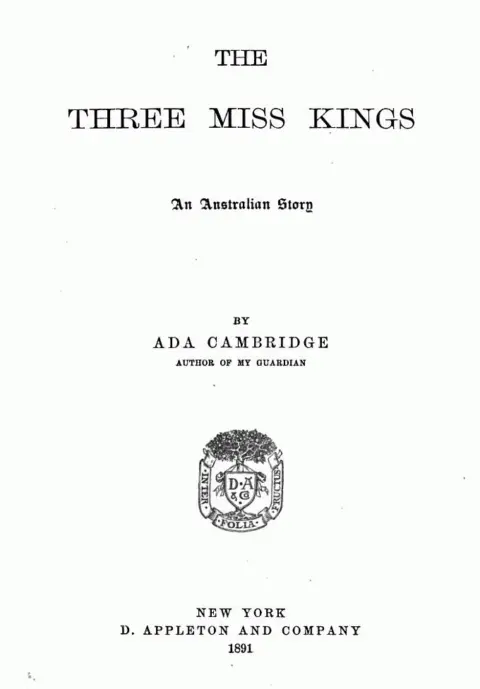
The Three Miss Kings: An Australian Story
Ada Cambridge
THE CLASSIC COLLECTION · 1912
"The Retrospect" by Ada Cambridge is a reflective autobiographical narrative written in the early 20th century. This book delves into the author's experiences and emotions surrounding her long-awaited return to England after nearly four decades spent in Australia. The central character, portraying the author herself, grapples with feelings of nostalgia, change, and the passage of time as she revisits her childhood home and the landscapes of her youth. The opening of the narrative introduces readers to the protagonist's poignant reflections on her thirty-eight-year absence from England, capturing her sense of longing and the complexities of returning home as an older woman. The text details her journey aboard a ship, the anticipation of finally reaching her native land, and her musings on the changes that have occurred both in herself and the world around her. As she approaches England, she experiences renewed hope and an unexpected joy in rediscovering places that once held deep significance in her past. The beginning sets the stage for a heartfelt exploration of memory, identity, and the inevitability of change, all while painting vivid descriptions of the landscapes she encounters along the way.
Introduction adapted from the source catalogue; source summaries may be automatically generated.
Free to read · English · 85,795 words · No account needed
MAKE TIME FOR A GOOD BOOK
On by default. Untick to stop anonymous reading totals. Each page counts after 10 seconds in view. How this works.
Anonymous counting is on unless you have switched it off.
The second evening ashore saw us speeding out of London towards Cambridge and Ely, and beyond to the not-to-be-mentioned spot in the fens which represented the bosom of the family--G.'s family, that is to say, for England held no more trace of mine.
I saw prettier English landscapes afterwards, from the windows of railway carriages, but this first picture of the green country was overwhelmingly beautiful to my eyes. I had forgotten what the country grass was like, and the country trees. Our "English trees" of boulevard and garden had not struck me as inferior to their ancestors in any way, but here, in these glorious free-flung masses, how different they were. Throughout my stay and various ramblings in the land, the trees and the grass were my constant joy. The lawns of English gardens--not bits and scraps that must not be trodden on, but acres of velvet-soft emerald carpet always under one's feet, making the loveliest setting for flowers and tea-parties. It happened in this lucky year that the summer was the finest the land had known for years, and I think I must have had my tea on grass more times in that short English season than in all the years of my sojourn in the brighter country of the South; if I except Bush picnics--and I need not except them, because the aim of Bush campers is to keep as clear of grass as possible. I am not ashamed to say that I could have wept for joy of those English trees and meadows when I first saw them after the long, long exile. Nothing but the publicity of my position prevented it. I could only look and look at them till throat and eyes ached. I could not talk.
The unspeakable memories that thronged the platform at Cambridge! The last moment of one of the most tragical happenings of my life passed me, probably, on the very spot where our train halted. At a later day the ghosts of all the hours belonging to that last moment forgathered with me in the old quadrangles, and I could not believe they had been there for forty years. The first glimpse of the towers of Ely was still more thrilling. That ever I should have lived to see them again! Here, when soon afterwards we prowled about the place--the first I saw of an English provincial town after my return--I found my eye hopelessly out of focus. I ought to have known it better than any spot in the country. I had lived there and married there, and it had been my last English home; yet, but for the cathedral, I should not have recognised it. "This Ely!" I exclaimed. "These little, little, quaint, cramped streets and houses!" I seemed to have seen them in a picture; they were incredible as the whole substance of our city of old. Gradually I got the perspective, but it took two or three visits to do it. The familiar past enmeshed me with its thousand tentacles. "You don't know me, ma'am?" a weather-beaten matron emotionally accosted me on the steps of the post-office--her married daughter drove the cart she hastily descended from on seeing me. "You don't remember me? I was housemaid at W---- when you were there on your honeymoon." One of the young maids, with white satin ribbon in their caps, who stood with their smiling welcomes on the doorstep of the rectory at W---- when our bridal brougham drove up in 1870! The tears jumped to my own eyes as I wrung her toil-worn hands. I nearly kissed her in the open street--and market day too! Old servants, old friends, stretched arms to draw me into the groove they had never left--never been thrown out of, as I was--until the gulf of years sank out of sight, and we fraternised again as if partings had never been. Yet I could not get the "atmosphere," so to speak. I am such a fresh-air person! The first time I attended service at the cathedral where I was such a devout worshipper in my youth, although it was a Pan-Anglican function, with a stirring American preacher to it, and my personal interest in the occasion, apart from that, was intense, I was so overcome with drowsiness that I had to struggle the whole time not to disgrace myself before the bishops, under whose eyes I sat. I could easily attribute it to the fatiguing excitements of the first days in England, but that was no reason why at each subsequent service at the same place the same phenomenon should occur. As surely as I went to church at the cathedral, I got deadly sleepy straight away, and had to fight to keep eyes snapping and head from rolling off. Suddenly I suspected what the trouble was. I looked up at the roofs, into the lantern, around the windows--there was not a crack for ventilation above the doorways, never had been in the hundreds of years that pious breathings had daily been going up. When I mentioned the matter to my old friends, who had been going to the cathedral all the time I had been away, they were rather inclined to be annoyed. They found nothing wrong with the air of the cathedral. Of course not. Nor did I in the old days. It was typical of the sea-change my whole being had undergone.
Your reading position is saved on this browser. Take it to another device with a library code. Reading pages adapt to text, rather than matching a printed edition.
Ada Cambridge
Ada Cambridge
Ada Cambridge
Ada Cambridge
BEHIND THE BOOK
This eBook is for the use of anyone anywhere in the United States and most other parts of the world at no cost and with almost no restrictions whatsoever. You may copy it, give it away or re-use it under the terms of the Project Gutenberg License included with this eBook or online at www.gutenberg.org. If you are not located in the United States, you will have to check the laws of the country where you are located before using this eBook. Read the source licence.
The original source file, including credits and licence, is retained by this library. Request an original-format copy at no charge. Please include the book title and Project Gutenberg identifier #42270.
KEEP YOUR CURIOSITY GOING
Wilfrid Scawen Blunt
Wilfrid Scawen Blunt

E. W. (Edgar Watson) Howe
Francis Greenleaf Allinson & Anne C. E. (Anne Crosby Emery) Allinson
Cyrenus Cole

John Martineau