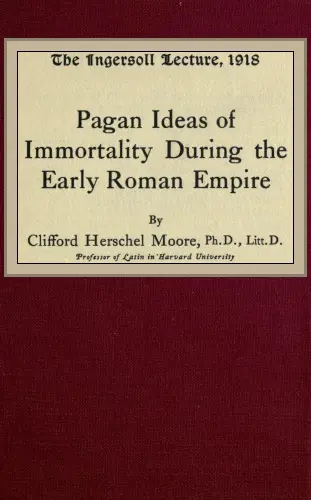
Pagan Ideas of Immortality During the Early Roman Empire
Clifford Herschel Moore
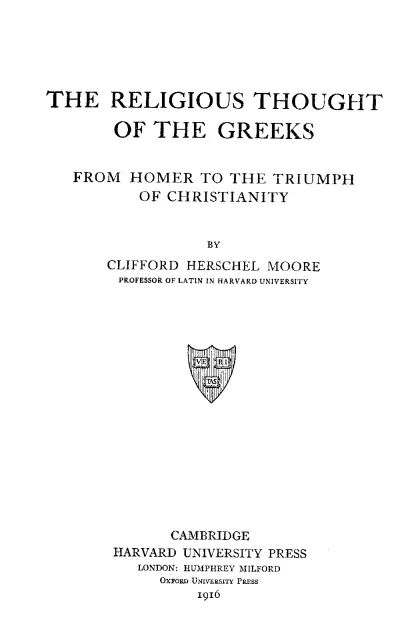
THE CLASSIC COLLECTION · 1916
"The Religious Thought of the Greeks, from Homer to the Triumph of Christianity" by Clifford Herschel Moore is a historical account written in the early 20th century. The work compiles eight lectures that explore the evolution of Greek religious thought over a span of more than a thousand years. The focus lies on the Greeks' concepts regarding the deities, human obligations toward them, and the philosophical implications of their beliefs, culminating in the rise of Christianity. At the start of the lectures, Moore sets the groundwork by discussing the significance of the Homeric epics, notably the "Iliad" and "Odyssey," in shaping Greek religious identity. He outlines how these works not only served as entertainment but also played a crucial role in defining the characteristics and attributes of the gods in the early Greek religion. The author emphasizes the human-like qualities of the divine figures depicted in Homer, illustrating how they reflect both the virtues and flaws of humanity, while simultaneously acknowledging the limited power of the gods compared to fate and moral law. This introductory portion ultimately aims to establish a framework for further exploration of Greek religious thought as it transitions into new philosophical territories, including the introduction of Christianity.
Introduction adapted from the source catalogue; source summaries may be automatically generated.
Free to read · English · 102,074 words · No account needed
MAKE TIME FOR A GOOD BOOK
On by default. Untick to stop anonymous reading totals. Each page counts after 10 seconds in view. How this works.
Anonymous counting is on unless you have switched it off.
To this school came pupils from almost every part of the Greek world. The chief subjects studied were the various branches of mathematics—including of course astronomy and harmonics,—and dialectics, by which is meant “the art of question and answer, the art of giving a rational account of things and of receiving such an account from others.” The distinctive methods employed were those of analysis and division which Plato seems to have developed so far that the invention of the former was actually, but erroneously, attributed to him. The purpose of analysis was to secure an explanation or proof of a proposition; that of division was to arrive at a proper classification or division of the object under consideration. Plato’s instruction was evidently given in considerable part by lectures, of which his hearers took notes; there was also scientific research on the part of the pupils who worked out the problems or difficulties set them by their master. Nor were these researches wholly mathematical and astronomical, for there is good reason to believe that studies in natural history were also pursued. Indeed, Aristotle, for twenty years a member of the Academy, must have had opportunities here to carry on those researches which interested him most in the early part of his life. But whatever the studies, the purpose was to lead the pupils to the discovery and contemplation of Reality, of Being, of the fundamental and permanent as against the individual and transitory phenomenon. Of Plato’s lectures we know virtually nothing; his Dialogues represent those parts of his doctrine which he wished to give to the outside world; it is probable that they in no sense adequately reproduce his teachings to his disciples.
How much of his philosophy Plato received from his master Socrates, how much he developed for himself cannot now be determined. Socrates left no writings; we know him only from the writings of others, and above all from the dialogues of Plato. There he is the chief spokesman, who leads his associates along various paths toward truth; and certainly no pupil ever built a nobler monument to his teacher than Plato did. Among modern scholars there are many views as to the extent of Plato’s debt to his master: one extreme wing, which has many adherents, would limit the Socratic elements in the Platonic doctrine to the ethical interest, the search for universals, and the dialectic method; the other wing, of which the eminent English Platonist Burnet is the chief representative, would attribute to Socrates practically everything found in the dialogues which Plato wrote before he began his teaching in the Academy. Indeed Burnet holds that Plato’s chief purpose in the earlier dialogues was to set forth the life and teaching of Socrates; he therefore claims that the “doctrine of ideas,” with all its consequences, and much besides, are purely Socratic, taken over by Plato in developed form. Few of us can accept either of these extreme views; it seems more probable that the truth lies between, that Plato learned much relating to “ideas” and their Pythagorean origins from his teacher, just as he derived from him his ethical interest and his method. But to reduce the brilliant pupil to a mere reporter of his master’s views with little philosophy of his own until he was past forty, is quite incredible, and such a procedure has no proper warrant. When speaking of Socrates in my previous lecture I avoided this question, for a discussion of it there would have been unprofitable and confusing; and even now for convenience I propose to treat that part of Plato’s philosophy which immediately concerns us as if it were wholly his own, begging you, however, to keep in mind always that undoubtedly much in germ or developed form was derived directly from Plato’s chief teacher. Furthermore I must ask you to remember that Plato had been given to poetry when a youth, and that although he renounced the practice of the art, he remained a poet in spirit to the end of his life; all his thoughts were touched with poetry, enlivened with humour, and fired with religious zeal. He was a consummate literary artist, and a man of many sides. It was natural therefore that he should nowhere set forth a crystallized system of philosophy such as a less imaginative and duller person might have done; he was apparently a man who grew through all his eighty years. The result is that in spite of the fact that we may properly speak of “the unity of Plato’s thought,” we find in his works variety, variation, and even contradiction. The requirements of our present situation, however, force us to consider our themes categorically, though that procedure is somewhat unfair to Plato.
Your reading position is saved on this browser. Take it to another device with a library code. Reading pages adapt to text, rather than matching a printed edition.
Clifford Herschel Moore
BEHIND THE BOOK
This eBook is for the use of anyone anywhere in the United States and most other parts of the world at no cost and with almost no restrictions whatsoever. You may copy it, give it away or re-use it under the terms of the Project Gutenberg License included with this eBook or online at www.gutenberg.org. If you are not located in the United States, you will have to check the laws of the country where you are located before using this eBook. Read the source licence.
The original source file, including credits and licence, is retained by this library. Request an original-format copy at no charge. Please include the book title and Project Gutenberg identifier #54406.
KEEP YOUR CURIOSITY GOING

David Patterson (Spirit) Hatch

David Patterson (Spirit) Hatch

David Patterson (Spirit) Hatch
Cécile Tormay

Moritz Busch
Coulson Kernahan