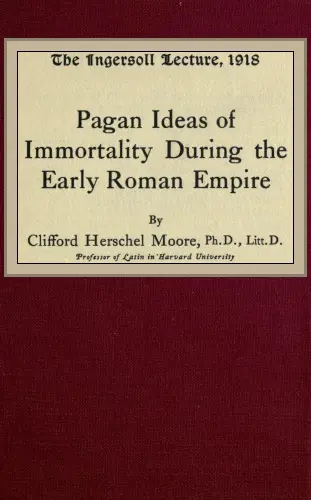
Pagan Ideas of Immortality During the Early Roman Empire
Clifford Herschel Moore
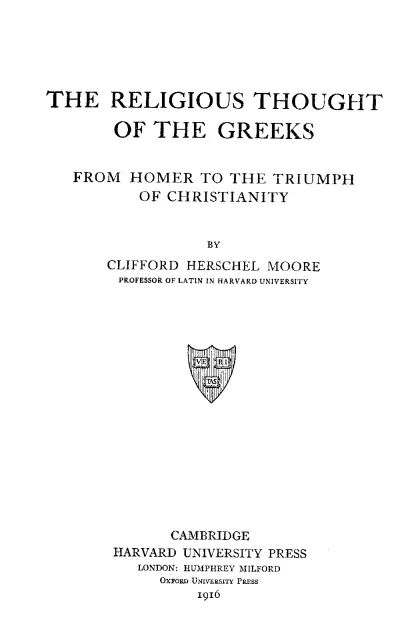
THE CLASSIC COLLECTION · 1916
"The Religious Thought of the Greeks, from Homer to the Triumph of Christianity" by Clifford Herschel Moore is a historical account written in the early 20th century. The work compiles eight lectures that explore the evolution of Greek religious thought over a span of more than a thousand years. The focus lies on the Greeks' concepts regarding the deities, human obligations toward them, and the philosophical implications of their beliefs, culminating in the rise of Christianity. At the start of the lectures, Moore sets the groundwork by discussing the significance of the Homeric epics, notably the "Iliad" and "Odyssey," in shaping Greek religious identity. He outlines how these works not only served as entertainment but also played a crucial role in defining the characteristics and attributes of the gods in the early Greek religion. The author emphasizes the human-like qualities of the divine figures depicted in Homer, illustrating how they reflect both the virtues and flaws of humanity, while simultaneously acknowledging the limited power of the gods compared to fate and moral law. This introductory portion ultimately aims to establish a framework for further exploration of Greek religious thought as it transitions into new philosophical territories, including the introduction of Christianity.
Introduction adapted from the source catalogue; source summaries may be automatically generated.
Free to read · English · 102,074 words · No account needed
MAKE TIME FOR A GOOD BOOK
On by default. Untick to stop anonymous reading totals. Each page counts after 10 seconds in view. How this works.
Anonymous counting is on unless you have switched it off.
Dill: Roman Society from Nero to Marcus Aurelius, pp. 547-626. Glover: The Conflict of Religions in the Early Empire, 3 ed., 1909. Benn: Greek Philosophers, pp. 487-522. J. Reville: La religion à Rome sous les Sévères, 1886. F. Cumont: Textes et monuments relatifs aux mystères de Mithra, 2 vols., 1894-1900. The only treatment of any of the oriental religions which takes fully into account the monumental, epigraphical, and literary evidence. Id.: Les mystères de Mithra, 2 ed., 1902; English translation, 1910; Les religions orientales dans le paganisme romaine, 1907; English translation, 1911; Astrology and Religion among the Greeks and Romans, 1912. J. Toutain: Les cultes païens dans l’empire romain, II, 1 Les cultes orientaux, 1911. A valuable treatment of the oriental religions in the Latin provinces. The geographical distribution of these religions in Britain, the Gauls and Germanies, and in Spain has been discussed by C. H. Moore in the following places: Harvard Studies in Classical Philology, XI, pp. 47 ff.; Transactions of the American Philological Association, XXXVIII, pp. 109 ff.; and in Studies in the History of Religions presented to C. H. Toy, 1912. G. Showerman: The Great Mother of the Gods, 1901. Hepding: Attis, 1903. G. Lafaye: Histoire der culte des divinités d’Alexandrie hors de l’Egypte, 1884. R. Reitzenstein: Die hellenistischen Mysterienreligionen, 1910.
Many of the pertinent articles in Hastings’ Dictionary of the Bible and Encyclopaedia of Religion and Ethics, in the Encyclopaedia Britannica, 11 ed., and in similar works are written by specialists and are valuable.
A. Harnack: Lehrbuch der Dogmengeschichte, I, 4 ed., 1909; English translation from the third German edition, I and II, 1901. The most valuable book on the subject. F. Loofs: Leitfaden zum Studium der Dogmengeschichte, 4 ed., Halle, 1906. The opening chapters cover the early period. G. B. Stevens: The Theology of the New Testament, 1903. H. Holtzmann: Lehrbuch der neutestamentlichen Theologie, 2 vols., 2 ed., 1911.
A. C. McGiffert: History of Christianity in the Apostolic Age, 1897. J. H. Ropes: The Apostolic Age, 1906.
S. J. Case: The Evolution of Early Christianity, 1914. K. Lake: The Earlier Epistles of St. Paul, 1911; The Stewardship of Faith, 1915. T. R. Glover: The Conflict of Religions in the Roman Empire, 1909.
J. Geffcken: Zwei griechischen Apologeten, 1907. An important commentary to Aristides and Athenagoras, preceded by an introduction dealing with the history and characteristics of the Greek Apologists, and followed by a sketch of the development of the apologetic literature after Athenagoras to Augustine. A. Puech: Les apologistes grecs du II^e siècle de notre ère, 1912.
H. S. Mansel: The Gnostic Heresies, 1875. E. de Faye: Gnostiques et
gnosticisme, 1913.
C. Bigg: The Christian Platonists of Alexandria, 1886. E. de Faye: Clément d’Alexandrie, 2 ed., 1906.
Your reading position is saved on this browser. Take it to another device with a library code. Reading pages adapt to text, rather than matching a printed edition.
Clifford Herschel Moore
BEHIND THE BOOK
This eBook is for the use of anyone anywhere in the United States and most other parts of the world at no cost and with almost no restrictions whatsoever. You may copy it, give it away or re-use it under the terms of the Project Gutenberg License included with this eBook or online at www.gutenberg.org. If you are not located in the United States, you will have to check the laws of the country where you are located before using this eBook. Read the source licence.
The original source file, including credits and licence, is retained by this library. Request an original-format copy at no charge. Please include the book title and Project Gutenberg identifier #54406.
KEEP YOUR CURIOSITY GOING

David Patterson (Spirit) Hatch

David Patterson (Spirit) Hatch

David Patterson (Spirit) Hatch
Cécile Tormay

Moritz Busch
Coulson Kernahan