
Last letters from the living dead man
David Patterson (Spirit) Hatch
THE CLASSIC COLLECTION · 1922
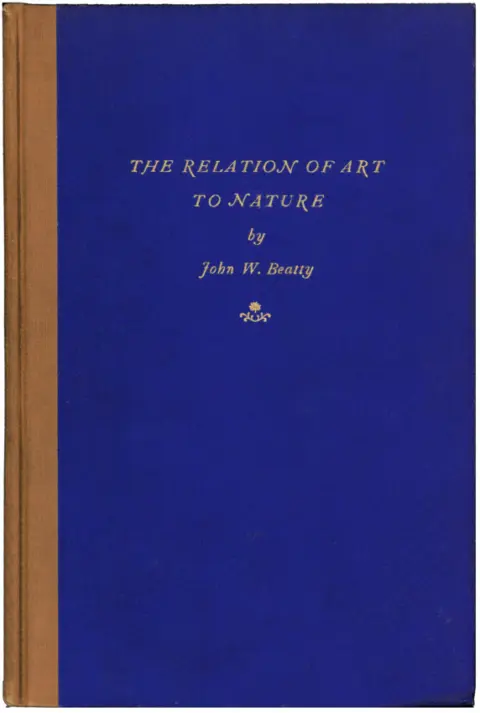
"The Relation of Art to Nature" by John W. Beatty is a philosophical treatise on the interconnection between art and the natural world, written in the early 20th century. As a prominent painter and Director of Fine Arts at the Carnegie Institute, Beatty draws on his extensive experience and the perspectives of other distinguished artists and philosophers. The book explores the fundamental assertion that art serves to imitate and reveal the beauty and character inherent in nature, challenging the prevailing notion that art is purely a creative endeavor. In this work, Beatty argues that the true purpose of art lies in its ability to faithfully reproduce the qualities of nature, thereby capturing its essence. He supports his thesis with insights from renowned artists such as Michelangelo, Dürer, and Whistler, who extoll the virtues of representing nature with accuracy and depth. The text also examines historical views on art, the necessity of aesthetic beauty, and the role of structures like symmetry within artistic endeavors. By emphasizing the significance of observation and truthful representation, Beatty ultimately calls for a deeper appreciation of the artist's relationship with nature, suggesting that this bond is essential for the creation of enduring masterpieces.
Introduction adapted from the source catalogue; source summaries may be automatically generated.
Free to read · English · 15,909 words · No account needed
MAKE TIME FOR A GOOD BOOK
On by default. Untick to stop anonymous reading totals. Each page counts after 10 seconds in view. How this works.
Anonymous counting is on unless you have switched it off.
p. 64 Sei-ichi Taki, “Three Essays on Oriental Painting,” pp. 43-45, quoting from Kuo Hsi, “Noble Features of the Forest and Stream.”
p. 42 John La Farge, “An Artist’s Letters
From Japan,” p. 141.
p. 65-66 John La Farge, “An Artist’s Letters
From Japan,” p. 145.
p. 25 C. R. Leslie, R. A., “Memoirs of the Life of John Constable, Esq., R. A.,” 1843, p. 148.
p. 52 Bernard Bosanquet, “A History of Aesthetics,”
1892, p. 185.
p. 21 “Leonardo da Vinci’s Notebooks,” trans. by Edward McCurdy, p. 156 and p. 160.
p. 55-56 Maurice Maeterlinck, “The Life of the Bee,” p. 5.
p. 44-46 Author’s Notebook.
p. 19-20 Francisco D’Ollanda, “Third Dialogue on Painting,” pub. in “Michael Angelo Buonarotti,” by Charles Holroyd, Appendix, p. 323.
p. 25-26 Romain Rolland, “Millet,” trans. by Clementina Black, pp. 383-385, 162, and 180.
p. 61 Plato’s Republic, pub. in “Dialogues of Plato,” trans. by B. Jowett, Vol. 3, pp. 86-87, and Enc. Brit. 9th Ed., Vol. 1, “Aesthetics.”
p. 39-41 Author’s Notebook.
p. 22-23 Henry William Beechy, “The Literary Works of Sir Joshua Reynolds,” Vol. 1, pp. 385 and 317, and G. Clausen, “Royal Academy Lectures on Painting,” p. 137.
p. 46-47 Auguste Rodin, “Art,” trans. from the French of Paul Gsell by Mrs. Romilly Fedden, pp. 30-33, and Literary Digest, June 4, 1910, p. 1127.
p. 48-49 “The German Classics of the Nineteenth and Twentieth Centuries,” trans. by Kuno Francke and Wm. G. Howard, Vol. 15, p. 48.
p. 43-44 Author’s Notebook.
p. 15-16 Enc. Brit. 9th Ed., Vol. 1, “Aesthetics.”
p. 25 George C. Mason, “The Life and Works of Gilbert Stuart,” 1894, pp. 68-69.
p. 50-51 H. Taine, “Philosophy of Art,” trans. by Durand, 1865, pp. 41, 57, 73, and H. Taine, “Lectures on Art,” Vol. 1, 1889, pp. 163, 197, and 353.
p. 64 Sei-ichi Taki, “Three Essays on Oriental
Painting,” p. 48.
p. 30-32 Carnegie Institute Catalogue, Abbott H.
Thayer Exhibition, 1919, p. 9.
p. 39 L. N. Tolstoi, “What is Art,” p. 43.
p. 26-30 Author’s Notebook, and James McNeill Whistler, “The Gentle Art of Making Enemies,” pp. 142-143, and James McNeill Whistler, “Ten O’clock,” pp. 13-14.
p. 34 Wm. Wordsworth, “Upon the Sight of a Beautiful
Picture,” lines 12-14.
NINE HUNDRED AND FIFTY COPIES PRINTED
AT THE PRESS OF WILLIAM EDWIN RUDGE
MOUNT VERNON, NEW YORK
Transcriber’s Notes:
Punctuation has been made consistent.
Variations in spelling and hyphenation were retained as they appear in the original publication, except that obvious typographical errors have been corrected.
Your reading position is saved on this browser. Take it to another device with a library code. Reading pages adapt to text, rather than matching a printed edition.
BEHIND THE BOOK
This eBook is for the use of anyone anywhere in the United States and most other parts of the world at no cost and with almost no restrictions whatsoever. You may copy it, give it away or re-use it under the terms of the Project Gutenberg License included with this eBook or online at www.gutenberg.org. If you are not located in the United States, you will have to check the laws of the country where you are located before using this eBook. Read the source licence.
The original source file, including credits and licence, is retained by this library. Request an original-format copy at no charge. Please include the book title and Project Gutenberg identifier #53477.
KEEP YOUR CURIOSITY GOING
David Patterson (Spirit) Hatch
Coulson Kernahan

Ralph Waldo Emerson
Frances Wright

Edwin Abbott Abbott

Joseph Droz