
Last letters from the living dead man
David Patterson (Spirit) Hatch
THE CLASSIC COLLECTION · 1922
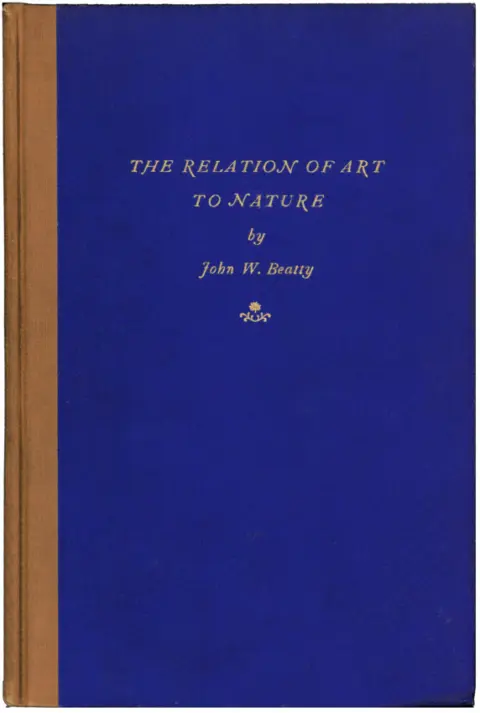
"The Relation of Art to Nature" by John W. Beatty is a philosophical treatise on the interconnection between art and the natural world, written in the early 20th century. As a prominent painter and Director of Fine Arts at the Carnegie Institute, Beatty draws on his extensive experience and the perspectives of other distinguished artists and philosophers. The book explores the fundamental assertion that art serves to imitate and reveal the beauty and character inherent in nature, challenging the prevailing notion that art is purely a creative endeavor. In this work, Beatty argues that the true purpose of art lies in its ability to faithfully reproduce the qualities of nature, thereby capturing its essence. He supports his thesis with insights from renowned artists such as Michelangelo, Dürer, and Whistler, who extoll the virtues of representing nature with accuracy and depth. The text also examines historical views on art, the necessity of aesthetic beauty, and the role of structures like symmetry within artistic endeavors. By emphasizing the significance of observation and truthful representation, Beatty ultimately calls for a deeper appreciation of the artist's relationship with nature, suggesting that this bond is essential for the creation of enduring masterpieces.
Introduction adapted from the source catalogue; source summaries may be automatically generated.
Free to read · English · 15,909 words · No account needed
MAKE TIME FOR A GOOD BOOK
On by default. Untick to stop anonymous reading totals. Each page counts after 10 seconds in view. How this works.
Anonymous counting is on unless you have switched it off.
If the principles laid down in this work are true, they become of vital importance. We will not think less of art, but we will be inspired by a new devotion to nature and the great laws which govern her. We will seek more diligently after the subtle harmonies and beauties in nature, those qualities which have been discovered by the great masters and translated with measurable success. We will go to nature with more intelligence and devotion, that we may there enjoy these things for ourselves at the source of all beauty. The student may lay aside all preconceived notions with reference to inspiration and creation, and address himself to his task as would any other workman. The result should be a more profound appreciation of all beauty and more joy in a world too often made commonplace by man.
References
p. 61 William Angus Knight, “Philosophy of the
Beautiful,” Part 1, p. 28.
p. 52 Enc. Brit. 9th Ed., Vol. 1, “Aesthetics.”
p. 62-63 The Contemporary Review, Vol. 43, June, 1883,
pp. 821-822.
p. 67-69 Founder’s Day Book, Carnegie Institute, 1908,
pp. 12-16.
p. 17-18 C. R. Leslie, R. A., “Memoirs of the Life of John Constable, Esq., R. A.,” 1843, pp. 147-148.
p. 23-25 C. R. Leslie, R. A., “Memoirs of the Life of John Constable, Esq., R. A.,” 1843, p. 66.
p. 34 C. J. Holmes, “Constable and His Influence on Landscape Painting,” 1902, p. 131.
p. 25 Mrs. Schuyler Van Rensselaer, “Six Portraits,”
p. 160.
p. 20-21 Wm. Angus Knight, “Philosophy of the Beautiful,” Part 1, p. 48, and Moriz Thausing, “Albert Dürer, His Life and Works,” 1882, p. 319.
p. 60-61 J. Henri Fabre, “Bramble Bees and Others,” p. 42.
p. 51-52 James Anthony Froude, “England’s Forgotten Worthies,” pub. in “Short Studies on Great Subjects,” Vol. 1, First Series, 1894, p. 360.
p. 58 Jay Hambidge, “Dynamic Symmetry: The Greek Vase.”
p. 64-65 Atlantic Monthly, Vol. 78, August, 1896, p. 224.
p. 13-15 “The German Classics of the Nineteenth and Twentieth Centuries,” trans. by Kuno Francke and Wm. G. Howard, Vol. 7, pp. 112-113.
p. 15 “Philosophy of Fine Art,” trans. by Bernard
Bosanquet, p. 105.
p. 22 William Hogarth, “Anecdotes of William Hogarth,”
1833, p. 47.
p. 37-39 Author’s Notebook.
p. 52-55 Immanuel Kant, “Critique of Aesthetic Judgment,” trans. by James Creed Meredith, 1911, p. 181.
p. 62 Immanuel Kant, “Critique of Aesthetic Judgment,” trans. by James Creed Meredith, 1911, pp. 216-217.
p. 61-62 Wm. Angus Knight, “Philosophy of the Beautiful,” Part 1, pp. 40-41 and page 19.
Your reading position is saved on this browser. Take it to another device with a library code. Reading pages adapt to text, rather than matching a printed edition.
BEHIND THE BOOK
This eBook is for the use of anyone anywhere in the United States and most other parts of the world at no cost and with almost no restrictions whatsoever. You may copy it, give it away or re-use it under the terms of the Project Gutenberg License included with this eBook or online at www.gutenberg.org. If you are not located in the United States, you will have to check the laws of the country where you are located before using this eBook. Read the source licence.
The original source file, including credits and licence, is retained by this library. Request an original-format copy at no charge. Please include the book title and Project Gutenberg identifier #53477.
KEEP YOUR CURIOSITY GOING
David Patterson (Spirit) Hatch
Coulson Kernahan

Ralph Waldo Emerson
Frances Wright

Edwin Abbott Abbott

Joseph Droz