THE CLASSIC COLLECTION✦A dead man’s diaryCLASSIC FREE BOOKS
A dead man’s diary
Coulson Kernahan
THE CLASSIC COLLECTION · 1900
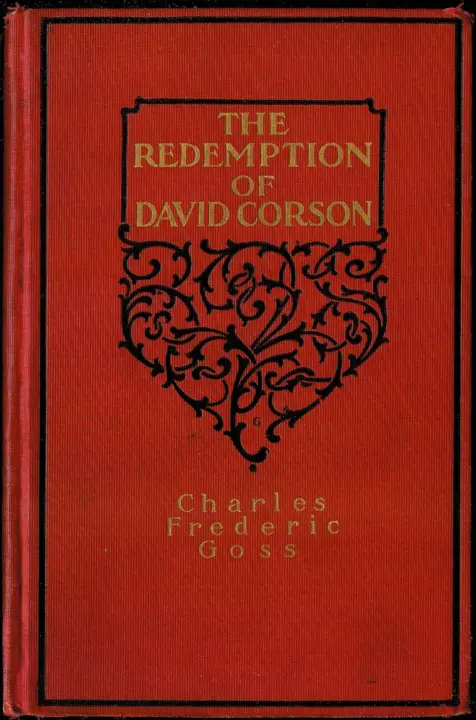
"The Redemption of David Corson" by Charles Frederic Goss is a novel written in the late 19th century. The story is set in a tranquil valley in Ohio during the mid-19th century, focusing on David Corson, a young Quaker with mystical qualities, who grapples with profound spiritual experiences and the struggles that arise from his faith and encounters with contrasting worldviews. The opening portion of the novel introduces a picturesque setting where David Corson is immersed in the beauty of the natural world. The narrative captures a quiet moment in his life as he is interrupted by a call to dinner from a nearby farmhouse, highlighting the serene yet complex life he leads. David is depicted as a mystic who experiences vivid visions of divine communication, drawing the attention of a curious young boy, Stephen. The comfort of his pastoral existence is juxtaposed with the looming reality of temptation and external influences, foreshadowing the personal and spiritual challenges that David is destined to face. As he navigates his daily life filled with simple joys and profound encounters, the reader is drawn into the foundation of his character and the depth of his upcoming trials.
Introduction adapted from the source catalogue; source summaries may be automatically generated.
Free to read · English · 101,989 words · No account needed
MAKE TIME FOR A GOOD BOOK
On by default. Untick to stop anonymous reading totals. Each page counts after 10 seconds in view. How this works.
Anonymous counting is on unless you have switched it off.
"Thee need not be afraid. I will protect thee," he said, reassuringly.
She obeyed him, and they moved forward.
"Are thy eyes shut tight? How many fingers do I hold up?" he asked,
raising his hand.
"Six," she answered.
"All right; there were only two," he said, convinced and satisfied.
He led her along a dozen steps or so, and then halted.
"Turn this way," swinging her about; "do not open thy eyes till I tell
thee. There--now!"
For an instant the darkness seemed impenetrable; but there was enough of a faint light, rather like pale belated moonbeams than the brightness of the sun, to enable her to read her own name carved upon the smooth wall of rock.
"Ah! little deceiver, when did you do this?" she asked, touched by his
gallantry.
"Do this! Why, Pepeeta, I did not do it," he answered, surprised and taken back by her misunderstanding.
"You did not do it?" she asked, astonished in her turn. "Who did it if
you did not?"
"Why--can't thee guess?" he asked.
And then it slowly dawned upon her that it was the work of her lover, done in those days when he wandered about the country restless and tormented by his passion. His own dear hand had traced those letters on the rock!
She kissed them, and burst into tears.
This was an indescribable shock to the child, who had anticipated a result so different, and he sprang to her side, embraced her in his young arms and cried:
"What is the matter, Pepeeta? I did not mean to make thee sad; I meant to make thee happy! Oh, do not cry!"
"You have made me a thousand times glad, my dear boy," she said, kissing him gratefully. "You could not in any other way in the world give me such happiness as this. But did you not know that we can cry because we are glad as well as because we are sad?"
"I have never heard of that," he answered wonderingly.
She did not reply, for her attention reverted to the letters on the wall and she stood feeding her hungry eyes upon that indubitable proof of the devotion of her lover.
The child's instinct taught him the sacredness of the privacy of grief and love. He freed himself from her embrace, slipped out of the cave and left her alone. She laid her cheek against the rude letters, patted them with her hand, and kissed them again and again. It was bliss to know that she had inspired this passion, although it was agony to know that it was only a memory.
Your reading position is saved on this browser. Take it to another device with a library code. Reading pages adapt to text, rather than matching a printed edition.
BEHIND THE BOOK
This eBook is for the use of anyone anywhere in the United States and most other parts of the world at no cost and with almost no restrictions whatsoever. You may copy it, give it away or re-use it under the terms of the Project Gutenberg License included with this eBook or online at www.gutenberg.org. If you are not located in the United States, you will have to check the laws of the country where you are located before using this eBook. Read the source licence.
The original source file, including credits and licence, is retained by this library. Request an original-format copy at no charge. Please include the book title and Project Gutenberg identifier #14730.
KEEP YOUR CURIOSITY GOING
Coulson Kernahan

Maurice Baring
Frances Wright
Cécile Tormay

Frederic Jesup Stimson

W. H. P. (William Henry Pope) Jarvis