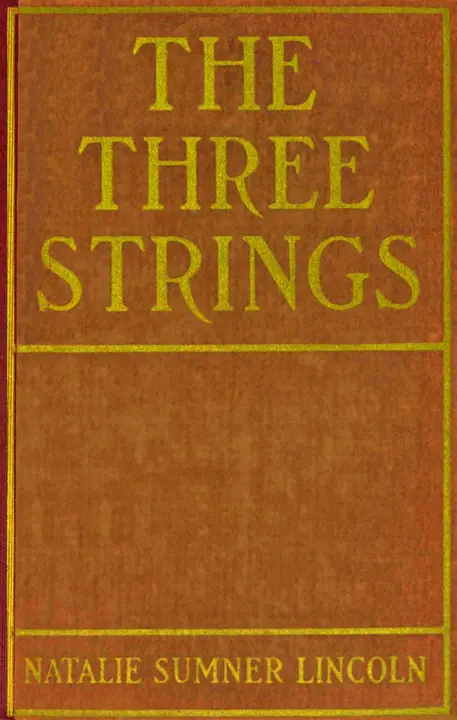
The three strings
Natalie Sumner Lincoln
THE CLASSIC COLLECTION · 1920
"The Red Seal" by Natalie Sumner Lincoln is a mystery novel likely written during the early 20th century. The narrative begins in a police court, where the complex circumstances surrounding a case of house-breaking unfold, involving the unfortunate incident of James Turnbull, a bank cashier who dies under mysterious conditions. The story intricately weaves the lives of the McIntyre twins, particularly Helen and Barbara, as they grapple with the implications of Turnbull's death and a puzzling connection to their social circle. At the start of the book, the tension builds as the courtroom drama reveals character testimonies that lead to the arrest of a man named John Smith, who is implicated in the alleged house-breaking. As the proceedings unfold, Helen McIntyre, one of the twin daughters of a wealthy colonel, intimately witnesses the trial and the unraveling events. The narrative then shifts dramatically when a sudden heart attack befalls Turnbull, who is later discovered disguised as the burglar. The opening portion culminates in Helen's emotional confrontation with the repercussions of the tragedy, hinting at deeper themes of love, deception, and societal expectations. As the characters navigate through grief and suspicion, questions arise about Turnbull's true motives and the circumstances leading to his death, setting the stage for a thrilling exploration of intrigue and human emotions.
Introduction adapted from the source catalogue; source summaries may be automatically generated.
Free to read · English · 55,232 words · No account needed
MAKE TIME FOR A GOOD BOOK
On by default. Untick to stop anonymous reading totals. Each page counts after 10 seconds in view. How this works.
Anonymous counting is on unless you have switched it off.
Colonel McIntyre tramped the deserted dining room in exasperation. Nine o'clock and the twins had not come to breakfast, nor was there any evidence that Mrs. Brewster intended taking that meal downstairs.
“Will you wait any longer, sir?” inquired Grimes, who hovered solicitously in the background. “I'm afraid, sir, your eggs will be over-done.”
“Bring them along,” directed McIntyre, and flung himself into his chair at the foot of the table. He had been seated but a few minutes when Barbara appeared and dutifully presented her cheek to be kissed, then she tripped lightly to Helen's place opposite her father, and pressed the electric bell for Grimes.
“Coffee, please,” she said as that worthy appeared, and busied herself in arranging the cups and saucers. “Helen is taking her breakfast upstairs,” she explained to her father.
“How about Mrs. Brewster?”
“Still asleep.” Barbara poured out her father's coffee with careful attention to detail. “I peeked into her room a moment ago and she looked so 'comfy' I hadn't the heart to awaken her. You must have been very late at the club last night.”
“We got home a little after one o'clock.”
McIntyre helped himself to poached eggs and bacon. “What did you do last
night?”
“Went to bed early,” answered Barbara with brevity. “Helen wasn't
feeling well.”
McIntyre's handsome face showed concern as he glanced across the table. “Have you sent for Dr. Stone?”
“No.”
“Why not?”
“Helen--I--we”--Barbara stumbled in her speech. “We have taken an aversion to Dr. Stone.”
McIntyre set down his coffee cup with unwonted force, thereby spilling
some of its contents.
“What!” he exclaimed in complete astonishment, and regarded her fixedly for a moment. His tolerant manner, which he frequently assumed toward Barbara, grew stern. “Dr. Stone is my personal friend, as well as our family physician--”
“And a cousin of Margaret Brewster,” put in Barbara mildly.
“Well, what of it?” trenchantly, aware that he had colored at mention of the widow's name. “Nothing,” Barbara's eyes opened innocently. “I only recalled the fact of his relationship as you enumerated his virtues.”
Colonel McIntyre transferred his regard from her to the butler. “You need not wait, Grimes.” He remained silent until the servant was safely in the pantry, and then addressed his daughter. “None of your tricks, Barbara,” he cautioned. “If Helen is ill enough to require medical attention, Dr. Stone is to be sent for, regardless of your sudden dislike to him, for which, by the way, you have given no cause.”
“Haven't I?” Barbara folded her napkin with neat exactness. “It's--it's
intangible.”
Your reading position is saved on this browser. Take it to another device with a library code. Reading pages adapt to text, rather than matching a printed edition.
Natalie Sumner Lincoln
Natalie Sumner Lincoln
Natalie Sumner Lincoln
Natalie Sumner Lincoln
BEHIND THE BOOK
This eBook is for the use of anyone anywhere in the United States and most other parts of the world at no cost and with almost no restrictions whatsoever. You may copy it, give it away or re-use it under the terms of the Project Gutenberg License included with this eBook or online at www.gutenberg.org. If you are not located in the United States, you will have to check the laws of the country where you are located before using this eBook. Read the source licence.
The original source file, including credits and licence, is retained by this library. Request an original-format copy at no charge. Please include the book title and Project Gutenberg identifier #1747.
KEEP YOUR CURIOSITY GOING
Coulson Kernahan

Maurice Baring
Frances Wright
Cécile Tormay

Frederic Jesup Stimson

W. H. P. (William Henry Pope) Jarvis