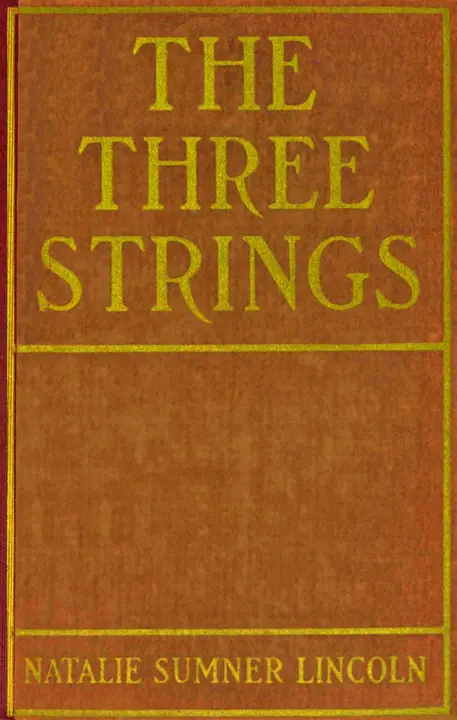
The three strings
Natalie Sumner Lincoln
THE CLASSIC COLLECTION · 1920
"The Red Seal" by Natalie Sumner Lincoln is a mystery novel likely written during the early 20th century. The narrative begins in a police court, where the complex circumstances surrounding a case of house-breaking unfold, involving the unfortunate incident of James Turnbull, a bank cashier who dies under mysterious conditions. The story intricately weaves the lives of the McIntyre twins, particularly Helen and Barbara, as they grapple with the implications of Turnbull's death and a puzzling connection to their social circle. At the start of the book, the tension builds as the courtroom drama reveals character testimonies that lead to the arrest of a man named John Smith, who is implicated in the alleged house-breaking. As the proceedings unfold, Helen McIntyre, one of the twin daughters of a wealthy colonel, intimately witnesses the trial and the unraveling events. The narrative then shifts dramatically when a sudden heart attack befalls Turnbull, who is later discovered disguised as the burglar. The opening portion culminates in Helen's emotional confrontation with the repercussions of the tragedy, hinting at deeper themes of love, deception, and societal expectations. As the characters navigate through grief and suspicion, questions arise about Turnbull's true motives and the circumstances leading to his death, setting the stage for a thrilling exploration of intrigue and human emotions.
Introduction adapted from the source catalogue; source summaries may be automatically generated.
Free to read · English · 55,232 words · No account needed
MAKE TIME FOR A GOOD BOOK
On by default. Untick to stop anonymous reading totals. Each page counts after 10 seconds in view. How this works.
Anonymous counting is on unless you have switched it off.
McIntyre reflected before answering. “I cannot remember doing so,” he stated finally. “Clymer was in rather a hurry to leave, and after bidding Mrs. Brewster good night, we went straight out to the car and I drove him to the Saratoga.”
“Then you cannot swear to the window having been re-locked?”
“I cannot.”
Penfield paused a moment. “Did you return immediately to your house from the Saratoga apartment?”
“I did” promptly. “My chauffeur, Harris, wasn't well, and I wanted him
to get home.”
Penfield thought a moment before putting the next question.
“How did Miss Barbara return from the Grosvenor dance?” he asked.
“She was brought home by friends, Colonel and Mrs. Chase.” McIntyre in turning about in his chair knocked down his walking stick from its resting place against its side, and the unexpected clatter made several women, nervously inclined, jump in their seats. Observing them, McIntyre smiled and was still smiling amusedly when Penfield addressed him.
“Did you observe many lights burning in your house when you returned?”
asked Penfield.
“No, only those which are usually left lit at night.”
“Was your daughter Helen awake?”
“I do not know. Her room was in darkness when I walked past her door on
my way to bed.”
Penfield removed his eye-glasses and polished them on his silk
handkerchief. “I have no further questions to ask. Colonel, you are
excused.”
McIntyre bowed gravely to him and as he left the platform came face to face with his family physician, Dr. Stone.
Penfield, who was an old acquaintance of the physician's, signed to him to come on the platform. After the preliminaries had been gone through, he shifted his chair around, the better to face Stone.
“Did you accompany the Misses McIntyre to the police court on Tuesday
morning?” he asked.
“I did,” responded the physician, “at Miss Barbara's request. She said her sister was not very well and they disliked going alone to the police court.”
“Did she state why she did not ask her father to go with them?”
“Only that he had not fully recovered from an attack of tonsillitis, which I knew to be a fact, and they did not want him to over-tax his strength.”
There was a moment's pause as the coroner, his attention diverted by a whispered word or two from the morgue master, referred to his notes before resuming his examination.
“Did you know James Turnbull?” he asked a second later.
“Yes, slightly.”
“Did you recognize him in his burglar's disguise?”
“I did not”
“Had you any suspicion that the burglar was other than he seemed?”
“No.”
Your reading position is saved on this browser. Take it to another device with a library code. Reading pages adapt to text, rather than matching a printed edition.
Natalie Sumner Lincoln
Natalie Sumner Lincoln
Natalie Sumner Lincoln
Natalie Sumner Lincoln
BEHIND THE BOOK
This eBook is for the use of anyone anywhere in the United States and most other parts of the world at no cost and with almost no restrictions whatsoever. You may copy it, give it away or re-use it under the terms of the Project Gutenberg License included with this eBook or online at www.gutenberg.org. If you are not located in the United States, you will have to check the laws of the country where you are located before using this eBook. Read the source licence.
The original source file, including credits and licence, is retained by this library. Request an original-format copy at no charge. Please include the book title and Project Gutenberg identifier #1747.
KEEP YOUR CURIOSITY GOING
Coulson Kernahan

Maurice Baring
Frances Wright
Cécile Tormay

Frederic Jesup Stimson

W. H. P. (William Henry Pope) Jarvis