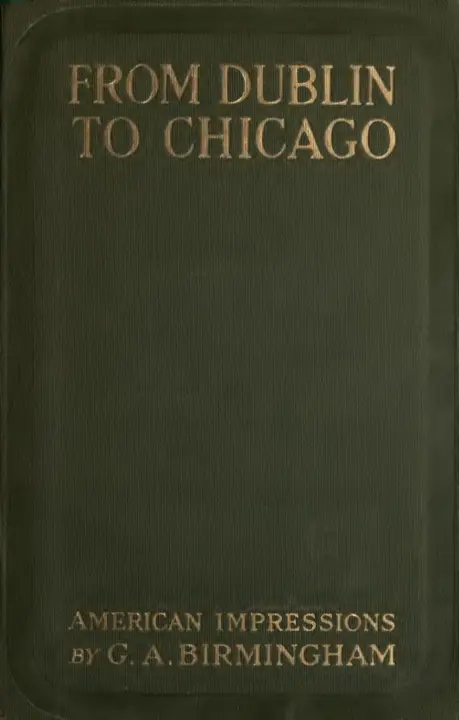
From Dublin to Chicago: Some Notes on a Tour in America
George A. Birmingham
THE CLASSIC COLLECTION · 1912
"The Red Hand of Ulster" by George A. Birmingham is a historical novel written in the early 20th century. The story delves into the complex political tensions in Ireland surrounding the Home Rule debate and features characters such as Joseph Peterson Conroy, a wealthy American, and Bob Power, his adventurous Irish secretary, as they become embroiled in revolutionary political schemes. The narrative weaves through their ambitions and the social dynamics of English society and Irish nationalism. The opening portion of the narrative introduces Conroy, who, having recently made a fortune, becomes disillusioned with London society and the emptiness of his extravagant lifestyle. He seeks something more thrilling and, through his discussions with Bob, contemplates stirring unrest in Ireland, suggesting financing a rebellion in the face of British authority. Meanwhile, Bob Power's perspective on the politics of Ireland reveals a mix of skepticism and loyalty, as he navigates their growing ambitions. Their conversations hint at a looming conflict between the Irish nationalists and loyalists, framing the exciting premise for the developing plot.
Introduction adapted from the source catalogue; source summaries may be automatically generated.
Free to read · English · 74,043 words · No account needed
MAKE TIME FOR A GOOD BOOK
On by default. Untick to stop anonymous reading totals. Each page counts after 10 seconds in view. How this works.
Anonymous counting is on unless you have switched it off.
"Your boss politicians," said Conroy, "have been flooding us out with
telegrams."
There was a large pile of telegrams in front of him and some forty or
fifty loose sheets of flimsy yellow paper were scattered about the
table.
"Their notion," said Conroy, "is that we should send a man over to
negotiate."
"An ambassador," I said, "Plenipotentiary?"
"Lord Moyne won't go," said the Dean.
"He's the proper man," I said. "Let's try to persuade him."
"He's up at the barracks," said McNeice. "He's been there all morning trying to get the General to arrest him."
"It would be far better," I said, "if he went to London and handed himself over to the Prime Minister."
"European convention," said Conroy, "makes it necessary, so I am informed, that this particular kind of job should be done by a member of your aristocracy."
I was, I think, with the exception of Moyne, the only member of the House of Lords in Belfast at the moment. The committee had evidently fixed on me as an ambassador.
"There is," I said, "a tradition that the Diplomatic Service should be--but our circumstances are so very peculiar--I am not sure that we ought to feel bound--"
"Will you go?" said Conroy.
"Of course, I'll go," I said. "There's nothing I should like better."
"The Finola is lying off Bangor," said Conroy. "I'll run you and Power down there in my motor. He'll land you wherever you like."
"Good," I said. "I suppose I'll go in my shirt with a rope round my neck, like the burghers of Calais."
"If that's the regular costume," said Conroy.
He spoke so severely that I thought I had better drop the subject of
clothes.
"Now, as to the terms which you are prepared to offer the Government,"
I said.
"We will not have Home Rule," said the Dean and Malcolmson together.
"Of course not," I said. "That will be understood at once. Shall I demand Mr. Redmond's head on a charger? I don't suppose you want it, but it's always well to ask for more than you mean to take. It gives the other side a chance of negotiating."
"All we ask," said McNeice, "is that the English clear out of this country, bag and baggage, soldiers, policemen, tax collectors, the whole infernal crew, and leave us free hand to clean up the mess they've been making for the last hundred years."
"Either that," said Malcolmson, "or fight us in earnest."
"They'll clear out, of course," I said. "If it's a choice between that and fighting. But what about governing the country afterwards?"
"We'll do that," said Conroy, "and if we can't do it better than they
did--"
Your reading position is saved on this browser. Take it to another device with a library code. Reading pages adapt to text, rather than matching a printed edition.
George A. Birmingham
George A. Birmingham
George A. Birmingham
George A. Birmingham
BEHIND THE BOOK
This eBook is for the use of anyone anywhere in the United States and most other parts of the world at no cost and with almost no restrictions whatsoever. You may copy it, give it away or re-use it under the terms of the Project Gutenberg License included with this eBook or online at www.gutenberg.org. If you are not located in the United States, you will have to check the laws of the country where you are located before using this eBook. Read the source licence.
The original source file, including credits and licence, is retained by this library. Request an original-format copy at no charge. Please include the book title and Project Gutenberg identifier #29533.
KEEP YOUR CURIOSITY GOING
Cécile Tormay

Moritz Busch
Coulson Kernahan
John L. Ransom

Maurice Baring
Frances Wright