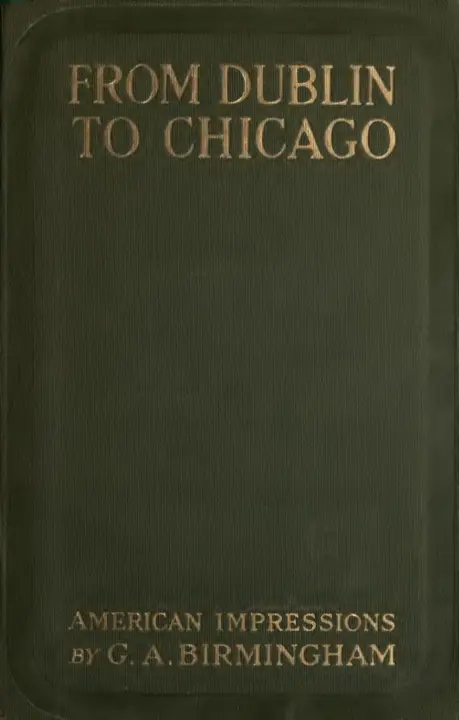
From Dublin to Chicago: Some Notes on a Tour in America
George A. Birmingham
THE CLASSIC COLLECTION · 1912
"The Red Hand of Ulster" by George A. Birmingham is a historical novel written in the early 20th century. The story delves into the complex political tensions in Ireland surrounding the Home Rule debate and features characters such as Joseph Peterson Conroy, a wealthy American, and Bob Power, his adventurous Irish secretary, as they become embroiled in revolutionary political schemes. The narrative weaves through their ambitions and the social dynamics of English society and Irish nationalism. The opening portion of the narrative introduces Conroy, who, having recently made a fortune, becomes disillusioned with London society and the emptiness of his extravagant lifestyle. He seeks something more thrilling and, through his discussions with Bob, contemplates stirring unrest in Ireland, suggesting financing a rebellion in the face of British authority. Meanwhile, Bob Power's perspective on the politics of Ireland reveals a mix of skepticism and loyalty, as he navigates their growing ambitions. Their conversations hint at a looming conflict between the Irish nationalists and loyalists, framing the exciting premise for the developing plot.
Introduction adapted from the source catalogue; source summaries may be automatically generated.
Free to read · English · 74,043 words · No account needed
MAKE TIME FOR A GOOD BOOK
On by default. Untick to stop anonymous reading totals. Each page counts after 10 seconds in view. How this works.
Anonymous counting is on unless you have switched it off.
"Well, mine, if this must be an interview; but I'd rather you had the whole credit.--Are nothing to mine when I survey the vacant pedestal of that statue. You catch the idea now?"
"No," said Bland. "I don't. Is there one?"
"Yes, there is. These unrecognizable fragments of stone, the once majestic statue, Ulster's loyalty."
"Good," said Bland. "I have it now." He began to write rapidly. "'To the thoughtful mind there was something infinitely tragic in the shattered statue of the great queen, symbol of the destruction of an ideal. England bought the friendship of Nationalist Ireland at a heavy price when the guns of her Fleet annihilated the loyalty of Ulster.' That's your idea."
"You've got it exactly," I said.
"I'll send it off at once."
"Yes. You'd better hurry. It's almost certain to occur to Babberly, and the moment it does he'll put it into a speech. If he does, the whole credit will go to him."
This impressed Bland. He hurried away towards the post-office. I felt that I was not likely to get anything more out of the statue. I put a small bit of it in my pocket to keep as a souvenir, and then strolled along Donegal Place.
I met Crossan, who saluted me gravely.
"The provisional Government," he said, "desires your lordship's
presence in the City Hall."
"I'm glad there's a provisional Government," I said. "We want something of the sort. Do you happen to know if I'm a member of it?"
"I've been looking for you, my lord," said Crossan, severely, "for over an hour, and there's no time to waste."
I hurried off. The Government, after driving off the British Fleet, was likely to be in a good temper, but I did not wish to keep it waiting for me too long.
When I entered the room I found Conroy, McNeice, Malcolmson, Cahoon and the Dean seated at the table. Moyne was not there.
"I congratulate you, gentlemen," I said, "on the result of the naval engagement. Malcolmson was perfectly magnificent. It was you, wasn't it, who--?"
"I didn't see anything magnificent about it," said Malcolmson,
sulkily.
"We're damned well sick of being played with," said McNeice.
"If the English Government means to fight us--" said the Dean,
speaking explosively.
"Do you mean to say," I said, "that you think the Admiral was not in earnest in that bombardment?"
"No more than the soldiers were yesterday," said McNeice. "They fired
over our heads."
"And we're not going to stand any more fooling," said Malcolmson.
"We're business men," said Cahoon, "and this sort of play-acting won't
do for Belfast."
Your reading position is saved on this browser. Take it to another device with a library code. Reading pages adapt to text, rather than matching a printed edition.
George A. Birmingham
George A. Birmingham
George A. Birmingham
George A. Birmingham
BEHIND THE BOOK
This eBook is for the use of anyone anywhere in the United States and most other parts of the world at no cost and with almost no restrictions whatsoever. You may copy it, give it away or re-use it under the terms of the Project Gutenberg License included with this eBook or online at www.gutenberg.org. If you are not located in the United States, you will have to check the laws of the country where you are located before using this eBook. Read the source licence.
The original source file, including credits and licence, is retained by this library. Request an original-format copy at no charge. Please include the book title and Project Gutenberg identifier #29533.
KEEP YOUR CURIOSITY GOING
Cécile Tormay

Moritz Busch
Coulson Kernahan
John L. Ransom

Maurice Baring
Frances Wright