
Constance Trescot
S. Weir (Silas Weir) Mitchell
THE CLASSIC COLLECTION · 1907
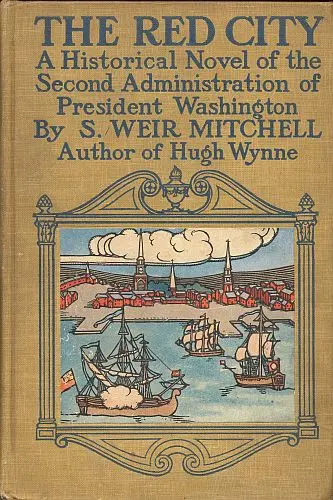
"The Red City: A Novel of the Second Administration of President Washington" by S. Weir Mitchell is a historical novel written in the early 20th century. The story is set during the early years of American democracy, focusing on the lives of émigrés from France amidst the backdrop of President Washington's administration. The main characters include René de Courval, a young French nobleman, and his mother, Madame de Courval, as they navigate their tumultuous past while seeking a new life in America. At the start of the novel, we are introduced to René and his mother aboard the brig "Morning Star", arriving in Delaware in May 1792 after fleeing the turmoil of revolutionary France. The captain of the ship and René share a light-hearted conversation about their travels. However, upon reaching land, the story takes a more serious turn as Madame de Courval reflects on their tragic past, particularly the death of her husband. This emotional revelation prompts René to recount the harrowing details that led to their escape. They arrive in Pennsylvania, filled with hopes and fears about their future in this new world, even as they are confronted with the prejudices and complexities of American society, representing both the promise and the challenges of their new beginning.
Introduction adapted from the source catalogue; source summaries may be automatically generated.
Free to read · English · 102,264 words · No account needed
MAKE TIME FOR A GOOD BOOK
On by default. Untick to stop anonymous reading totals. Each page counts after 10 seconds in view. How this works.
Anonymous counting is on unless you have switched it off.
It is well for us to follow the fortunes of some of those who were in De Courval's mind as the Marie lost sight of the steeple of Christ Church.
Mrs. Swanwick, born in the creed and customs of the Church of England, was by many ties of kindred allied to the Masters, Willings, Morrises, and to that good Whig rector, the Rev. Richard Peters. She had conformed with some doubts to the creed of John Swanwick, her dead husband, but was of no mind to separate her daughter altogether from the gay cousins whose ways her simpler tastes in no wise always approved.
It was also black Nanny's opinion that the girl should see the gayer world, and she expressed herself on this matter to her mistress with the freedom of an old servant. She could neither read nor even tell the time, and never left the house or garden, except for church or the funeral of some relative. Just now, a week after the vicomte had gone, she was busy in the kitchen when Mrs. Swanwick came in.
"Were there many at thy cousin's burial?" asked the mistress.
"Yes, there was; but this goin' out don't agree with me. I ain't young enough to enjoy it." Then she said abruptly: "Miss Margaret she's pinin' like. She ain't no Quaker--no more than me."
Mrs. Swanwick smiled, and Nanny went on peeling potatoes.
"I don't go with Friends--I'm church people, and I likes the real
quality."
"Yes, I know, Nanny." She had heard all this many times.
"I heard the Governor askin' you--"
"Yes, yes. I think she may go, Nanny."
"She'll go, and some time she'll stay," said Nanny.
"Indeed? Well--I shall see," said the mistress.
"Potatoes ain't what they used to be, and neither is folks."
Now and then, with more doubt as Margaret grew and matured, her mother permitted her to stay for a day at Belmont, or at Cliveden with the Chews, but more readily with Darthea Wynne. Just now an occasional visitor, Mr. John Penn, the Proprietary, had come with his wife to ask the girl to dine at Landsdowne. It would be a quiet party. She could come with Mr. Schmidt, who, like Nanny, seeing the girl of late somewhat less gay than usual and indisposed to the young Quaker kinsfolk, with whom she had little in common, urged the mother to consent. She yielded reluctantly. "Ann," said the gentleman in the ruby-colored coat, "would take care of her." This Ann, the daughter of the Chief Justice Allen, was a friend of Mary Swanwick's youth. There was advice given, and some warnings, which the pleased girl, it is to be feared, thought little of as, wrapped in furs, Schmidt drove her in his sleigh over the float bridge at the middle ferry, and at last along the Monument Road from the Lancaster Pike to the front of the Italian villa John Penn built where now in the park stands the Horticultural Hall.
Your reading position is saved on this browser. Take it to another device with a library code. Reading pages adapt to text, rather than matching a printed edition.
S. Weir (Silas Weir) Mitchell

S. Weir (Silas Weir) Mitchell
S. Weir (Silas Weir) Mitchell
S. Weir (Silas Weir) Mitchell
BEHIND THE BOOK
This eBook is for the use of anyone anywhere in the United States and most other parts of the world at no cost and with almost no restrictions whatsoever. You may copy it, give it away or re-use it under the terms of the Project Gutenberg License included with this eBook or online at www.gutenberg.org. If you are not located in the United States, you will have to check the laws of the country where you are located before using this eBook. Read the source licence.
The original source file, including credits and licence, is retained by this library. Request an original-format copy at no charge. Please include the book title and Project Gutenberg identifier #32942.
KEEP YOUR CURIOSITY GOING
Cécile Tormay

Moritz Busch
Coulson Kernahan
John L. Ransom

Maurice Baring
Frances Wright