
Constance Trescot
S. Weir (Silas Weir) Mitchell
THE CLASSIC COLLECTION · 1907
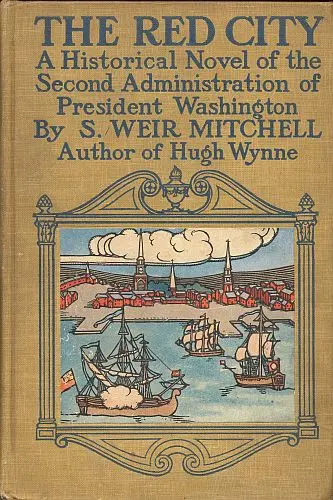
"The Red City: A Novel of the Second Administration of President Washington" by S. Weir Mitchell is a historical novel written in the early 20th century. The story is set during the early years of American democracy, focusing on the lives of émigrés from France amidst the backdrop of President Washington's administration. The main characters include René de Courval, a young French nobleman, and his mother, Madame de Courval, as they navigate their tumultuous past while seeking a new life in America. At the start of the novel, we are introduced to René and his mother aboard the brig "Morning Star", arriving in Delaware in May 1792 after fleeing the turmoil of revolutionary France. The captain of the ship and René share a light-hearted conversation about their travels. However, upon reaching land, the story takes a more serious turn as Madame de Courval reflects on their tragic past, particularly the death of her husband. This emotional revelation prompts René to recount the harrowing details that led to their escape. They arrive in Pennsylvania, filled with hopes and fears about their future in this new world, even as they are confronted with the prejudices and complexities of American society, representing both the promise and the challenges of their new beginning.
Introduction adapted from the source catalogue; source summaries may be automatically generated.
Free to read · English · 102,264 words · No account needed
MAKE TIME FOR A GOOD BOOK
On by default. Untick to stop anonymous reading totals. Each page counts after 10 seconds in view. How this works.
Anonymous counting is on unless you have switched it off.
"I do not know," said Schmidt. He had no mind to spoil the meal with what he knew must very likely be evil tidings. "It is from England," he added. Miss Gainor, understanding him, said: "We were to have had Mr. Hamilton. I think I told you."
"I saw him at the office of the Secretary of the Treasury," said Schmidt; "a less capable successor he has in his place. We talked much about the rage for lotteries, and he would stop them by a law."
"He should let things alone," said Langstroth. "A nice muddle he has made of it with his bank and his excise."
"And what do you know about it?" said Gainor, tartly.
"Fiddlesticks! I know that a man who cannot manage his own affairs had better leave larger things alone."
"He has," said Schmidt quietly, "as I see it, that rare double gift, a genius for government and finance."
"Humph!" growled Langstroth.
Schmidt was silent, and took the Wynne Madeira with honest appreciation, while the young man ate his dinner, amazed at the display of bad manners.
Then the girl beside him said in a half-whisper: "Fiddlesticks! Why do people say that? The violin is hard to play, I hear. Why do men say fiddlesticks?"
De Courval did not know, and Aunt Gainor asked, "What is that,
Margaret?"
"I was saying that the violin must be hard to play."
"Ah, yes, yes," returned the hostess, puzzled, while Schmidt smiled, and the talk fell upon mild gossip and the last horse-race--and so on to more perilous ground.
"About lotteries," said Josiah, "I have bought thee a ticket, Margaret, number 1792--the lottery for the college of Princeton."
"A nice Quaker you are," said Miss Wynne. "I see they forbid lotteries in Massachusetts. The overseers of meeting will be after you."
"I should like to see them. A damn pretty business, indeed. Suppose thee were to win the big prize, child." He spoke the intolerable language then becoming common among Friends. "Thee could beat Gainor in gowns."
"I should not be let to wear them." Alas! she saw herself in brocades
and lutestring underskirts. The young man ignorantly shared her
distress.
"There is small chance of it, I fear," said Gainor. "A hundred lottery chances I have bought, and never a cent the richer." And so the talk went on, Langstroth abusing all parties, Schmidt calmly neutral, the young people taking small part, and regarding the lottery business as one of Josiah's annoying jokes--no one in the least believing him.
At last the cloth was off the well-waxed mahogany table, a fresh pair of decanters set before the hostess, and each guest in turn toasted.
Your reading position is saved on this browser. Take it to another device with a library code. Reading pages adapt to text, rather than matching a printed edition.
S. Weir (Silas Weir) Mitchell

S. Weir (Silas Weir) Mitchell
S. Weir (Silas Weir) Mitchell
S. Weir (Silas Weir) Mitchell
BEHIND THE BOOK
This eBook is for the use of anyone anywhere in the United States and most other parts of the world at no cost and with almost no restrictions whatsoever. You may copy it, give it away or re-use it under the terms of the Project Gutenberg License included with this eBook or online at www.gutenberg.org. If you are not located in the United States, you will have to check the laws of the country where you are located before using this eBook. Read the source licence.
The original source file, including credits and licence, is retained by this library. Request an original-format copy at no charge. Please include the book title and Project Gutenberg identifier #32942.
KEEP YOUR CURIOSITY GOING
Cécile Tormay

Moritz Busch
Coulson Kernahan
John L. Ransom

Maurice Baring
Frances Wright