
Constance Trescot
S. Weir (Silas Weir) Mitchell
THE CLASSIC COLLECTION · 1907
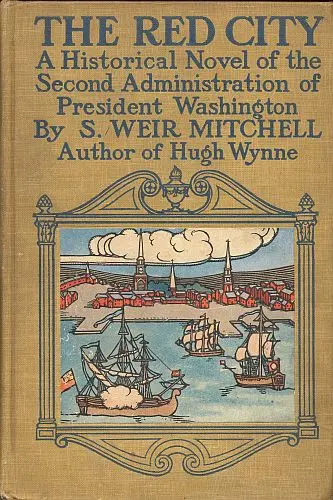
"The Red City: A Novel of the Second Administration of President Washington" by S. Weir Mitchell is a historical novel written in the early 20th century. The story is set during the early years of American democracy, focusing on the lives of émigrés from France amidst the backdrop of President Washington's administration. The main characters include René de Courval, a young French nobleman, and his mother, Madame de Courval, as they navigate their tumultuous past while seeking a new life in America. At the start of the novel, we are introduced to René and his mother aboard the brig "Morning Star", arriving in Delaware in May 1792 after fleeing the turmoil of revolutionary France. The captain of the ship and René share a light-hearted conversation about their travels. However, upon reaching land, the story takes a more serious turn as Madame de Courval reflects on their tragic past, particularly the death of her husband. This emotional revelation prompts René to recount the harrowing details that led to their escape. They arrive in Pennsylvania, filled with hopes and fears about their future in this new world, even as they are confronted with the prejudices and complexities of American society, representing both the promise and the challenges of their new beginning.
Introduction adapted from the source catalogue; source summaries may be automatically generated.
Free to read · English · 102,264 words · No account needed
MAKE TIME FOR A GOOD BOOK
On by default. Untick to stop anonymous reading totals. Each page counts after 10 seconds in view. How this works.
Anonymous counting is on unless you have switched it off.
"I mean, and that soon, to marry the woman I think worthy of any man's
love and respect."
"She is as bad as you--two obstinate fools! I am sorry for your
children."
"Mother!"
"Well, and what now?"
"It is useless to resist. It will do no good. It only hurts me. Did your people want you to marry Jean de Courval, my father?"
"No."
"You did. Was it a mesalliance?"
"They said so."
"You set me a good example. I shall do as you did, if, after this, her pride does not come in the way."
"Her pride, indeed! Will it be to-morrow, the marriage?"
"Ah, dear mother, why will you hurt me so?"
"I know you as if it were myself. I take the lesser of two evils." And to his amazement, she said, "Send the girl up to me."
"If she will come."
"Come? Of course she will come." He shook his head and left her, but before he was out of the room, her busy hands were again on the embroidery-frame.
"No, I will not go," said Margaret when he delivered his message.
"For my sake, dear," said Rene, and at last, reluctant and still angry,
Margaret went up-stairs.
"Come in," said madame; "you have kept me waiting." The girl stood still
at the open door.
"Do not stand there, child. Come here and sit down."
"No," said Margaret, "I shall stand."
"As you please, Mademoiselle. My son has made up his mind to an act of folly. I yield because I must. He is obstinate, as you will some day discover to your cost. I cannot say I am satisfied, but as you are to be my daughter, I shall say no more. You may kiss me. I shall feel better about it in a few years, perhaps."
Never, I suppose, was Margaret's power of self-command more sorely tried. She bent over, lifted the hand of the vicomtesse from the embroidery, and kissed it, saying, "Thou art Rene's mother, Madame," and, turning, left the room.
Rene was impatiently walking in the hall when Margaret came down the stair from this brief interview. She was flushed and still had in her eyes the light of battle. "I have done as you desired. I cannot talk any more. I have had all I can stand. No, I shall not kiss thee. My kisses are spoilt for to-night." Then she laughed as she went up the broad stairway, and, leaning over the rail, cried: "There will be two for to-morrow. They will keep. Good night."
The vicomtesse she left was no better pleased, and knew that she had had the worst of the skirmish.
Your reading position is saved on this browser. Take it to another device with a library code. Reading pages adapt to text, rather than matching a printed edition.
S. Weir (Silas Weir) Mitchell

S. Weir (Silas Weir) Mitchell
S. Weir (Silas Weir) Mitchell
S. Weir (Silas Weir) Mitchell
BEHIND THE BOOK
This eBook is for the use of anyone anywhere in the United States and most other parts of the world at no cost and with almost no restrictions whatsoever. You may copy it, give it away or re-use it under the terms of the Project Gutenberg License included with this eBook or online at www.gutenberg.org. If you are not located in the United States, you will have to check the laws of the country where you are located before using this eBook. Read the source licence.
The original source file, including credits and licence, is retained by this library. Request an original-format copy at no charge. Please include the book title and Project Gutenberg identifier #32942.
KEEP YOUR CURIOSITY GOING
Cécile Tormay

Moritz Busch
Coulson Kernahan
John L. Ransom

Maurice Baring
Frances Wright