
Constance Trescot
S. Weir (Silas Weir) Mitchell
THE CLASSIC COLLECTION · 1907
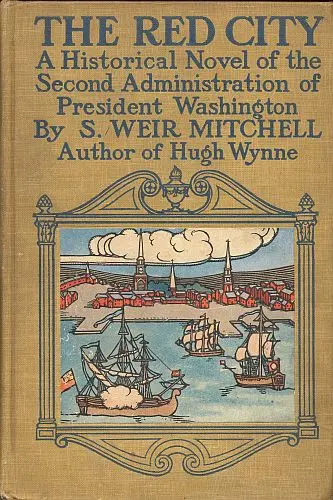
"The Red City: A Novel of the Second Administration of President Washington" by S. Weir Mitchell is a historical novel written in the early 20th century. The story is set during the early years of American democracy, focusing on the lives of émigrés from France amidst the backdrop of President Washington's administration. The main characters include René de Courval, a young French nobleman, and his mother, Madame de Courval, as they navigate their tumultuous past while seeking a new life in America. At the start of the novel, we are introduced to René and his mother aboard the brig "Morning Star", arriving in Delaware in May 1792 after fleeing the turmoil of revolutionary France. The captain of the ship and René share a light-hearted conversation about their travels. However, upon reaching land, the story takes a more serious turn as Madame de Courval reflects on their tragic past, particularly the death of her husband. This emotional revelation prompts René to recount the harrowing details that led to their escape. They arrive in Pennsylvania, filled with hopes and fears about their future in this new world, even as they are confronted with the prejudices and complexities of American society, representing both the promise and the challenges of their new beginning.
Introduction adapted from the source catalogue; source summaries may be automatically generated.
Free to read · English · 102,264 words · No account needed
MAKE TIME FOR A GOOD BOOK
On by default. Untick to stop anonymous reading totals. Each page counts after 10 seconds in view. How this works.
Anonymous counting is on unless you have switched it off.
Then Citizen Freneau of the new "National Gazette," a clerk in the Department of State, was too abruptly eager to help; but at last saying "Good-by, Citizen Jefferson," went his way as the statesman, talking his best French to the handsome woman at his side, went down Chestnut Street, while De Courval, relieved, followed them and reflected with interest--for he had learned many things on the voyage--that the tall man in front must be the former minister to France, the idol of the Democratic party, and the head of that amazing cabinet of diverse opinions which the great soldier president had gathered about him. East of Fourth Street, Mr. Jefferson turned into a court, and presently stood for a moment on the front step of a two-story brick building known as Carpenter's Hall, over which a low spire still bore a forgotten crown. Not less forgotten were Jefferson's democratic manners. He was at once the highly educated and well-loved Virginian of years ago.
He had made good use of his time, and the woman at his side, well aware of the value of being agreeable, had in answer to a pleasant question given her name, and presently had been told by the ex-minister his own name, with which she was not unfamiliar.
"Here, madame," he said, "the first Congress met. I had the misfortune
not to be of it."
"But later, monsieur--later, you can have had nothing to regret."
"Certainly not to-day," said the Virginian. He paused as a tall,
powerfully built man, coming out with a book in his hand, filled the
doorway.
"Good morning, Mr. Wynne," said Jefferson. "Is the librarian within?"
"Yes; in the library, up-stairs."
Hearing the name of the gentleman who thus replied, the young vicomte
said:
"May I ask, sir, if you are Mr. Hugh Wynne?"
"Yes, I am; and, if I am not mistaken, you are the Vicomte de Courval, and this, your mother. Ah, madame," he said in French, far other than that of the secretary, "I missed you at Oeller's, and I am now at your service. What can I do for you?"
The vicomtesse replied that they had been guided hither by Mr. Jefferson to find a list of lodging-houses.
"Then let us go and see about it."
"This way, Vicomte," said Jefferson. "It is up-stairs, madame." Ah, where now were the plain manners of democracy and the scorn of titles? A low, sweet voice had bewitched him, the charm of perfect French at its best.
Your reading position is saved on this browser. Take it to another device with a library code. Reading pages adapt to text, rather than matching a printed edition.
S. Weir (Silas Weir) Mitchell

S. Weir (Silas Weir) Mitchell
S. Weir (Silas Weir) Mitchell
S. Weir (Silas Weir) Mitchell
BEHIND THE BOOK
This eBook is for the use of anyone anywhere in the United States and most other parts of the world at no cost and with almost no restrictions whatsoever. You may copy it, give it away or re-use it under the terms of the Project Gutenberg License included with this eBook or online at www.gutenberg.org. If you are not located in the United States, you will have to check the laws of the country where you are located before using this eBook. Read the source licence.
The original source file, including credits and licence, is retained by this library. Request an original-format copy at no charge. Please include the book title and Project Gutenberg identifier #32942.
KEEP YOUR CURIOSITY GOING
Cécile Tormay

Moritz Busch
Coulson Kernahan
John L. Ransom

Maurice Baring
Frances Wright