
Constance Trescot
S. Weir (Silas Weir) Mitchell
THE CLASSIC COLLECTION · 1907
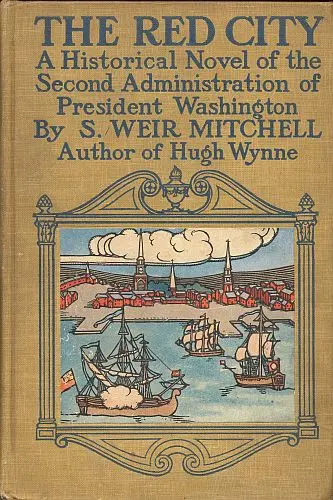
"The Red City: A Novel of the Second Administration of President Washington" by S. Weir Mitchell is a historical novel written in the early 20th century. The story is set during the early years of American democracy, focusing on the lives of émigrés from France amidst the backdrop of President Washington's administration. The main characters include René de Courval, a young French nobleman, and his mother, Madame de Courval, as they navigate their tumultuous past while seeking a new life in America. At the start of the novel, we are introduced to René and his mother aboard the brig "Morning Star", arriving in Delaware in May 1792 after fleeing the turmoil of revolutionary France. The captain of the ship and René share a light-hearted conversation about their travels. However, upon reaching land, the story takes a more serious turn as Madame de Courval reflects on their tragic past, particularly the death of her husband. This emotional revelation prompts René to recount the harrowing details that led to their escape. They arrive in Pennsylvania, filled with hopes and fears about their future in this new world, even as they are confronted with the prejudices and complexities of American society, representing both the promise and the challenges of their new beginning.
Introduction adapted from the source catalogue; source summaries may be automatically generated.
Free to read · English · 102,264 words · No account needed
MAKE TIME FOR A GOOD BOOK
On by default. Untick to stop anonymous reading totals. Each page counts after 10 seconds in view. How this works.
Anonymous counting is on unless you have switched it off.
"Why not?" said Mistress Gainor, and they went up-stairs, where Nanny, delighted, opened the trunks and took out one by one the garments of a gayer world, long laid away unused. The maid in her red bandana head-gear was delighted, having, like her race, great pleasure in bright colors.
The widow, standing apart, looked on, with memories which kept her silent, as the faint smell of lavender, which seems to me always to have an ancient fragrance, hung about the garments of her youth.
Margaret watched her mother with quick sense of this being for her something like the turning back to a record of a girlhood like her own. De Courval had eyes for the Pearl alone. Gainor Wynne, undisturbed by sentimental reflections, enjoyed the little business.
"Goodness, my dear, what brocade!" cried Miss Wynne. "How fine you were, Mary! And a white satin, with lace and silver gimp."
"It was my mother's wedding-gown," said the widow.
"And for day wear this lutestring will fit you to a hair, Margaret; but the sleeves must be loose. And lace--what is it?" She held up a filmy fabric.
"I think I could tell." And there, a little curious, having heard her son's voice, was the vicomtesse, interested, and for her mildly excited, to Rene's surprise.
Miss Gainor greeted her in French I dare not venture upon, and this common interest in clothes seemed somehow to have the effect of suddenly bringing all these women into an intimacy of the minute, while the one man stood by, with the unending wonder of the ignorant male, now, as it were, behind the scenes. He fell back and the women left him unnoticed.
"What is it, Madame?" asked Margaret.
"Oh, French point, child, and very beautiful."
"And this other must be--"
"It is new to me," cried Miss Wynne.
"Permit me," said the vicomtesse. "Venetian point, I think--quite priceless, Margaret, a wonder." She threw the fairy tissue about Pearl's head, smiling as she considered the effect.
"Is this my mother?" thought her son, with increase of wonder. He had seen her only with restricted means, and knew little of the more luxurious days and tastes of her youth.
"Does you remember this, missus?" said Nanny.
"A doll," cried Gainor, "and in Quaker dress! It will do for your
children, Margaret."
"No, it is not a child's doll," said Mrs. Swanwick. "Friends in London sent it to Marie Wynne, Hugh's mother, for a pattern of the last Quaker fashions in London--a way they had. I had quite forgotten it."
"And very pretty, quite charming," said the vicomtesse.
Your reading position is saved on this browser. Take it to another device with a library code. Reading pages adapt to text, rather than matching a printed edition.
S. Weir (Silas Weir) Mitchell

S. Weir (Silas Weir) Mitchell
S. Weir (Silas Weir) Mitchell
S. Weir (Silas Weir) Mitchell
BEHIND THE BOOK
This eBook is for the use of anyone anywhere in the United States and most other parts of the world at no cost and with almost no restrictions whatsoever. You may copy it, give it away or re-use it under the terms of the Project Gutenberg License included with this eBook or online at www.gutenberg.org. If you are not located in the United States, you will have to check the laws of the country where you are located before using this eBook. Read the source licence.
The original source file, including credits and licence, is retained by this library. Request an original-format copy at no charge. Please include the book title and Project Gutenberg identifier #32942.
KEEP YOUR CURIOSITY GOING
Cécile Tormay

Moritz Busch
Coulson Kernahan
John L. Ransom

Maurice Baring
Frances Wright