
Constance Trescot
S. Weir (Silas Weir) Mitchell
THE CLASSIC COLLECTION · 1907
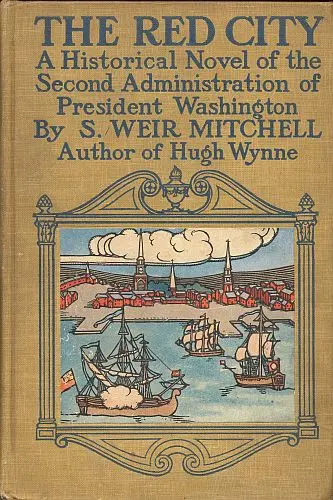
"The Red City: A Novel of the Second Administration of President Washington" by S. Weir Mitchell is a historical novel written in the early 20th century. The story is set during the early years of American democracy, focusing on the lives of émigrés from France amidst the backdrop of President Washington's administration. The main characters include René de Courval, a young French nobleman, and his mother, Madame de Courval, as they navigate their tumultuous past while seeking a new life in America. At the start of the novel, we are introduced to René and his mother aboard the brig "Morning Star", arriving in Delaware in May 1792 after fleeing the turmoil of revolutionary France. The captain of the ship and René share a light-hearted conversation about their travels. However, upon reaching land, the story takes a more serious turn as Madame de Courval reflects on their tragic past, particularly the death of her husband. This emotional revelation prompts René to recount the harrowing details that led to their escape. They arrive in Pennsylvania, filled with hopes and fears about their future in this new world, even as they are confronted with the prejudices and complexities of American society, representing both the promise and the challenges of their new beginning.
Introduction adapted from the source catalogue; source summaries may be automatically generated.
Free to read · English · 102,264 words · No account needed
MAKE TIME FOR A GOOD BOOK
On by default. Untick to stop anonymous reading totals. Each page counts after 10 seconds in view. How this works.
Anonymous counting is on unless you have switched it off.
"Mr. Hamilton is below, Rene--just come from New York. He has been here
twice."
"Then I shall hear of the world. You have starved me of news." There was little good to tell him. The duke, their cousin, had fled from France, and could write to madame only of the Terror and of deaths and ruin.
The Secretary came up fresh with the gaiety of a world in which he was still battling fiercely with the Republican party, glad of the absence of his rival, Jefferson, who saw no good in anything he did or said.
"You are very kind," said De Courval, "to spare me a little of your time, sir." Indeed he felt it. Hamilton sat down, smiling at the eagerness with which Rene questioned him.
"There is much to tell, Vicomte. The outrages on our commerce by the English have become unendurable, and how we are to escape war I do not see. An embargo has been proclaimed by the President; it is for thirty days, and will be extended to thirty more. We have many English ships in our ports. No one of them can leave."
"That ought to bring them to their senses," said Rene.
"It may," returned Hamilton.
"And what, sir, of the treaty with England?"
Hamilton smiled. "I was to have been sent, but there was too much opposition, and now, as I think, wisely, Chief-Justice Jay is to go to London."
"Ah, Mr. Hamilton, if there were but war with England,--and there is cause enough,--some of us poor exiles might find pleasant occupation."
The Secretary became grave. "I would do much, yield much, to escape war, Vicomte. No man of feeling who has ever seen war desires to see it again. If the memory of nations were as retentive as the memory of a man, there would be an end of wars."
"And yet, sir," said Rene, "I hardly see how you--how this people--endure what you so quietly accept."
"Yes, yes. No man more than Washington feels the additions of insult to injury. If to-day you could give him a dozen frigates, our answer to England would not be a request for a treaty which will merely secure peace, and give us that with contempt, and little more. What it personally costs that proud gentleman, our President, to preserve his neutral attitude few men know."
Rene was pleased and flattered by the thoughtful gravity of the
statesman's talk.
"I see, sir," he said. "There will be no war."
"No; I think not. I sincerely hope not. But now I must go. My compliments to your mother; and I am glad to see you so well."
Your reading position is saved on this browser. Take it to another device with a library code. Reading pages adapt to text, rather than matching a printed edition.
S. Weir (Silas Weir) Mitchell

S. Weir (Silas Weir) Mitchell
S. Weir (Silas Weir) Mitchell
S. Weir (Silas Weir) Mitchell
BEHIND THE BOOK
This eBook is for the use of anyone anywhere in the United States and most other parts of the world at no cost and with almost no restrictions whatsoever. You may copy it, give it away or re-use it under the terms of the Project Gutenberg License included with this eBook or online at www.gutenberg.org. If you are not located in the United States, you will have to check the laws of the country where you are located before using this eBook. Read the source licence.
The original source file, including credits and licence, is retained by this library. Request an original-format copy at no charge. Please include the book title and Project Gutenberg identifier #32942.
KEEP YOUR CURIOSITY GOING
Cécile Tormay

Moritz Busch
Coulson Kernahan
John L. Ransom

Maurice Baring
Frances Wright